Engineering Life: The Complex Reality Behind Colossal’s De-Extinction Claims
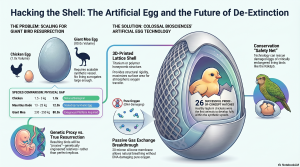
Thur, May 21 2026 /Mpelembe Media/ — Colossal Biosciences has successfully hatched 26 healthy chickens using a novel synthetic incubation platform, marking a significant milestone in avian embryology. The artificial egg consists of a 3D-printed titanium or polymer lattice cup lined with a bioengineered silicone membrane. This exceptionally thin membrane replicates the gas-exchange properties of a natural eggshell, allowing embryos to breathe ambient air and bypassing the harmful pure oxygen supplementation required by earlier shell-less incubation attempts.
The primary catalyst for developing this technology is the de-extinction of massive birds like the South Island Giant Moa and the dodo. Because extinct giants like the moa laid eggs up to 80 times the volume of a modern chicken egg, no living surrogate bird is physically capable of incubating them. The artificial egg solves this mechanical constraint by providing an independently scalable gestational environment where a genetically engineered embryo can finish its development outside of a biological host.
Beyond de-extinction, experts believe the most immediate value of the synthetic egg lies in endangered species conservation and commercial biotechnology. It provides conservationists with a sterile backup system for “embryo rescue”—saving compromised or damaged eggs of highly threatened species—and can help bypass the thick, malformed shells caused by severe inbreeding. For the biotechnology and pharmaceutical industries, the platform’s transparent viewing window provides unprecedented, continuous access to the developing embryo, which could revolutionize the efficiency of generating transgenic chickens used to manufacture therapeutic proteins and vaccines.
Despite these advancements, the scientific community has responded with intense skepticism. To date, Colossal has only promoted its success through press releases and videos, failing to provide peer-reviewed data or exact hatch-rate statistics, making independent verification impossible. Furthermore, researchers warn of severe biological limitations, such as the unproven hypothesis of merging 50 delicate biological yolks together to sustain a giant moa embryo. Critics also emphasize that the technology will not bring back true extinct species, but rather genetically modified proxies—like an emu edited to look like a moa—raising profound ethical, animal welfare, and ecological concerns, including strong cultural opposition from Māori communities in New Zealand.
The 3D-Printed Vessel of De-Extinction: Why Colossal’s ‘Techno-Egg’ is the Ultimate Bio-Hacking Pivot
1. Introduction: The High-Tech Coffee Pod That Breathes
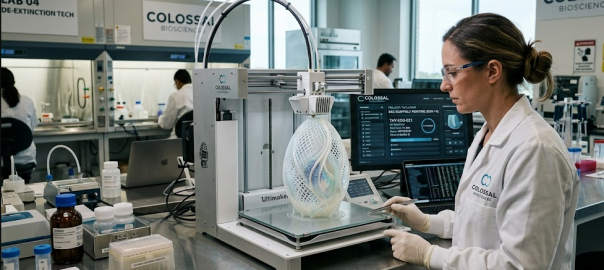
Inside a Dallas laboratory, a bioengineer lifts a device from an incubator that resembles a high-tech coffee pod. It features a black, honeycomb-structured base and an integrated clear upper observation window. Through this lens, the translucent future of biology is visible: a living chicken embryo shifting within, its cardiovascular network and beating heart exposed for real-time monitoring of organogenesis.For 40 years, avian de-extinction and advanced conservation have been paralyzed by the “oxygen toxicity loop.” Traditional shell-less incubation required hyperoxic supplementation (concentrated oxygen) to sustain life, but these elevated levels frequently triggered oxidative stress, leading to DNA damage and developmental failure. Furthermore, many extinct targets—like the South Island Giant Moa—have no living surrogates capable of laying eggs at the required scale. Colossal Biosciences’ new “techno-egg”—a 3D-printed lattice shell lined with a bioengineered silicone membrane—aims to solve the “surrogacy gap” by providing a scalable, artificial environment that functions independently of biological hosts.
2. Takeaway 1: The Membrane That Outperforms Nature
The platform’s primary technical breakthrough is a proprietary, bioengineered silicone membrane only 20 micrometers thick—roughly one-fifth the thickness of a human hair. This membrane replicates the thousands of microscopic pores found in a natural eggshell, which govern moisture retention and gas exchange. The support cup itself uses a sophisticated hexagonal lattice shell architecture to maximize surface area, facilitating the necessary gas flux.Unlike historical systems that relied on artificial oxygen pumping, this membrane allows for passive atmospheric oxygen transfer at a 21% capacity. This allows the embryo to “breathe” ambient air naturally, avoiding the DNA-damaging effects of historical pure-oxygen methods.Analysis: There is a profound irony in the fact that to “bring back” nature, scientists had to re-engineer one of its most elegant systems from first principles. Replicating the crystalline calcium carbonate of a shell required moving into advanced material science. As Chief Biology Officer Andrew Pask notes, “The genome is the blueprint, but without a place to build, it’s meaningless.” This technology is, essentially, building that place.
3. Takeaway 2: The Titanium Calcium Gap
Despite the high-tech materials, the artificial egg faces a fundamental nutritional crisis. In a natural egg, a developing embryo actively scavenges calcium from the interior of its own shell to drive skeletal development. Because the “techno-egg” utilize chemically inert materials like 3D-printed titanium or rigid polymers, it offers no mineral resources to the occupant.To solve this, researchers must perform a manual intervention: supplementing the internal liquid matrix with exogenous ground-up natural calcium during the transfer process to prevent skeletal deformities.Analysis: This highlights a persistent limitation in bioengineering. Even with a $10 billion valuation and $600 million in funding, the “cyber-egg” still requires a dash of crushed-up nature to succeed. While the $10B poultry industry is monitoring these developments closely for genetic modification potential, natural hens remain far more efficient for mass production. For now, the techno-egg is a specialized tool for high-value de-extinction, not a replacement for industrial farming.
4. Takeaway 3: Scaling to the “Salad Spinner”
Resurrecting the South Island Giant Moa requires testing the “scalable” promise of this technology to its physical limits. The Moa was a bird of massive proportions, and its eggs were equally staggering.| Species | Average Adult Mass | Egg Volume (Relative to Chicken) || —— | —— | —— || Chicken | 1.5 – 3.0 kg | 1x || Emu | 30 – 50 kg | 10 – 12x || South Island Giant Moa | 230 – 250 kg | 80x |
To accommodate the Moa, Colossal has developed a massive prototype nicknamed the “Salad Spinner,” designed to hold 80 times the volume of a chicken egg. This prototype represents a move toward automated incubation infrastructure, designed for eventual transition to low-cost injection molding for high-volume manufacturing.Analysis: This is a “scaling paradox.” While 3D-printing a larger titanium lattice is a straightforward engineering task, the biological contents remain a mystery. As volume increases, managing fluid dynamics and biological stability within a synthetic vessel becomes exponentially more complex.
5. Takeaway 4: The 50-Yolk Paradox
The most daunting hurdle is the yolk. A surrogate species like an emu cannot provide the nutritional volume required by a Moa embryo, which needs roughly eight times the reserves of an emu egg.Colossal’s researchers have proposed a controversial hypothesis: using ultra-fine needles to micro-inject and merge approximately 50 separate biological yolks into a single synthetic vessel.Analysis: This reflects a clash between engineering and deep biology. A yolk is a single massive cell enclosed by a delicate vitelline membrane. Attempting to “stitch” 50 of these cells together without triggering immediate cell lysis—where the cells burst and collapse—is an unprecedented hurdle. The vitelline membrane’s integrity may be the ultimate gatekeeper of avian de-extinction.
6. Takeaway 5: A “Safety Net” for the Living
Beyond de-extinction, this technology offers a “Genetic Rescue” platform for species on the brink. The platform could rescue “compromised embryos” from cracked eggs of endangered birds like the Kākāpō or Black Stilt. More importantly, the system’s open design allows for “upgrading” the living—introducing genetic variation or disease resistance (such as resistance to avian flu) directly into the embryonic bloodstream through real-time micro-injections.Colossal has issued a “free-use pledge,” promising to make these technologies available to the public sector for non-commercial conservation. As Matt James, head of The Colossal Foundation, notes, this adds a vital new tool to the conservation toolbox, allowing for interventions that were previously impossible.
7. Takeaway 6: De-Extinction or “Faux-doh”?
The project remains subject to a rigorous epistemological debate. Paleogeneticists like Nic Rawlence and evolutionary biologists like Jerry Coyne argue that the result will not be a “true species” but a “genetically engineered proxy”—a “man-made ghost.” A bird may look like a Dodo, but if it lacks the instinctual behaviors, gut microbiome, and ecological context of the original, it is merely a high-tech facsimile.Furthermore, critics like Dr. Louise Johnson point to the lack of peer-reviewed data. Until the company publishes standardized statistical tables rather than promotional videos, the scientific community remains skeptical. As Johnson puts it, without data, expert reaction is just “commentary on a YouTube ad.”Analysis: Is the appearance of a species enough if its essence is lost? This isn’t just about biology; it’s about what we value in the natural world—the authentic lineage or the man-made simulation.
8. Conclusion: A Multi-Century Morning
Colossal’s momentum is undeniable, bolstered by their 2024 success in producing three “Dire Wolf” pups through similar cloning pathways. Currently, 26 healthy chickens live on a Texas farm, serving as living proof that the techno-egg can sustain life from embryo to hatch.As the company pivots toward the Moa and Dodo, we are left with a fundamental question: If we can 3D-print the vessel for life, do we have a moral obligation to fill it, or are we simply creating a high-tech echo of what we’ve already lost?