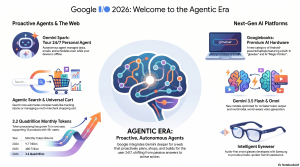
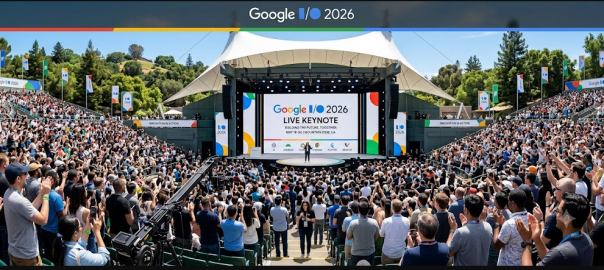
Tue, May 19 2026 /Mpelembe Media/ — Google I/O 2026 and the preceding Android Show marked a major pivot for Google towards an “agentic era,” where AI transitions from a passive assistant to a proactive, autonomous system. Google introduced advanced models like Gemini Omni and Gemini 3.5, which are designed to perform complex actions rather than just generating text. A major focus was placed on Google Antigravity, a development platform that enables creators to build autonomous agents for various tasks. These innovations extend across the company’s ecosystem, including intelligent eyewear, a universal shopping cart, and enhanced scientific research tools. Furthermore, the updates emphasize multimodal capabilities and new creative applications such as Google Pics and Stitch. Ultimately, the source portrays a future where proactive AI assistants are deeply integrated into search, hardware, and professional workflows.
Summary of Key Announcements:
- Agentic AI & Gemini Spark: Google introduced Gemini Spark, a 24/7 cloud-based personal agent capable of independently handling complex, multi-step workflows like planning events, managing emails, and interacting with third-party apps even when your device is off. To help developers build these ecosystems, Google launched Antigravity 2.0, a platform for building and orchestrating multiple autonomous agents.
- Next-Generation Models: Gemini 3.5 Flash is the new default model, designed specifically for speed and complex agentic tasks, notably outperforming older “Pro” models in coding benchmarks and token output speeds. Additionally, Gemini Omni was unveiled as a groundbreaking multimodal world model that can generate and edit videos through natural language while understanding real-world physics and fluid dynamics.
- Hardware Innovations: Google and Samsung revealed new screen-free “audio glasses” designed by Warby Parker and Gentle Monster for the Android XR platform. Google also introduced the “Googlebook,” a new premium Android-based laptop category featuring an animated “glowbar” and an AI-powered “Magic Pointer” cursor.
- Android 17 & Mobile Features: The upcoming Android 17 update integrates Gemini Intelligence, bringing features like “Rambler” for cleaning up voice dictation, “Create My Widget” for AI-generated home screen tools, and “Pause Point” to intervene during doomscrolling.
- Agentic Commerce: Google Shopping is being overhauled with the Universal Cart, which tracks items across the web, monitors price drops, and flags product incompatibilities. Powered by the Universal Commerce Protocol (UCP) and Agent Payments Protocol (AP2), AI agents can now complete purchases autonomously within user-defined guardrails.
- Workspace & Creator Tools: New tools include Docs Live (allowing users to speak a document into existence), Ask YouTube (allowing users to search for specific parts of videos using natural language), and the expansion of the SynthID watermark to Chrome and Search to easily identify AI-generated content.
The Web Just Became Your Employee: 5 Life-Changing Shifts from Google I/O 2026
We have all felt the “mental load” of the modern web: the wearying cycle of navigating endless browser tabs, filling out redundant forms, and managing the digital chores that eat away at our cognitive bandwidth. For decades, the internet has been a destination—a place we go to find information and then do the heavy lifting ourselves. We have been the operators, and the web has been our cluttered workshop.At Google I/O 2026, that relationship fundamentally shattered. Google is executing a calculated pincer maneuver on the open web, pivoting from a traditional operating system to a proactive “intelligent system.” This isn’t just another incremental update; it is a structural move designed to absorb the friction of existence. While Microsoft struggles with the controversy surrounding its own “Agentic OS” efforts, Google is doubling down on a vision where the interface effectively disappears.We are entering the era of the “Agentic Web,” moving toward a reality where the web doesn’t just show us what we want, but understands our intent and executes on it. Here are the five most surprising ways our relationship with the screen—and the internet itself—is about to change forever.
1. The 24/7 Assistant: Gemini Spark and the End of the Active Session
The most significant leap toward this new reality is Gemini Spark , a personal AI agent that redefines what it means to be “online.” Unlike traditional chatbots that wait for a prompt, Spark is designed to work in the background 24/7. It manages emails, organizes schedules, and tracks complex tasks even when your laptop is closed.This isn’t running on your local processor; it leverages dedicated virtual machines in Google Cloud to ensure your digital life keeps moving while you sleep. This shift is counter-intuitive: the “active session”—the time you spend staring at a screen to get something done—is becoming optional. We are moving from “using” a computer to “supervising” one. This orchestration is powered by the Antigravity 2.0 harness and the new Gemini 3.5 Flash model, which generates tokens four times faster than previous frontier models, processing a staggering 3.2 quadrillion tokens per month across Google’s ecosystem.To manage this, Google is introducing Android Halo in Android 17—a dedicated homebase on your phone where you can monitor your Spark agents’ progress in real time. As Sundar Pichai noted during the keynote:”I’m excited to see how it will unlock new ways to accelerate our mission… it’s clear we’re firmly in our agentic Gemini era.”
2. The Shopping Cart with a Brain: Universal Cart and Proactive Commerce
Google is positioning itself as the ultimate middleman through the Universal Cart . This isn’t just a digital wallet; it’s a centralized hub built on the Universal Commerce Protocol (UCP) . Think of UCP as the “HTTP of shopping”—a common language that allows agents to research, check out, and track shipments across the entire web, from YouTube to Gmail.The “intelligent reasoning” built into this system changes commerce from a search mission into a guided experience. For instance, if you are building a custom PC, the Universal Cart uses Gemini-led logic to proactively flag incompatible parts—like a CPU that won’t fit your selected motherboard—and suggest alternatives. When coupled with the Agent Payments Protocol (AP2) , your agent can autonomously make purchases within pre-set limits. Using cryptographically signed “Mandates,” these agents can now handle “Human Not Present” transactions, such as snagging limited-release tickets the moment they go on sale.
3. The Cursor’s Second Act: Magic Pointer and Docs Live
The tools we use to create are being reimagined to kill the “friction of the blank page.” The Magic Pointer , developed with Google DeepMind, transforms the traditional cursor from a navigation tool into a context-aware suggestion engine. Hover over a date in an email, and the pointer suggests a meeting; select two separate images, and it offers to intelligently combine them into a single graphic.Complementing this is Docs Live , which replaces traditional typing with “verbal brain dumps.” You can speak unorganized thoughts into the system, and Gemini 3.5 Flash synthesizes the raw input—pulling relevant files from Drive or details from Gmail—to create a polished document in real time. The focus has shifted from the mechanics of input to the refinement of ideas. It is a “vibe code” for productivity: you set the intent, and the AI handles the syntax.
4. Farewell, Chromebook; Hello, Googlebook
The era of web-based simplicity is ending. Google is abandoning the “browser-only” legacy of the Chromebook for the Googlebook , a premium category of hardware designed for native intelligence. Built in partnership with heavyweights like Acer, ASUS, Dell, HP, and Lenovo , these machines run on Aluminium OS —a modern system designed to bridge the gap between Android and the desktop.The hardware itself features a distinct “glowbar” using the four Google colors for functional feedback. More importantly, it features deep “Personal Intelligence” integration, allowing a feature called Quick Access to search and pull files directly from your connected Android phone without manual transfers. It is a strategic pivot: Google is moving away from the light-weight web and toward a hardware-integrated ecosystem where the AI and the OS are inseparable.
5. The Invisible Interface: Screenless Smart Glasses
Perhaps the most radical departure is Google’s push into “Intelligent Eyewear.” In partnership with Samsung, Warby Parker, and Gentle Monster , Google announced a new category of audio-first glasses. Crucially, these have no screens.While Google’s broader Android XR ecosystem includes display-based hardware (like the Project Aura specs), the immediate shift for the average user is toward ambient, audio-driven assistance. These glasses use Gemini to “speak into your ear privately,” using cameras and microphones to perceive the world around you. They can handle tasks like ordering your usual coffee via DoorDash or identifying a mysterious dashboard light in your car while your phone remains in your pocket. AI is moving from visual clutter to invisible, constant companionship.
Conclusion: The Agency of Choice
The announcements from I/O 2026 confirm that the web is no longer a place we go to look for things; it is a system that proactively works for us. We are entering an era where our digital tools have “agency”—the power to plan, reason, and execute across the 900 million users currently in the Gemini ecosystem.As the chores of digital life dissolve into the background, we are left with a new kind of freedom. But this reclaim of time comes with a question of human purpose. When our AI agents are busy planning our lives and making our purchases, what will we do with all the time we’ve reclaimed?