
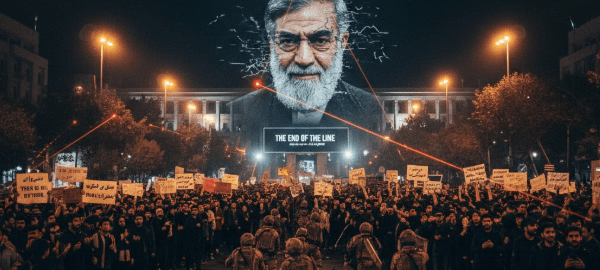
Iran’s 2026 Systemic Collapse
The sources detail a massive geopolitical and economic upheaval centering around the 2026 Iran War, which fundamentally altered the Middle East and the global economy.
Sat, Jun 05 2026 /Mpelembe Media/ — The Geopolitical and Military Conflict: By early 2026, the long-standing “shadow war” between Israel and Iran erupted into a direct, high-intensity conflict. Driven by fears that Iran was mere days away from possessing weapons-grade uranium for a nuclear bomb, Israel and the United States launched unprecedented military strikes targeting Iranian nuclear facilities, air defenses, and energy infrastructure. This followed Israel’s systematic degradation of Iran’s “Axis of Resistance,” including the severe weakening of Hezbollah and Hamas, and the collapse of the Assad regime in Syria.
Despite profound tactical successes by Israel and the U.S., analysts argue that the conflict has resulted in a “strategic paradox”. Israel demonstrated immense military reach, but it failed to secure a definitive political resolution. Iran survived the initial onslaught, successfully launched retaliatory strikes into Israel, and continues to wield significant leverage by turning the conflict into a war of attrition and holding global shipping hostage.
The Global Economic Shock: The most immediate global consequence of the 2026 war has been a catastrophic economic shock on par with the 1970s energy crisis. Following Iran’s blockade of the Strait of Hormuz, 20% of global oil supplies and vital liquefied natural gas (LNG) shipments from Qatar were instantly cut off. This caused Brent crude oil to surge past $120 a barrel, sparking a global energy and fuel crisis.
The blockade has triggered a systemic economic collapse for Gulf Cooperation Council (GCC) states, resulting in a mass exodus of expatriates, paralyzed aviation sectors, and dire threats to their food and desalinated water supplies. Globally, the disruption of energy and fertilizers has driven up inflation, pushed European economies toward a recession, and caused widespread fuel rationing and panic buying across Asian nations.
Iran’s Internal Systemic Collapse: Domestically, the Iranian regime is facing what experts call “systemic exhaustion,” a convergence of massive structural failures. The nation’s economy is in ruins under renewed “snapback” sanctions, with the rial depreciating to 1.5 million per US dollar and inflation pushing 75% of the population below the absolute poverty line. This economic devastation sparked nationwide “hunger riots” in January 2026, which the regime met with extreme lethal force.
Furthermore, Iran is suffering from “hydrological bankruptcy” caused by decades of environmental mismanagement, leading to toxic salt storms from a dried Lake Urmia and massive sinkholes swallowing parts of Tehran. With its regional proxies decimated and its strategic “Look East” alliance with Russia and China proving transactional and unreliable, the Iranian regime has been left isolated and is fighting for its very survival.
Suggested Headlines
- Focus on the Global Impact: Chokehold on Hormuz: The Global Economic Shockwaves of the 2026 Iran War
- Focus on Geopolitics: The Strategic Paradox: Israel’s Tactical Triumphs and the Unresolved Iranian Threat
- Focus on Iran’s Internal State: Systemic Collapse: Inside the Fall of Iran’s Deterrence and Domestic Stability
- Comprehensive/Analytical: Iran at the Brink: The Convergence of War, Economic Ruin, and Systemic Exhaustion in 2026
- Action-Oriented/Journalistic: Playing with Fire: How the 2026 Direct Conflict Reshaped the Middle East and Paralyzed Global Markets
The Sinking State: 5 Shocking Takeaways from Iran’s 2026 Systemic Collapse
For forty-seven years, the Islamic Republic of Iran was the Middle East’s ultimate survivor. Since the 1979 revolution, the clerical establishment navigated a brutal eight-year war with Iraq, decades of international pariah status, and periodic internal uprisings through a combination of ideological zeal, a sprawling security apparatus, and strategic depth. Analysts often spoke of Tehran’s “resilience” as a fixed geopolitical constant.That era ended abruptly on February 28, 2026. The assassination of Supreme Leader Ali Khamenei during the joint U.S.-Israeli strikes of “Operation Epic Fury” did more than create a power vacuum; it signaled the terminal phase of an ideology that had finally run out of road. What we are witnessing in 2026 is not another cyclical crisis, but a state of “systemic exhaustion” where the nation’s economic, environmental, and strategic pillars are collapsing simultaneously.The Iranian model is no longer fighting for expansion or regional hegemony; it is fighting for its very physical and sovereign survival amidst the wreckage of its own structural contradictions. To understand why this collapse is so absolute, we must look at the factors that have turned the once-formidable state into a sinking vessel.
The Earth is Literally Sinking: Hydrological Bankruptcy
While traditional security reports focus on missiles and enrichment levels, the most visceral threat to the Iranian state is quite literally the ground beneath its feet. According to the Security Science Journal , Iran has entered a state of “hydrological bankruptcy.” This is not a temporary drought but a permanent environmental failure born of a disastrous “Food Sovereignty” ideology. In a bid to reward political allies and achieve self-sufficiency, the regime constructed over 600 dams, often under the IRGC’s construction arm, decimating the nation’s water table.The consequences have shifted from ecological to existential. In the Tehran basin, the earth is sinking at a rate of 25 centimeters per year—the highest rate recorded in any metropolitan area on the planet. This land subsidence is no longer a slow-moving academic concern; in January 2026, massive sinkholes opened in central Tehran, swallowing sections of infrastructure and forcing the emergency evacuation of entire neighborhoods.”This ‘sinking’ of the capital has become a powerful metaphor for the regime’s own decline.” — Security Science JournalFrom the toxic salt flats of what was once Lake Urmia to the crumbling foundations of the capital, the state is proving incapable of meeting the most basic biological needs of its citizens. Mismanagement has become a revolutionary catalyst, replacing the slogans of the 1979 revolution with a new, survivalist cry: “Water, Electricity, Life.”
From Ideology to Hunger: The 1.5 Million Rial Crisis
The nature of Iranian dissent has undergone a fundamental transformation. While the 2022 protests were driven by socio-cultural demands and civil liberties, the uprisings of January 2026 are “hunger riots.” The spark was a 200% hike in the price of subsidized flour and fuel, a desperate measure by a regime trapped in a “terminal depreciation spiral.”By early 2026, the Iranian Rial crashed to 1.5 million IRR per US dollar. The most haunting symbol of this hyperinflation is the issuance of the 10-million-rial note—the largest in the nation’s history and a testament to the total loss of public confidence. The “resilient economy” narrative has vanished, replaced by a “Revolutionary Ruin” that has hollowed out the urban middle class. Teachers, civil servants, and small business owners have been pushed into a “new proletariat,” with 75% of the population now living below the absolute poverty line.The human cost is staggering. Humanitarian assessments indicate that the average caloric intake of Iranian households has dropped by nearly 40% compared to 2023 levels. Unlike previous waves of dissent, the current strikes by workers at the South Pars gas fields and the Abadan refinery have paralyzed the regime’s remaining revenue streams, leaving the state both bankrupt and besieged.
The Shattered Shield: The Death of “Forward Defense”
For thirty years, Tehran’s “Forward Defense” doctrine kept conflict away from its borders by utilizing a regional “Axis of Resistance.” By 2026, this shield has been completely shattered. The most catastrophic blow was the 2024 collapse of the Assad regime in Syria. For the IRGC, Syria was not just an ally; it was the “Golden Link” connecting Tehran to the Mediterranean.”The loss of Syrian territory did not just remove a buffer; it severed the logistical spinal cord of the ‘Axis of Resistance.'” — Razavi (2026)This loss was compounded by the 2025 conflicts that decimated Hezbollah’s leadership and missile arrays. Iran’s “Triadic Deterrence Model”—which relied on proxy threats, energy leverage, and a latent nuclear sword—has collapsed. The kinetic strikes on the Natanz and Fordow nuclear facilities in June 2025 proved that the regime could no longer protect its most prized strategic assets. Without its proxy buffer or its nuclear deterrent, the regime stands exposed, unable to project the external intimidation that once stabilized its internal vulnerabilities.
The Great Eastern Mirage: Abandoned by Moscow and Beijing
A cornerstone of the regime’s survival strategy was the “Look East” policy, the belief that Russia and China would provide a geopolitical veto against Western pressure. By early 2026, this has been exposed as a strategic mirage. Despite Tehran’s total commitment to the Russian war effort in Ukraine, Moscow remained “deafeningly silent” when kinetic strikes hit Iranian soil. Entrenched in its own war of attrition, the Kremlin has shown that Tehran is a useful pawn, but a dispensable ally.Beijing has exercised a similar “economic realism.” As the world’s largest oil importer, China prioritizes the stability of global energy markets and its massive trade relationships with the GCC over the survival of the Islamic Republic. Under the “Snapback” sanctions of 2026, Chinese state-owned enterprises have treated Iran as a “distressed asset,” curtailing purchases of Iranian crude and refusing to invest in crumbling infrastructure while signing multibillion-dollar deals in Riyadh and Dubai. Tehran discovered too late that in the cold calculus of the Eastern powers, their revolutionary model was an obstacle to global trade, not a partner in it.
Global Shockwaves: The Greatest Energy Challenge in History
The collapse of the Iranian state has triggered a cascade of global crises. On March 4, 2026, the closure of the Strait of Hormuz disrupted 20% of global oil supplies, sending Brent Crude prices past $120 per barrel. The International Energy Agency has characterized this as the “greatest global energy security challenge in history,” but the impact extends far beyond the price at the pump.The crisis has turned into a humanitarian emergency for the Gulf Cooperation Council (GCC) states. Iranian strikes on desalination plants—which provide 99% of Qatar’s and 90% of Kuwait’s potable water—have transformed a fiscal crisis into a struggle for survival. A “grocery supply emergency” has gripped the region, with food prices spiking up to 120%.This instability has reshaped global demographics. In a trend analysts call the “Returnee” movement, over 220,000 Indian nationals—many of them highly skilled professionals and business owners—have fled the Gulf. This exodus has shattered the narrative of the Gulf as a permanently safe haven, with “Returnee” capital now flooding into secondary real estate markets in India, signaling a long-term shift in global wealth and talent.
The Poisoned Chalice of 2026
As we survey the ruins of the Iranian state, the regime faces a choice between two equally perilous paths. The first is a continued cycle of external kinetic strikes and domestic uprisings that point toward total state death. The second is the “Negotiation Option”—the requirement for the clerical elite to “drink from the poisoned chalice,” much as Ayatollah Khomeini did in 1988. This would involve accepting “Maximum Demands,” including the total dismantling of their missile and regional programs, in exchange for the liquidity needed to prevent immediate collapse.The fundamental question of 2026 is whether a revolutionary model can survive when its physical, environmental, and strategic foundations have vanished. The “sinking” of Tehran is no longer just a geological fact; it is a geopolitical reality. Can the Islamic Republic negotiate its way out of “hydrological bankruptcy” and a 1.5-million-rial exchange rate? History suggests that when a state loses the ability to provide both water and hope, the ideology holding it together is already a ghost.