
Sun, Aug 0& 2026 /Mpelembe Media/ — Mariah Carey’s fifth studio album, Daydream, released in 1995, represented a monumental turning point in her career both musicSlly and personally. Moving away from the highly managed, traditional pop-balladeer image cultivated by Columbia Records, Carey sought to infuse her sound with contemporary R&B and hip-hop influences. This stylistic pivot led to intense creative friction with her record label and her then-husband, Sony Music head Tommy Mottola, who favored her established adult-contemporary formula. To bypass this corporate surveillance, Carey systematically established direct studio partnerships with innovative producers like Jermaine Dupri, Dave “Jam” Hall, and Kenneth “Babyface” Edmonds. Through these collaborations, she achieved immediate historic success; the Tom Tom Club-sampling lead single “Fantasy” became the first song by a female artist to debut at number one on the Billboard Hot 100, while her Boyz II Men duet “One Sweet Day” remained at the top of the charts for a record-breaking sixteen weeks. Ultimately, the album achieved a Diamond certification from the RIAA, selling over 11 million copies in the United States and cementing Carey’s status as a self-directed pop auteur.h
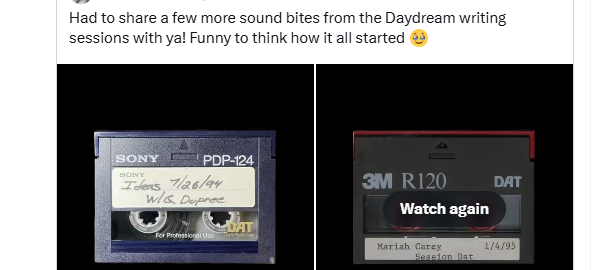
The 2026 launch of the #Daydream30 campaign unveiled physical Digital Audio Tapes (DAT) from Carey’s private archives, providing invaluable historical evidence of her hands-on role as a composer, arranger, and producer. These tapes, dating from late 1994 to early 1995, document her rapid, intensive production schedule. For example, Tape 1, dated July 26, 1994, shows that collaboration on “Always Be My Baby” with Jermaine Dupri began months earlier than previously assumed, taking place in low-overhead sessions outside of label executive oversight. Tape 2, dated January 4, 1995, captures the high-fidelity tracking of “Underneath the Stars,” establishing Carey’s favorite retro-soul vocal styling. The raw “writing session rough demos” released for “I Am Free” and “Melt Away” reveal her spontaneous “ping-pong” songwriting methodology, where she would stand at the mic improvising vocal runs, melodies, and “mumble vocals” or scatting over rough chord progressions played by a co-writer in the room to map out a song’s structure before penning the final lyrics.
The raw studio recordings capture a relaxed, highly confident artist who prioritized emotional resonance and creative exploration over pristine, corporate perfection. In the “I Am Free” rough demo with Walter Afanasieff, Carey is heard managing the recording room in perfect pitch and humorously ad-libbing technical instructions, such as asking the engineers to turn the music up. At the demo’s conclusion, she laughingly sings that she is “singing everything wrong but I don’t care,” demonstrating a playful studio habit of referencing vocal mistakes that persisted throughout her career. Meanwhile, the “Melt Away” writing demo with Babyface features an extended, unedited vocal outro that explored syncopated lower registers. Although this outro was ultimately cut from the final 1995 album due to commercial radio constraints, fans have noted its structural similarities to her 2005 chart-topping single “Don’t Forget About Us,” revealing that these mid-90s writing sessions functioned as a foundational creative reservoir she would revisit a decade later.
To celebrate these creative milestones, Columbia and Legacy Recordings implemented a multi-format distribution strategy that balances digital accessibility with physical collector appeal, sparking considerable debate among fans regarding track list completeness. The Deluxe Digital Edition offers the most exhaustive archive, containing 33 tracks that pair the remastered album with classic remixes, rare a cappellas, and both songwriting demos. However, the physical double-CD version excludes several tracks due to spatial constraints, dropping the Spanish-language version of “Open Arms,” three unreleased a cappellas, and the “Melt Away” writing demo, while shortening the club mix of “Underneath the Stars”. In contrast, the iridescent gold triple-vinyl box set completely bypasses the raw songwriting demos to focus on live fidelity, marking the first physical release of Carey’s complete 11-track audio from her historic October 10, 1995 concert special, Fantasy: Live at Madison Square Garden. This strategic division highlights the modern challenges of catalog curation, providing complete archival depth on streaming while offering distinct, premium physical experiences for audiophiles and physical collectors.
Inside the Vault: 6 Surprising Revelations from Mariah Carey’s ‘Daydream’ Archival Disclosures
1. Introduction: The Secret Life of a Masterpiece
In 1995, Mariah Carey’s Daydream was a pop culture juggernaut of seemingly impossible proportions. To the casual listener, it was the ultimate corporate product: a polished, diamond-certified machine that dominated radio with “Fantasy” and “One Sweet Day.” However, the 30th Anniversary archival disclosures—featuring a treasure trove of physical Digital Audio Tapes (DAT) and iridescent gold vinyl —tell a more defiant story. This was not a label-driven victory, but a high-stakes battle for independence. These unearthed “mumble demos” and studio fragments reveal a metamorphosis—the “beginning of the end for Mariah’s innocence”—where a global superstar successfully wrested control from a major label to become the technical architect of the modern pop-R&B crossover.
2. The Timeline Twist: Production Began Months Earlier Than We Thought
For decades, standard music history has cited November 1994 as the inception of the Daydream sessions. The archival recovery of Tape Unit 1 has officially corrected that narrative. Inscribed with the date July 26, 1994 , this DAT proves that the sessions for what would become “Always Be My Baby” were underway nearly four months earlier than previously believed.As an archival journalist, the sheer physicality of this tape illustrates Carey’s staggering workload. In the summer of 1994, she was a woman living in several musical eras at once: finishing the promotional cycle for Music Box , recording the multi-platinum Merry Christmas album, and secretly laying the R&B groundwork for her next chapter. This accelerated schedule shows an artist working with incredible intensity to pivot her sound while still fulfilling her obligations as a traditional pop balladeer.
3. The “G. Dupree” Index: Avoiding Label Surveillance
Perhaps the most charming piece of evidence from the vault is the label on Tape 1 , which features a misspelling of Atlanta producer Jermaine Dupri as “G. Dupree.” This is more than a clerical error; it serves as a physical index of the informal, “low-overhead” environment Carey cultivated to avoid the surveillance of Columbia Records executives and her then-husband, Tommy Mottola.At the time, Sony leadership was notoriously resistant to Carey’s hip-hop leanings, famously fearing that her “Fantasy” remix with Ol’ Dirty Bastard would alienate her adult-contemporary audience. By ducking into these secret, informal sessions for “Always Be My Baby,” Carey was able to experiment with the street-soul sound that would eventually define a decade. The “G. Dupree” label stands as a testament to a quiet rebellion that bypassed the “formula” of the corporate office.
4. The Secret Grunge Alter-Ego: ‘Someone’s Ugly Daughter’
The archives confirm a long-whispered legend: while Carey was perfecting the high-pressure pop of Daydream , she was also leading a secret double life as a member of the alternative rock band Chick. During the Daydream sessions, she wrote and recorded a complete “breezy-grunge” album titled Someone’s Ugly Daughter .Carey was completely immersed in the project, contributing not just vocals and production, but total art direction . Because the label refused to release a rock project featuring their most profitable pop star, Carey brought in her friend Clarissa Dane as the public face of the band, layering Dane’s vocals over her own to obscure her identity. This “punk-light” alter-ego provided a vital creative escape from the clinical perfectionism required by her mainstream career.
5. The “Ping-Pong” Method: How the Magic Actually Happened
The writing demos for “I Am Free” offer a rare look at Carey’s “ping-pong” system—an interactive songwriting process that provides empirical evidence of her role as a primary composer and producer. Standing at the microphone, Carey would use “mumble vocals” and scatting to lock in rhythmic peaks and lower-register syncopations while a co-writer riffed on the keyboards.This was a highly technical environment where Carey acted as the room’s director. In the demos, she can be heard issuing precise instructions to her engineering team, including Jay Healy and Dana Jon Chappelle , often singing her technical adjustments in perfect pitch to maintain the flow of the session.”Can you turn the music up please, cause I can’t really hear at all… singing everything wrong but I don’t care because I’m free.”By integrating communication directly into the musical structure, Carey demonstrated that her vocal arrangements were physically woven into the instrumentation from the very first take.
6. The Ten-Year Time Capsule: Melodic DNA in the Vault
One of the most significant finds in the vault is the writing demo for “Melt Away,” co-produced with Babyface . This version features an extended, syncopated vocal outro that was originally cut to satisfy the radio constraints of 1995. This discovery has sparked a “curatorial debate” among collectors, as the demo appears on the 33-track Deluxe Digital Edition but was excluded from the physical CD due to space constraints.Archival analysts have noted that the lower-register syncopations in this unreleased 1994 outro share a striking structural DNA with her 2005 chart-topper “Don’t Forget About Us.” This proves that Carey’s mid-nineties sessions served as a “foundational creative reservoir.” She wasn’t just making hits for the moment; she was bankrolling melodic patterns and vocal arrangements that she would tap into for her late-career reinvigoration a decade later.
7. The 1996 Grammy Heartbreak: A Commercial Giant, a Critical Shut-Out
Despite Daydream being a diamond-certified masterpiece and a critical favorite, the 38th Annual Grammy Awards remain a bittersweet chapter in the Carey archive. The album was nominated for six awards, and critics branded her the favorite for Album of the Year . However, on the night of February 28, 1996, Carey was shut out entirely, going 0 for 6.The camera famously lingered on Carey’s face with every passing loss, capturing a moment of profound professional resilience. Following the ceremony, Carey famously declared, “I will never be disappointed again.” This heartbreak marked a definitive shift in her career; she stopped seeking institutional validation from the “corporate machine” and doubled down on the creative independence she had pioneered in the Daydream sessions.
Conclusion: The Architect of Modern Pop
The archival disclosures of the Daydream era reframe Mariah Carey as far more than a “ballad voice box.” She was a technical architect who systematically established studio partnerships to bypass corporate oversight. By blending mainstream pop with genuine R&B artistry, she established the blueprint for modern-day pop melodies featuring rap verses—a path later walked by everyone from Beyoncé to Ariana Grande.As we examine the physical DAT tapes of these “mumble demos,” we are left to wonder: how many other hidden blueprints are tucked away in the vaults of pop history, waiting to reveal the true architects of the music we love? For now, the Daydream archives remain the definitive record of a metamorphosis that changed the sound of pop forever.