Tag Archives: South Africa

07Aug/26

From Zamrock to Internet Kill-Switches

The Rise of Zed Beats and the Digital Music Revolution

Fri , Aug 0& 2026 /Mpelembe Media/ — Zed Beats, which takes its name from the letter “Z” in Zambia, represents a dynamic hybrid music genre that emerged in the late 1980s. Young, self-taught producers began using affordable computer software to blend indigenous Zambian elements with popular global sounds like R&B, reggae, rap, hip-hop, Jamaican dancehall, Afrobeats, and amapiano. The rise of this digital movement was catalyzed by a major cultural void in the late 1980s and 1990s, when the devastating HIV/AIDS epidemic claimed the lives of a generation of veteran musicians who had anchored traditional live genres like Kalindula and Zamrock. To fill this void, which had left radio and television heavily dominated by foreign music, young enthusiasts utilized newly accessible computer technology to resurrect local music and forge a modern urban identity. Continue reading

06Aug/26

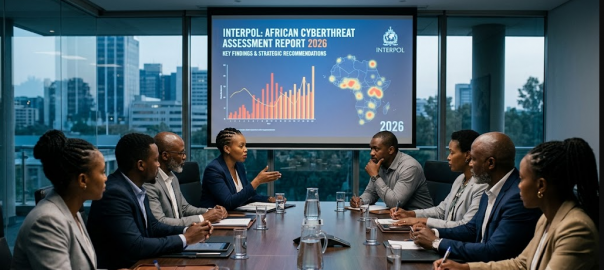
AI Automates the Industrialized Cybercrime Economy

Coordinated Policing Battles a Surge in Sophisticated, AI-Powered Scams Across Africa

Thur , Aug 06 2026 /Mpelembe Media/ — Artificial intelligence has become the primary engine transforming cybercrime across Africa, driving 55 percent of all reported digital offenses and shifting the threat landscape from isolated incidents into an industrialized, borderless criminal ecosystem. This automation spans every stage of a cyberattack, from initial target reconnaissance and highly personalized phishing generation to execution, extortion, and operational evasion. Fueled by the continent’s rapid digital transformation, which reached over 1.1 billion registered mobile subscribers in 2025, cybercriminals have successfully scaled their operations to target massive audiences simultaneously. This has resulted in a devastating financial toll, with annual regional losses skyrocketing from $192 million in 2024 to $484 million in 2025, while the number of identified individual victims surged from 35,000 to 87,000. Continue reading

04Aug/26

Bond Rallies and Blackouts in Zambia

Zambia’s 2026 Election: A High-Stakes Two-Horse Race Decided by Economic Squeeze and Drought

Tue , Aug 04 2026 /Mpelembe Media/ — Zambia’s general election on August 13, 2026, represents a pivotal, alliance-driven contest that will test the country’s democratic resilience and economic direction. Although fourteen presidential candidates are officially cleared to run, the election is fundamentally a two-horse race between incumbent President Hakainde Hichilema of the United Party for National Development (UPND) and opposition challenger Brian Mundubile. Hichilema enters the race backed by an expanded 15-party UPND Alliance, leveraging the power of incumbency. His challenger, Mundubile—a 55-year-old lawyer, accountant, and former government chief whip—is running under the National Reconciliation Party for Unity and Prosperity (NRPUP) banner after unifying a highly fractured opposition under the Tonse–Pamodzi Alliance. Continue reading

03Aug/26

The Memoir of Dr. Kenneth Kaunda

A Wake-Up Call for the Diaspora and Economic Sovereignty Institutionalizing Peace:

Mon, Aug 03 2026 /Mpelembe Media/ — The provided sources collectively chronicle Africa’s historical journey from colonial subjugation toward liberation, heavily emphasizing the enduring spirit of Pan-Africanism. A central figure in this narrative is Dr. Kenneth Kaunda, the first president of Zambia, who led his nation to independence in 1964 and became a patriarch of the continent’s anti-colonial struggles. Through his philosophical framework of Zambian Humanism and the unifying national slogan “One Zambia, One Nation,” Kaunda sought to build a cohesive, multi-ethnic society free from the exploitation of man by man. Internationally, he—alongside contemporaries like Julius Nyerere and Kwame Nkrumah—offered crucial support to regional liberation movements fighting against apartheid and minority rule in Southern Africa. While Kaunda’s legacy involves complex debates regarding his period of one-party rule and post-colonial economic challenges, his published works, such as the seminal 1962 autobiography “Zambia Shall Be Free,” remain foundational texts that articulate the ethical and political defense of African self-determination. Continue reading

30Jul/26

Southern Africa is breaking energy monopolies

Zambia’s 2024 Open Access Reforms: A Catalyst and Testing Ground for Regional Energy Liberalization

Thu, July 30 2026 /Mpelembe Media/ — The electricity supply industries in Southern Africa are undergoing a major structural shift, transitioning from vertically integrated, state-dominated monopolies toward decentralized and competitive wholesale power markets. This transformation is largely driven by persistent power deficits, climate-induced hydropower shortages, and the soaring energy demands of the region’s mining sectors. Continue reading

29Jul/26

How Shoprite Became Africa’s Operating System

The Digital Integration and Social Evolution of African Retail: An Analysis of Mobile Wallet Adoption and Community Impact

Wed, July 29 2026 /Mpelembe Media/ — The landscape of retail in Africa is undergoing a profound transformation, characterized by the rapid digitization of payment ecosystems and a deep, institutional commitment to social impact. Driven by high mobile penetration and the need for inclusive financial services, retailers are rethinking traditional commercial infrastructures to better serve unbanked populations. A leading example of this dual evolution is observed in Zambia, where Shoprite Holdings has seamlessly integrated mobile wallet payments into its point-of-sale systems while simultaneously expanding its extensive community resilience programs. Continue reading

28Jul/26

B-cell bootcamps to outsmart HIV

First-of-Its-Kind HIV Vaccine Enters South African Human Trials Using Moderna’s Sequenced mRNA Technology

Tue, July 28 2026 /Mpelembe Media/ — Researchers at the La Jolla Institute for Immunology and Scripps Research have achieved a significant breakthrough by developing an HIV vaccine that successfully produced high levels of broadly neutralizing antibodies in primates. This innovative germline targeting approach functions as an “immune system bootcamp,” utilizing a sequence of specialized injections to train naive B cells to recognize and attack the virus’s most vulnerable regions. By mimicking the natural maturation of rare, effective antibodies, the vaccine overcomes HIV’s ability to mutate and hide behind glycan shields. Preclinical results showed that nearly half of the animal subjects developed the desired immune response, marking the most successful trial of its kind to date. Following these unprecedented results in non-human primates, scientists have transitioned to human clinical trials to evaluate the safety and efficacy of this multi-step immunization regimen. This collaborative effort represents a major advancement in the long-term mission to create a preventative vaccine for global public health. Continue reading

22Jul/26

How Green Copper Overthrew Zambia’s Democracy

The Restroom Negotiations: How a Canadian Mining Giant Bought a Presidency and Rewrote Zambia’s Laws

Wed, July 22 2026 /Mpelembe Media/ — The provided documents explore the essential role of the mining industry in the global transition toward a low-carbon economy, particularly the rising demand for transition minerals. These sources emphasize that while mineral extraction underpins a vast portion of global wealth, it simultaneously presents significant environmental and social risks, such as habitat loss, water stress, and human rights concerns. To address these challenges, the Global Investor Commission on Mining 2030 outlines a framework for institutional investors to use their financial influence to promote responsible operations. By prioritizing capital allocation and active stewardship, investors can encourage better safety standards, equitable benefit distribution, and the adoption of circular economy principles. Ultimately, the reports argue that a strategic “reset” of the relationship between finance and mining is necessary to ensure the industry leaves a positive legacy for host communities. These materials serve as a roadmap for achieving a sustainable mining sector that balances industrial growth with ecological and ethical boundaries. Continue reading

03Jul/26

From Student Prefects to Parliament: The Leadership Pipeline of Kitwe Boys High School

Building Zambia’s Engineers: The STEM Legacy and Academic Rigor of Kitwe Boys

Thur, July 03 2026 /Mpelembe Media/ — Kitwe Boys Secondary School, founded in 1957 during the peak of British colonial administration in Northern Rhodesia, reflects the broader social, political, and architectural transformations of the Copperbelt region. Spanning eras of strict racial segregation, rapid post-independence integration, and modern educational adaptation, the school’s history provides a powerful lens into the heritage of Zambia’s mining heartland. Continue reading

21Jun/26

Chinese debt and mining labor in Zambia

The Dragon and the Copper Belt: The Complex Realities of China-Zambia Relations

Fri, Jun 18 2026 /Mpelembe Media/ — The relationship between China and Zambia is deeply complex, evolving from historical solidarity into a modern partnership defined by massive economic investment, sovereign debt crises, and significant labor controversies. Continue reading