Tag Archives: Presidents of Zambia

21Aug/26

Blood and Copper in Zambia’s Stolen Election

Independent Audit Exposes Systematic Tallying Discrepancies in 30 Constituencies of Zambia’s Presidential Vote

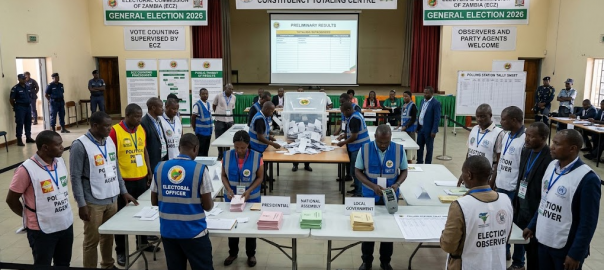
Fri, Aug 21 2026 /Mpelembe Media/ — On August 18, 2026, the Electoral Commission of Zambia (ECZ) declared the re-election of incumbent President Hakainde Hichilema (United Party for National Development – UPND) to a second five-year term. The official results indicated that Hichilema won 60.49% of the vote (2,965,326 votes), while his primary challenger, Brian Mundubile of the National Reconciliation Party for Unity and Prosperity (NRPUP)—representing the Tonse-Pamodzi Alliance—secured 37.87% (1,856,222 votes). The ECZ reported an official voter turnout of 57.23% out of 8,786,300 registered voters. Hichilema praised the electorate for their trust, pledging to focus on national unity and development, while the opposition immediately rejected the results, alleging systematic irregularities and promising legal challenges. Continue reading

20Aug/26

Zambia’s Landslide Victory and Opposition Crackdown

From Democratic Beacon to Shadow State — President Hichilema’s Co-option of the Judiciary and Post-Election Security Crackdowns

Thu, Aug 20 2026 /Mpelembe Media/ — Zambia’s standing as a historically resilient multiparty democracy in Southern Africa has been severely tested by the events surrounding the August 13, 2026, general election, which critics argue represent a systematic campaign by President Hakainde Hichilema’s administration to dismantle the country’s democratic framework. Although Hichilema came to power in 2021 on a reformist “New Dawn” platform pledging to restore the rule of law and depoliticize the civil service, his administration has increasingly co-opted state institutions to eliminate political opposition and consolidate executive hegemony, fueling fears of an engineered “life presidency”. The run-up to the election was marked by rising authoritarianism, including the weaponization of the Cyber Crimes Act of 2025 to arrest independent journalists like MacPherson Mukuka and Thomas Allan Zgambo, as well as a proposed Non-Governmental Organizations Bill designed to grant the government excessive control over civil society groups. Tensions escalated further following the death of former President Edgar Lungu in June 2025, which fragmented the opposition, and the Constitutional Court’s retroactive disqualification of Lungu from contesting the 2026 elections. Continue reading

20Aug/26

Military raids and treason in Zambia

Democracy in Peril: Military Raid, High-Profile Arrests, and Disputed Ballots Shackle Zambia’s Post-Election Landscape

Thu, Aug 20 2026 /Mpelembe Media/ — Zambia’s general election, held on August 13, 2026, resulted in the re-election of incumbent President Hakainde Hichilema for a second five-year term. According to the Electoral Commission of Zambia (ECZ), Hichilema secured 60.49% of the vote, defeating his primary challenger, Brian Mundubile of the National Reconciliation Party for Unity and Prosperity (NRPUP), who received 37.87%. While Hichilema expressed gratitude to voters and committed his second term to national unity, economic expansion, and debt recovery, the electoral process was instantly marred by major disruptions. On August 14, the ECZ temporarily suspended vote counting and results tabulation nationwide, citing localized violence against polling staff and the theft of marked ballots. Although the suspension was lifted the same day, international observer groups, including the European Union and the Southern African Development Community (SADC), voiced concerns over an uneven playing field, late constitutional and legal reforms, extended pauses in results tabulation, and reports of political intimidation. Continue reading

17Aug/26

Zambia’s 2026 Election and 22-Hour Blackouts

The Defining Moments of Zambia’s 2026 Election

Mon, Aug 17 2026 /Mpelembe Media/ —  These sources provide a comprehensive look at the 2026 Zambian general election, covering the candidates, legal reforms, and shifting political alliances. Incumbent Hakainde Hichilema sought a second term against a fractured opposition, with Brian Mundubile emerging as his primary challenger representing the Tonse Alliance. The reports detail significant constitutional amendments that expanded the National Assembly and introduced a mixed-member proportional representation system. Analysts highlight concerns regarding legislative maneuvering, economic grievances like the high cost of living, and accusations of gerrymandering. Despite reports of isolated violence and a temporary pause in vote counting, the data indicates a high voter turnout among the nearly nine million registered citizens. Ultimately, the records illustrate a tense political landscape defined by regional voting blocks and the ongoing test of Zambia’s democratic institutions. Continue reading

15Aug/26

Zambia’s 2026 Election in the Dark

Zambia Suspends Election Count Amid Violence, Then Resumes
Sat , Aug 15 2026 /Mpelembe Media/ — Zambia’s Electoral Commission halted result announcements on August 14 after attacks on staff and stolen ballots in some areas, an unprecedented step under the Electoral Process Act. Incumbent President Hakainde Hichilema called for peace amid encouraging early signs, while challenger Brian Mundubile declared victory from his party’s tallies and warned of potential interference. The suspension lasted hours; counting resumed that evening with extra security, and partial results on August 15 showed Hichilema leading in key spots like Southern Province.

Continue reading

07Aug/26

From Zamrock to Internet Kill-Switches

The Rise of Zed Beats and the Digital Music Revolution

Fri , Aug 0& 2026 /Mpelembe Media/ — Zed Beats, which takes its name from the letter “Z” in Zambia, represents a dynamic hybrid music genre that emerged in the late 1980s. Young, self-taught producers began using affordable computer software to blend indigenous Zambian elements with popular global sounds like R&B, reggae, rap, hip-hop, Jamaican dancehall, Afrobeats, and amapiano. The rise of this digital movement was catalyzed by a major cultural void in the late 1980s and 1990s, when the devastating HIV/AIDS epidemic claimed the lives of a generation of veteran musicians who had anchored traditional live genres like Kalindula and Zamrock. To fill this void, which had left radio and television heavily dominated by foreign music, young enthusiasts utilized newly accessible computer technology to resurrect local music and forge a modern urban identity. Continue reading

04Aug/26

Bond Rallies and Blackouts in Zambia

Zambia’s 2026 Election: A High-Stakes Two-Horse Race Decided by Economic Squeeze and Drought

Tue , Aug 04 2026 /Mpelembe Media/ — Zambia’s general election on August 13, 2026, represents a pivotal, alliance-driven contest that will test the country’s democratic resilience and economic direction. Although fourteen presidential candidates are officially cleared to run, the election is fundamentally a two-horse race between incumbent President Hakainde Hichilema of the United Party for National Development (UPND) and opposition challenger Brian Mundubile. Hichilema enters the race backed by an expanded 15-party UPND Alliance, leveraging the power of incumbency. His challenger, Mundubile—a 55-year-old lawyer, accountant, and former government chief whip—is running under the National Reconciliation Party for Unity and Prosperity (NRPUP) banner after unifying a highly fractured opposition under the Tonse–Pamodzi Alliance. Continue reading

03Aug/26

Zambia’s Debt Miracle and Democratic Backsliding

For Zambian voters, the 2026 election represents a critical choice balancing long-term macroeconomic recovery against immediate, severe household pressures. While President Hakainde Hichilema’s administration successfully restructured the nation’s default-era debt and introduced popular programs like universal free education, ordinary citizens are heavily squeezed by a high cost of living, rising food costs, and inflation exacerbated by a historic drought. A primary concern voters should watch out for is the post-election handling of the country’s structural electricity crisis. To avoid grueling 20-hour blackouts during the campaign cycle, the state utility ZESCO has relied on costly emergency regional power imports. Because this spending is fiscally unsustainable, voters face the high risk of a post-election fiscal correction, which will likely involve steep, inflation-inducing retail tariff hikes or a return to severe load-shedding. Furthermore, due to widespread grassroots dissatisfaction with local representation, there is a strong potential for split-ticket voting, meaning voters may back the incumbent president while actively rejecting sitting members of parliament and local councilors. Continue reading

01Aug/26

Zambia’s 2026 battle over development receipts

Sat, Aug 01 2026 /Mpelembe Media/ —  The 2026 elections are unfolding within a

new governance paradigm that prioritizes decentralized development and performance-based outcomes over traditional dynastic patronage and performative rhetoric. The unprecedented expansion of the Constituency Development Fund (CDF)—which increased allocations per constituency from K1.6 million in 2021 to K40 million in 2026—has made localized, tangible development the primary test of political legitimacy. Consequently, the path to public office in 2026 will likely be determined by a candidate’s proven record of local service, effective management of public resources, and engagement in evidence-based campaign discourse, rather than relying on hereditary claims or social media influence. Continue reading

22Jul/26

How Green Copper Overthrew Zambia’s Democracy

The Restroom Negotiations: How a Canadian Mining Giant Bought a Presidency and Rewrote Zambia’s Laws

Wed, July 22 2026 /Mpelembe Media/ — The provided documents explore the essential role of the mining industry in the global transition toward a low-carbon economy, particularly the rising demand for transition minerals. These sources emphasize that while mineral extraction underpins a vast portion of global wealth, it simultaneously presents significant environmental and social risks, such as habitat loss, water stress, and human rights concerns. To address these challenges, the Global Investor Commission on Mining 2030 outlines a framework for institutional investors to use their financial influence to promote responsible operations. By prioritizing capital allocation and active stewardship, investors can encourage better safety standards, equitable benefit distribution, and the adoption of circular economy principles. Ultimately, the reports argue that a strategic “reset” of the relationship between finance and mining is necessary to ensure the industry leaves a positive legacy for host communities. These materials serve as a roadmap for achieving a sustainable mining sector that balances industrial growth with ecological and ethical boundaries. Continue reading