

Tag Archives: Phoenix

05Sep/26

Emmanuel Mwamba from statecraft to sedition

Diplomacy, Dissidence, and Digital Resistance: The Life and Career of Emmanuel Mwamba

Sat Sep 05 2026 /Mpelembe Media/ — Emmanuel Mwamba was born on April 18, 1971, in the mining hub of Luanshya within the Copperbelt Province of Zambia. He completed his secondary education at Roan Antelope Secondary School and subsequently earned a Diploma in Journalism and Public Relations from Evelyn Hone College. He expanded his qualifications globally, obtaining a Master of Business Administration from Edith Cowan University in Australia and a Master in Peace Studies from the Institute of Peace & Security Studies at Addis Ababa University. After initial employment at the Zambia National Commercial Bank, he entered the political arena as the administrative secretary and spokesperson for Zambia’s second president, Frederick Chiluba. During this time, Mwamba aggressively defended Chiluba against state-directed corruption prosecutions. This loyalty caused friction with the administration of Levy Mwanawasa, resulting in the termination of Mwamba’s probationary contract in October 2004, though he continued serving Chiluba in a private capacity. Following the reconciliation of Chiluba and Michael Sata in 2005, Mwamba transitioned his allegiance to the Patriotic Front (PF). Continue reading

30May/26

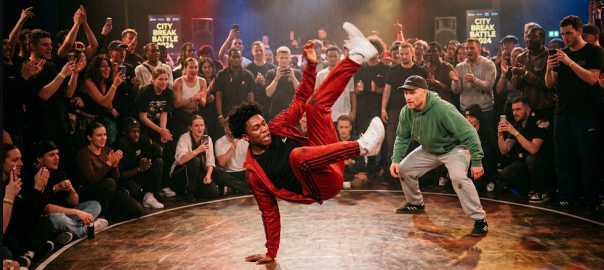
Breaking Boundaries: How Beat Street and Breakin’ Exported Street Culture

The Phoenix of the Bronx: From 1970s Block Parties to the Olympic Games and Broadway

Sat, May 30 2026 /Mpelembe Media/ — The Origins of Street Dance Hip-hop dance originated in the 1970s as a powerful form of self-expression and community building for marginalized youth. In the South Bronx, African American and Puerto Rican teenagers developed breaking (b-boying/b-girling) as a creative outlet and a peaceful alternative to territorial gang violence. Concurrently, West Coast dancers in California independently invented “funk styles,” such as popping and locking, which were originally danced to funk music rather than hip-hop. Continue reading

03May/26

A Fall from Innocence

Sun, May 3 2026 /Mpelembe Media/ — The physical trek to find the missing boy, Ray Brower, serves as a profound metaphor for the transition from childhood to adulthood. What begins as a youthful adventure to become local heroes quickly transforms into a journey of internal healing and self-discovery. By separating the boys from the critical eyes of their hometown, the isolated setting acts as a pressure cooker that forces their hidden traumas—such as physical abuse, parental neglect, and societal prejudice—to the surface. Continue reading

29Mar/26

Navigating the Friendship Recession and the Cost of Connection

The Decline of the “Third Place” and the Rise of Global Isolation

March 30, 2026 /Mpelembe Media/ — The Core Issue: The “Friendship Recession” Modern society is experiencing a severe decline in social capital and interpersonal connections, a phenomenon widely referred to as the “friendship recession”. Data shows a quantifiable collapse in the size of our social networks: in 1990, 33% of Americans reported having 10 or more close friends, but by 2021, that number had plummeted to just 13%. Meanwhile, the percentage of individuals reporting zero close friends has quadrupled. This erosion of social capital—the “glue” that holds communities together through networks, trust, and reciprocity—is undermining both civic engagement and personal well-being.

Continue reading

22Nov/25

Autonomous Economy: Agentic Economy as the Operating System of the Machine Economy

Nov. 22, 2025 /Mpelembe Media/ — We are currently in the foundational or emergence phase of the Autonomous Economy. It is no longer a futuristic concept; it is actively being built and deployed, though the full, ubiquitous vision of a global, self-regulating autonomous economy is still years away.

Many experts compare the current state of the Autonomous Economy to the Internet in the early 1990s—the core technologies and infrastructure are being established, and we are seeing the first truly disruptive commercial applications emerge. Continue reading

13May/23

The ‘gay world cup’: why LGBTQ+ audiences love Eurovision

Matt Weaver, University of Portsmouth

In 1956, seven European countries – Belgium, France, Italy, Luxembourg, the Netherlands, Switzerland and West Germany – gathered in Lugano, Switzerland for the first ever Eurovision Song Contest. The competition was only broadcast in select countries, meaning only a small number of viewers watched Swiss entry Lys Assia win the grand prize with the song Refrain.

Continue reading