Tue, Jun 09 2026 /Mpelembe Media/ — Kemi Badenoch argues that equality legislation like the Public Sector Equality Duty (PSED) has inadvertently created a culture where public authorities are so terrified of career-ending accusations of racism that they replace common sense and critical thinking with bureaucratic box-ticking. She claims this deep-seated fear has caused institutions to withhold information, avoid difficult conversations, and become “institutionally incompetent” when dealing with issues of race and identity. Continue reading
Category Archives: Politics
The Architecture of Obfuscation: How Bondi Used a “Voluntary” Loophole to Shield Trump
Institutional Resistance: How the DOJ Coached Bondi Through Her Epstein Files Interrogation
Fri, May 29 2026 /Mpelembe Media/ — On May 29, 2026, former U.S. Attorney General Pam Bondi appeared before the House Oversight Committee for a closed-door, transcribed interview regarding the Justice Department’s highly criticized handling of the Epstein Files Transparency Act. During the hours-long session, Bondi repeatedly refused to answer questions about President Donald Trump’s involvement in, or knowledge of, the file release process. Continue reading
The Politics of Humiliation: Why Shared Cruelty is the Ultimate Community Builder
United by Contempt: The Psychological Roots of Authoritarianism and Affective Polarization
Sun, May 24 2026 /Mpelembe Media/ — The intersection of psychology and contemporary politics reveals that the rise of modern authoritarian and populist movements is largely driven by identity, fear, and malice rather than policy or economic grievances. At the center of this dynamic is the deployment of shared cruelty as a political strategy. Demagogues turn the degradation of vulnerable out-groups into a participatory public spectacle, which provides their supporters with a profound sense of community, pride, and euphoria. This shared joy in the suffering of others functions as a powerful social adhesive, securing fierce loyalty to the leader while distracting the public from the elite’s personal enrichment or political corruption. Continue reading
From Doret Legore to Kemi Badenoch: Unpacking Britain’s Post-Racial Paradox
The Bureaucratic Class and the Culture War: Kemi Badenoch’s Vision for Britain
April 9, 2026 /Mpelembe Media/ — The provided sources revolve around the contemporary British political and cultural landscape, specifically focusing on debates over race, institutional power, and conservative ideology. The material can be summarized across three interconnected themes: Continue reading
The Economic and Strategic Costs of Cosplaying Madness
Wrecking Ball Diplomacy: How ‘America First’ Tariffs and Transactionalism Alienated the World
April 8, 2026 /Mpelembe Media/ — The “Madman Theory” is a concept in international relations suggesting that a leader can gain coercive bargaining leverage by appearing irrational, highly volatile, or indifferent to the costs of conflict. By cultivating a reputation for madness, a leader attempts to make otherwise incredible threats—such as initiating a nuclear war or destroying the global economy—appear credible, thereby forcing adversaries to concede to avoid a catastrophe.
The UN Resolution on Slavery Reparations
UN General Assembly Makes History: Declares Transatlantic Slave Trade the “Gravest Crime Against Humanity”
March 27, 2026 /Mpelembe Media/ — On March 25, 2026, coinciding with the International Day of Remembrance of the Victims of Slavery and the Transatlantic Slave Trade, the United Nations General Assembly adopted a historic resolution declaring the transatlantic trafficking of enslaved Africans and racialized chattel enslavement as “the gravest crime against humanity”. Spearheaded by Ghana and heavily supported by the African Union and Caribbean Community (CARICOM), Resolution A/80/L.48 marks a significant shift in international human rights by calling for a comprehensive framework of reparatory justice.
Cover-Ups, Missing Files, and Congressional Surveillance: The Escalating Crisis Over the DOJ’s Handling of the Epstein Documents
25 Feb. 2026 /Mpelembe Media/ — The Department of Justice’s (DOJ) recent release of documents mandated by the Epstein Files Transparency Act (EFTA) has ignited a fierce political and constitutional crisis. While the DOJ claims to have complied with the law by publishing roughly 3.5 million pages, investigations and congressional leaders allege a systemic cover-up designed to protect President Trump and his associates, alongside gross negligence regarding victim privacy. Continue reading
Analyzing Zambia’s Progress: An Interview with Hakainde Hichilema
Zambia’s Strategic Evolution: From Landlocked to Land-Linked Economic Powerhouse
25 Feb. 2026 /Mpelembe Media/ — This is an analysis of John McDermott, The Economist chief Africa correspondent
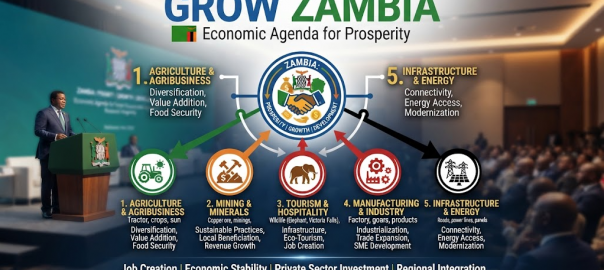
interview with Zambian President Hakainde Hichilema (often referred to as “HH”) ahead of the country’s upcoming August elections,. Hichilema is urging voters to “stay the course,” arguing that his administration has made significant strides in repairing the damage left by his predecessor, Edgar Lungu. He highlights several achievements, including securing a debt restructuring deal, delivering free education, enacting liberal reforms in power and agriculture, and initiating major infrastructure projects like the Lobito Corridor and Tazara railway renovations to transform Zambia into a “land-linked” nation. He also aims for the country to reach 1 million tonnes of copper production this year. Continue reading
The Documentary the DOJ Hopes You Never Stream: Unmasking the Evidence American Media Ignored
25 Feb. 2026 /Mpelembe Media/ — The Borowitz Report details allegations of sexual misconduct by Donald Trump involving teenagers and children, referencing claims found within the Epstein files and a 2018 BBC Panorama documentary. The author asserts that the Department of Justice has attempted to suppress evidence, such as withholding interviews with a woman who alleged Trump abused her when she was 13. The BBC documentary, which has never aired in the US, features on-camera testimonies from women who encountered Trump as teen models, including Barbara Pilling. It also highlights instances where Trump bragged about invading pageant dressing rooms to ogle naked girls, including contestants as young as 15 at the Miss Teen USA pageant. Asserting that the FCC is aligned with Trump, the author urges readers to bypass traditional broadcasting by sharing the documentary clips online. Continue reading