Tag Archives: Germany

26Oct/26

Audi Ditches Its Logo in China

The Great Automotive Realignment: How China Upended Germany’s Global Car Supremacy

Mon, July 26 2026 /Mpelembe Media/ — For decades, German automotive giants—Volkswagen Group, BMW, and Mercedes-Benz—dominated the global industry and derived a significant share of their corporate profits from mainland China. However, a severe structural contraction has destabilized this industrial core, culminating in a 76% year-on-year collapse in combined Q3 operating profits down to €1.711 billion. China’s share of total global vehicle deliveries for German carmakers dropped from 39% in 2020 to 29% in 2025, with quarterly deliveries in China plummeting between 30% and 41% by mid-2026. Domestically, annual German passenger vehicle output fell from 5.6 million units in 2017 to 3.4 million in 2024, burdened by high labor costs averaging €62 per hour and severely underutilized assembly plants—such as Wolfsburg operating at just 61% capacity—compelling Volkswagen to shutter a domestic manufacturing plant in Germany for the first time in its 88-year history. Continue reading →
25Oct/26

How Sewage Tomatoes Beat the AI Web

Mapping the Neighborhood: Reimagining Wikipedia as a Proximity-Based Experience

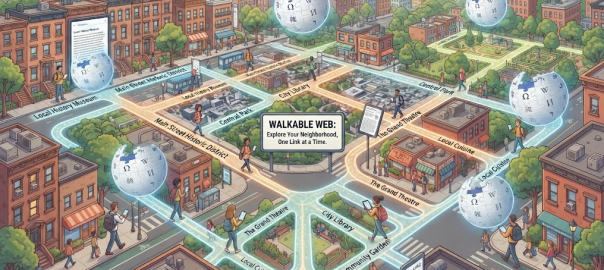
Sat Oct. 24, 2026 /Mpelembe Media/ — Local Wikipedia is an independent, unofficial web application developed by journalist, software developer, and data specialist Ed Jefferson that turns Wikipedia into a proximity-focused, ambient spatial encyclopedia. Conceived during lockdown and released in late 2026, the application operates on the core thesis of displaying geotagged Wikipedia articles located within a thirty-minute walk from the user. Users can set their location using native browser geolocation or manual text queries such as town names, landmarks, and UK postal codes. To balance visual clutter and system performance across varying geographic densities, the platform automatically adjusts its operational scope, expanding up to six miles in low-density rural areas or capping results at five hundred items in dense urban centers. Designed with client-side privacy in mind, positioning coordinates remain strictly within temporary local browser memory, and exported links are sanitized to ensure physical location data is never shared. Continue reading →

22Oct/26

Why Machiavelli Believed Rulers Need Dirty Hands

Power, Virtù, and Human Nature: A Multidisciplinary Synthesis of Machiavellian Pragmatism

Thu Oct. 22, 2026 /Mpelembe Media/ — Niccolò Machiavelli’s foundational political thought, articulated in The Prince (1513) and the Discourses on Livy (1517), marks a radical shift from classical teleological ethics and medieval Christian scholasticism toward empirical political realism. Rejecting idealized imaginary republics, Machiavelli sought the “effectual truth” of human behavior, asserting that effective governance must be guided by strategic necessity (necessità) and the preservation of state stability (ragione di stato) rather than abstract moral pieties. He redefined virtù not as moral goodness, but as the dynamic capability, drive, and tactical agility—symbolized by combining the courage of the lion with the cunning of the fox—required to master unpredictable circumstances (fortuna). Although critics historically viewed The Prince as an autocratic handbook and the Discourses as a defence of republican liberty, scholars emphasize that these works are complementary: princely authority is often necessary to establish order in a corrupted state, whereas a mixed republican constitution preserves long-term security, popular freedom, and civic vitality. Continue reading →

20Oct/26

AfD Cyber Leak and Russian Ties

Beyond the Public Facade: What Germany’s Far-Right Leadership Says Behind Closed Doors

Tue Oct. 20, 2026 /Mpelembe Media/ — A major cyberattack targeting a hosting provider used by Germany’s far-right party, Alternative für Deutschland (AfD), resulted in the unlawful exposure of 281 gigabytes of internal party data, including 421,179 emails across ten accounts. Published online as an unedited archive accompanied by AI-generated summaries, the leak contains personal correspondence, bank statements, membership lists, and academic certificates belonging to top officials, including party co-leader Alice Weidel and former leader Alexander Gauland. While the AfD confirmed that a breach occurred in September 2026 and stated it was conducting an internal investigation, the sheer volume of leaked records has brought unprecedented public scrutiny to the party’s internal operations. Continue reading →

17Oct/26

Why America Is Losing Global Talent

America’s Gendered Exit: Why 40% of Young Women Want to Leave the U.S.

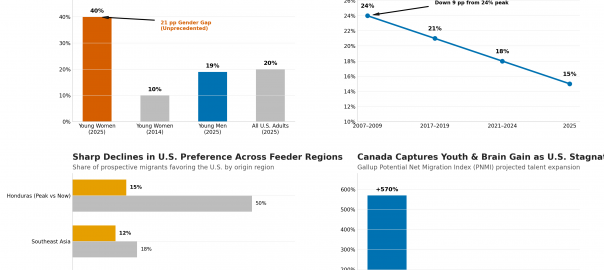
Sat Oct. 16, 2026 /Mpelembe Media/ — Global migration aspirations have entered a period of structural recalibration, as the proportion of adults worldwide desiring to relocate permanently dipped to 15% in 2025 after sustaining a record peak of 16% between 2021 and 2024. Although the United States remains the single most desired destination globally, its attraction has fallen to a nearly two-decade low of 15% in 2025, down from 24% in the 2007–2009 period. This cooling demand is particularly striking in traditional feeder corridors such as Latin America and the Caribbean (dropping from 33% to 28%) and Southeast Asia (falling from 18% to 12%), with Honduras recording a dramatic 35-percentage-point collapse in U.S. preference. Instead of defaulting to North America, potential migrants are turning toward multipolar regional networks—favoring Japan in Southeast Asia, Germany in the Middle East, and Spain in Europe—while Canada solidly maintains its position as the second most preferred global destination at 9% (representing ~85 million adults). Continue reading →

23Aug/26

Pancake Breakfasts and Satanic Bloodlines

Behind the Closed Door: Evaluating Religious and Political Critiques of the Masonic Family

Sun, Aug 23 2026 /Mpelembe Media/ — The conspiracy literature surrounding global power structures often centers on the theory of elite secret societies and generational dynasties pulling the strings of world events. According to Fritz Springmeier’s Bloodlines of the Illuminati, a hidden cabal consisting of thirteen powerful, generational Satanic lineages secretly rules the world through a multi-layered network of secret societies, including Freemasonry and various occult councils. Proponents of this view argue that these families—including prominent names like the Astors, Rothschilds, Rockefellers, and Collinses—have amassed unchecked financial and political influence through intermarriage and the preservation of secret occult practices. Conspiracist narratives contend that these elite networks are responsible for massive historical manipulations, orchestrating major conflicts like the World Wars, setting up international institutions like the United Nations, and even controlling global illegal industries such as the narcotics trade. To hide their influence, these groups are alleged to operate through front companies, legitimate religious organizations, and systemic media censorship, maintaining a facade of normal civil society. Continue reading →

17Aug/26

Harriet Tubman led a Civil War raid

Reclaiming the Classroom: How Carter G. Woodson Fought the Violence of Miseducation

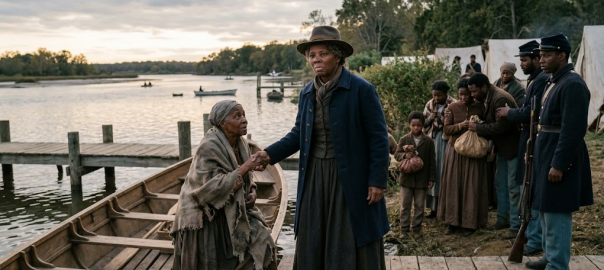
Mon, Aug 17 2026 /Mpelembe Media/ —  The foundational struggle for racial equality in America is deeply rooted in the preservation and legitimization of Black history as an active tool of resistance. Carter G. Woodson, recognized as the “Father of Black History,” dedicated his life to establishing separate institutional structures like the Association for the Study of Negro Life and History in 1915 and Negro History Week in 1926 to counter the “miseducation” of African Americans. Woodson argued in his landmark 1933 book, The Mis-Education of the Negro, that the American educational system culturally indoctrinated Black students to accept an inferior status by white-washing their contributions to world culture and history. He observed that controlling a population’s thinking eliminates the need to police their physical actions, as individuals conditioned to believe they are outcasts will naturally find their way to the “back door”. This early twentieth-century battle to reclaim the narrative highlights that systemic control begins in the classroom, a reality that echoes in modern debates over how race and history are taught in public schools. Continue reading →

17Jun/26

The Tactics and Mythos of England’s 1966 World Cup Victory

The Mythos of 1966: Sir Alf Ramsey, the Fire Horse, and the 60-Year Wait for World Cup Glory

Wed, Jun 17 2026 /Mpelembe Media/ — The psychological landscape of competitive sports is a high-stakes environment where the difference between victory and defeat often rests on an athlete’s ability to manage intense pressure and fluctuating emotions. In the quest for an edge, athletes frequently adopt specific behaviors to navigate this stress. These behaviors generally fall into two categories: those grounded in technical preparation and those rooted in “magical thinking.””Superstition is a behavior which does not have a clear technical function in the execution of skill, yet which is believed to control luck and/or other external factors. Rituals comprise magical thinking, belief in specific sayings, and ritualized behavior.”While the desire for victory is universal, the specific paths athletes take to achieve readiness vary wildly. Have you ever wondered why an elite striker insists on a specific pair of socks, or why a goalkeeper talks to the goalposts? Understanding the distinction between irrational rituals and professional routines is the first step in moving from a mindset of luck to a mindset of logic. Continue reading →

04Jun/26

The Tactics and Mythos of England’s 1966 World Cup Victory

Thur, Jun 04 2026 /Mpelembe Media/ — These sources offer a multifaceted preview of 2026, primarily focusing on its identity as the Year of the Fire Horse in the Chinese zodiac. Authors explore the cultural symbolism and astrological significance of this rare sixty-year event, noting its reputation for intense energy, unbridled passion, and global upheaval. Historical analysis links the upcoming year to past milestones, most notably England’s 1966 World Cup victory, which is examined through both tactical innovations and its enduring national legacy. The collection further extends into sports psychology and gambling, investigating how pre-performance rituals mitigate athlete anxiety and how historical betting data shapes expectations for the 2026 World Cup. Together, these texts blend ancient tradition with modern analysis to project a year defined by competitive spirit and transformative change Continue reading →

29May/26

Britain’s Million Missing Young Workers

Rebuilding the Broken Ladder: Strategic Interventions to Save the UK’s Entry-Level Job Market

Fri, May 28 2026 /Mpelembe Media/ — The United Kingdom is facing a severe youth detachment crisis, with the number of young people Not in Education, Employment, or Training (NEET) surpassing 1 million, which equates to roughly one in eight young people. If left unaddressed, this figure could surge to 1.25 million within five years. This trajectory leaves the UK with the third-highest NEET rate among wealthy European nations, trailing only Italy and Lithuania. The crisis exacts a massive toll, costing the UK economy an estimated £125 billion annually in lost productivity, foregone taxes, and increased health and welfare expenditures. Continue reading →