
Rebuilding the Broken Ladder: Strategic Interventions to Save the UK’s Entry-Level Job Market
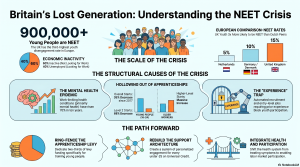
Fri, May 28 2026 /Mpelembe Media/ — The United Kingdom is facing a severe youth detachment crisis, with the number of young people Not in Education, Employment, or Training (NEET) surpassing 1 million, which equates to roughly one in eight young people. If left unaddressed, this figure could surge to 1.25 million within five years. This trajectory leaves the UK with the third-highest NEET rate among wealthy European nations, trailing only Italy and Lithuania. The crisis exacts a massive toll, costing the UK economy an estimated £125 billion annually in lost productivity, foregone taxes, and increased health and welfare expenditures.
Key Drivers of the Youth Detachment Crisis:
- Rising Ill-Health and “Hands-Off” Welfare: A defining shift in the crisis is the surge in young people becoming economically inactive due to work-limiting health conditions, primarily mental health issues like anxiety and depression. The UK benefits system inadvertently reinforces this detachment; for every £25 spent on passive welfare benefits for young people, only £1 is spent on active employment support. Consequently, a rapidly growing number of young claimants are placed in the Limited Capability for Work-Related Activity (LCWRA) group, which provides higher payouts but exempts them from any requirements to engage with job centers or prepare for work.
- A Hostile Entry-Level Labour Market: The traditional pathways from education to employment have eroded, with 1.6 million fewer low- and medium-skilled jobs available compared to previous decades. Vacancies in reliable entry-point sectors like hospitality have halved, and the traditional “Saturday job” has severely declined. Furthermore, recruitment has become automated and remote; artificial intelligence (AI) increasingly screens out young, inexperienced applicants without them ever interacting with a human, while simultaneously automating many of the junior-level tasks that once served as training roles.
- Educational Disconnect and Declining Apprenticeships: The UK education system is frequently criticized for prioritizing academic qualifications and exam results over preparing students for the workforce. High academic attainment no longer guarantees employment; nearly 30% of NEET youths hold good GCSEs, and 15% have university degrees. Compounding the problem, apprenticeship starts—historically a vital vocational pathway—have plummeted by over 40%.
Proposed Solutions and Global Comparisons: Addressing the crisis requires transitioning the UK from a “Welfare State” that exacerbates inactivity to a “Working State” that actively builds capacity and pathways to employment. To combat this, the UK Government has announced a £1 billion package to expand the Youth Guarantee and provide financial incentives to employers who hire young apprentices or those who have been out of work.
International models offer proven blueprints for recovery. For example, the Netherlands maintains a NEET rate of under 5% through highly coordinated regional labor market networks that seamlessly link education providers, employers, and local municipalities. Meanwhile, Denmark successfully reintegrates vulnerable youth by providing personalized, sustained mentoring and integrating clinical mental health care with practical workplace preparation.
We are often fed a convenient, if cynical, narrative about the “lazy” youth of today—a generation allegedly more concerned with the dopamine hits of a TikTok feed than the discipline of a paycheck. But for the nearly one million young people in the United Kingdom currently classified as NEET (Not in Education, Employment, or Training), the reality isn’t a lack of ambition; it is the crushing silence of a thousand unread job applications.The data shatters the stereotype: a staggering 84% of NEET young people report that they actually want to find a job or training. This is not a story of individual lethargy, but of a widening generational fault line. Between 2019 and 2025, the NEET rate for 18-to-24-year-olds sharpened from 13% to 15%. This 1-in-8 figure represents more than just a statistical blip; it is an institutional fracture that threatens to leave a permanent scar on the nation’s social fabric.
2. The “Never-Worked” Trap
The most alarming shift in the youth economy is the rise of the “never-worked.” In 2005, four in ten NEETs had no prior work history. Today, that figure has climbed to six in ten. The situation is particularly dire for those on the cusp of full adulthood; among 24-year-old NEETs specifically, 45% have never held a single job.Missing the first rung of the career ladder is not a slow start—it is a financial catastrophe. This “long-term scarring effect” results in a lifetime earnings loss estimated at up to £300,000. When the foundation is never laid, the entire structure of a working life remains precarious. As the government’s recent interim report on young people and work notes:”One million lives. Behind the statistics lie individual lives: aspirations thwarted, opportunities lost, futures placed on hold… too many are becoming detached from education and employment altogether. We are at risk of a lost generation.”
3. The Great Health Inversion: From Unemployment to Inactivity
The nature of the NEET crisis has undergone a fundamental transformation. In previous decades, being NEET usually meant you were “unemployed”—actively searching for work. Today, the crisis is defined by “economic inactivity,” where young people are not just out of work, but have stopped looking entirely.The primary driver is a catastrophic decline in youth health. The share of 18-to-24-year-olds inactive due to ill health has risen by half since 2019, climbing from 2.8% to 4.2%. This is largely a crisis of the mind:
- Mental Health Dominance: Four in ten disabled NEETs cite mental health as their primary condition.
- Rising Inactivity: Since 2011, the proportion of disabled NEETs citing mental health has nearly doubled.
- Systemic Failure: Our current infrastructure is configured for clinical treatment—diagnosis and discharge—rather than supporting workforce participation.Lindsay Judge, Research Director at the Resolution Foundation, captures the gravity of this shift:“While the post-pandemic increase is explained by a weaker labour market and rising ill-health, longstanding issues like weak vocational education, and a benefits system that both expects and provides too little to its claimants, are also playing a major role in Britain having the third highest NEET rate in Europe.”
4. The Vocational Gap: Why the UK is an Outlier
When placed under an international lens, the UK appears as a stark outlier. A young person in Britain is now more than three times as likely to be NEET than their peer in the Netherlands. The difference lies in the “bridge” between the classroom and the workplace.The UK suffers from a “prestige bias” toward university degrees that has effectively hollowed out practical pathways. While our European neighbors invest heavily in vocational stability, the UK has allowed its entry-level routes to wither.
- UK Vocational Enrollment: 22%
- Low-NEET Trio (Netherlands, Germany, Denmark): 35%Worse still, the apprenticeship system—the traditional ladder for the most at-risk—has drifted toward upskilling older, existing employees. Since 2017, apprenticeship starts for young people have declined by over 40%. We have, in effect, pulled up the ladder while telling those at the bottom to climb.
5. The Algorithmic Gatekeeper: Death of the “Human” Interview
For a young person today, the “demand side” of the labor market is an automated black hole. The days of walking into a shop and being given a “chance” are dead. Recruitment is now mediated by AI-powered portals and platforms like HireVue.Applicants are screened by algorithms before a human ever looks them in the eye. For a generation already struggling with unprecedented levels of anxiety, this “black hole” of automated rejections creates a soul-sucking cycle. It breeds a “quitting culture” that is less about a lack of grit and more about a habit of avoidance born from repeated, faceless rejection. One young person described the mentally draining ordeal of modern applications:”You have to apply to at least 30 until you get one, and that’s, like, a really mentally draining process, because some of the application processes have six rounds, and then you don’t even make it to the final round, and it’s just, like, what was the point?”Beyond those we can see, there is an “invisible city” of 314,000 hidden NEETs—young people neither in work nor education, and not receiving benefits. Out of sight and out of mind, they represent the ultimate failure of our digital-first recruitment gatekeepers.
6. The “Springboard” vs. The “Safety Net”: A Welfare Design Flaw
The UK welfare system is built on a “deficit model.” It is designed to replace income for what a young person cannot do, rather than investing in what they could become.This creates a perverse incentive. Currently, the state spends £8.1 billion on benefits for this age group, yet less than half of that spending has any participation support or requirements attached to it. For a young person with a fluctuating health condition, the pathway to “economic inactivity” offers lower risk and more stability than attempting to navigate a job market that offers no flexibility. The system functions as a passive safety net when it needs to be an active springboard.
7. The £125 Billion Price Tag: A Strategic Economic Risk
This is no longer just a social tragedy; it is a strategic economic risk. The cumulative annual cost of the UK’s one million NEETs is estimated at £125 billion. To provide scale: this is more than the nation spends on its entire education budget each year.In an aging society, we are increasingly reliant on the next generation to sustain the economy. Allowing the talent of one million people to sit on the sidelines is a fiscal time bomb that hampers national growth and increases the long-term burden on a shrinking tax base.
8. Conclusion: The Fork in the Road
The UK stands at a crossroads. We can continue to treat youth disengagement as a series of disconnected problems—a tweak to benefits here, a mental health initiative there—or we can admit the architecture itself is broken.The “Old Welfare State” was built to protect against temporary unemployment. Today’s crisis requires a “Working State”—one that asks “What would help you take the next step?” rather than “What can’t you do?” We must decide if we are willing to build a system that meets this generation where they actually are, or if we are content to let a million futures stay on hold.