
The Defining Moments of Zambia’s 2026 Election
Mon, Aug 17 2026 /Mpelembe Media/ — These sources provide a comprehensive look at the 2026 Zambian general election, covering the candidates, legal reforms, and shifting political alliances. Incumbent Hakainde Hichilema sought a second term against a fractured opposition, with Brian Mundubile emerging as his primary challenger representing the Tonse Alliance. The reports detail significant constitutional amendments that expanded the National Assembly and introduced a mixed-member proportional representation system. Analysts highlight concerns regarding legislative maneuvering, economic grievances like the high cost of living, and accusations of gerrymandering. Despite reports of isolated violence and a temporary pause in vote counting, the data indicates a high voter turnout among the nearly nine million registered citizens. Ultimately, the records illustrate a tense political landscape defined by regional voting blocks and the ongoing test of Zambia’s democratic institutions.
The Zambia Paradox: 5 Surprising Takeaways from the 2026 General Election
Zambia has long been the darling of Western capitals—a “democratic success story” in a region often defined by volatility. Yet, the August 2026 polls proved that reputation is a fragile thing. To the outside world, President Hakainde Hichilema had engineered a macroeconomic “miracle,” but on the ground in Lusaka and the Copperbelt, that miracle felt like a hollow victory . While sovereign credit ratings climbed, citizens were left to navigate a reality of 22-hour blackouts and a political landscape that many observers described as “fraying.” The 2026 election was less a celebration of democracy and more an autopsy of its paradoxes: how does a nation maintain its credibility when high-level economic wins are divorced from the struggle for household survival?Here are five surprising takeaways from the 2026 election that reveal the complex state of Zambian democracy today.
1. The Inclusion Paradox: Why New Reforms Backfired on Women
On paper, the 2026 election was supposed to be a landmark for representation. The Constitutional Amendment Act No. 13 of 2025 introduced the Mixed Member Proportional Representation (MMPR) system, creating 40 reserved seats for women, youth, and persons with disabilities. However, a critical design flaw turned a win for inclusion into a setback for female political power.Because these 40 seats were tied directly to the national presidential vote share , political parties shifted their strategic focus away from local constituency candidates. The logic was cold: why spend resources “adopting” women for grueling constituency battles when they could be tucked into a list based on the president’s performance? The results were devastating for female participation. National Assembly female candidates plummeted from 21% in 2021 to a mere 12.5% in 2026 .”The Mission noted a decrease in the total number of women duly nominated to contest as candidates. Stakeholders reported that political parties were no longer issuing adoption certificates for female candidates, citing the fact that they already have reserved seats under proportional representation.” — AU-COMESA Election Observation Mission Preliminary Statement
2. Macro-Miracles vs. Micro-Misery: The Great Divide
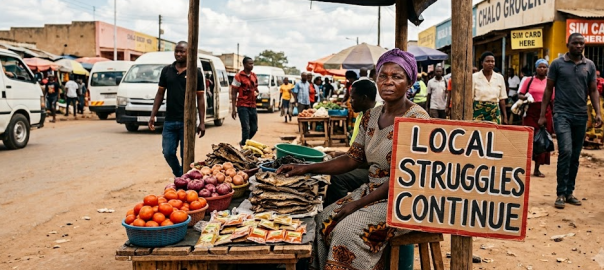
The 2026 election was a referendum on the kitchen table, not the sovereign ledger. While the Hichilema administration celebrated elite-level wins, the average voter was reeling from the 2024–2025 drought and the ensuing economic shocks.
- Macro Successes: Completion of G20 debt restructuring , a finalized IMF program, single-digit inflation at 6.8% , and a surge in mining investment.
- Micro Vulnerabilities: A 60% poverty rate , record-high maize prices, and 22-hour daily blackouts that crippled small businesses.The rural vote was particularly volatile. The administration’s move to a private-dealer voucher system for agricultural inputs—intended to improve fiscal efficiency—backfired as remote farmers were crushed by prohibitive transport costs. This economic friction is reflected in the turnout data: a staggering 14-percentage point decline in participation compared to 2021. The Geopolitical Risk Assessment captured this friction perfectly, noting that economic grievances weighed far more than elite political disputes, making “household survival” the true ballot-box driver.
3. The “Procedural Blitzkrieg”: 70 Bills in 14 Days
In the lead-up to the dissolution of Parliament in May 2026, the government executed what can only be described as a procedural blitzkrieg . Within a two-week window, the legislature passed over 70 bills , including the critical Electoral Process Act .This “legislative flooding” tactic effectively strangled public scrutiny and consensus-building. By finalizing electoral laws just three months before the polls, the government violated regional SADC best practices, which recommend a six-month “lockdown” on such laws to allow for voter education. For an administration that campaigned on the “rule of law,” this last-minute maneuvering raised uncomfortable questions about whether procedural legitimacy was being used as a shield for political expediency.
4. The 24-Hour Democracy Blackout: August 14, 2026
The most volatile moment of the cycle occurred on August 14, 2026 , when the Electoral Commission of Zambia (ECZ) temporarily suspended the nationwide count. Citing “security concerns”—including the theft of marked ballot papers and violence against officials in Lusaka—the ECZ paused the process, sending a wave of anxiety through the nation.Tensions reached a breaking point when opposition leader Brian Mundubile made a premature victory claim, alleging the suspension was a cover for government interference. It took a high-stakes display of “shuttle diplomacy” by regional observers—led by figures like Samuel Tembenu (SADC) and Mokgweetsi Masisi (ICGLR) —to pull the country back from the brink. Riot police were deployed to secure tallying hubs, and the count resumed only after international missions secured mutual commitments to de-escalate rhetoric and trust established judicial pathways.
5. Gerrymandering or Geometry? The Battle of the New Map
The 2026 election was the first conducted under a radically expanded electoral map, with the National Assembly growing from 156 to 226 directly elected seats . This massive redrawing was officially meant to address voter distribution, but it was a exercise driven more by political decisions than technocratic ECZ recommendations , as noted by ISS Africa.While critics cried gerrymandering, the “geometry” of the map was suspiciously balanced:
- The Southern Province (Hichilema’s traditional stronghold) gained 9 new seats .
- The Eastern areas (Mundubile’s opposition stronghold) also gained 9 new seats .By “matching” seat increases in rival strongholds, the delimitation exercise may not have rigged the total, but it effectively institutionalized regional polarization . Instead of fostering a national consensus, the new map locked in ethno-regional voting blocks, ensuring that Zambia remains a house divided by its own geography.
Conclusion: Beyond the Ballot
As the results stabilized—with Hichilema holding 58.1% of the vote at the 58% reporting stage—Zambia appeared to have escaped a total breakdown. However, the resilience of the system is being tested by a public that feels increasingly alienated.The 2026 cycle leaves us with a haunting question raised by ISS Africa: Is ” procedural legitimacy “—simply following the rules and checking the boxes—enough to retain “hard-won democratic credibility” when the public feels the legal and economic systems are being manipulated? For the next administration, the challenge will not be managing debt, but bridging the chasm between national fiscal recovery and the daily survival of the Zambian people.