Zambia’s 2026 Election: A High-Stakes Two-Horse Race Decided by Economic Squeeze and Drought
Tue , Aug 04 2026 /Mpelembe Media/ — Zambia’s general election on August 13, 2026, represents a pivotal, alliance-driven contest that will test the country’s democratic resilience and economic direction. Although fourteen presidential candidates are officially cleared to run, the election is fundamentally a two-horse race between incumbent President Hakainde Hichilema of the United Party for National Development (UPND) and opposition challenger Brian Mundubile. Hichilema enters the race backed by an expanded 15-party UPND Alliance, leveraging the power of incumbency. His challenger, Mundubile—a 55-year-old lawyer, accountant, and former government chief whip—is running under the National Reconciliation Party for Unity and Prosperity (NRPUP) banner after unifying a highly fractured opposition under the Tonse–Pamodzi Alliance.
The vote has essentially become a referendum on Hichilema’s macroeconomic stabilization program. After inheriting a nation in default, Hichilema’s administration successfully restructured 94% of Zambia’s sovereign debt, securing $1.4 billion in annual savings that helped fund major social programs, such as introducing free primary and secondary education for over 2.5 million children. However, a historic El Niño drought has severely depleted water levels at the Kariba Dam, forcing the state utility ZESCO to spend $50 million monthly on emergency power imports while citizens face blackouts of up to 20 hours a day. While annual inflation slowed to 6.5% by June 2026, everyday citizens are struggling with escalating food costs and a doubling of maize-meal prices. Mundubile has tapped into this grassroots frustration, dismissing the government’s economic figures as “big English” and proposing to use Zambia’s $6.5 billion foreign exchange reserves to subsidize basic goods—a populist move that critics warn could trigger massive currency depreciation.
Political tensions are further exacerbated by significant constitutional reforms enacted in late 2025, which expanded parliament from 156 to 226 constituency-based seats and reserved 40 proportional representation seats for women, youth, and persons with disabilities. The resulting redrawing of the electoral map has triggered accusations of gerrymandering to favor the ruling party, while the opposition has condemned a rapid “legislative overload” meant to push through major bills without public consensus. Additionally, the state’s selective use of the Cyber Security and Cyber Crimes Act to arrest prominent opposition figures, including Mundubile and Socialist Party leader Fred M’membe for online digital associations and statements, has fueled concerns from UN envoys and civil society about the shrinking of Zambia’s democratic space and political intimidation ahead of the polls.
The electoral narrative is also deeply intertwined with a highly sensitive dispute over the burial of former president Edgar Lungu, who died in South Africa in June 2025. The government’s insistence on a public state funeral clashed with the family’s demands for a private burial, culminating in a June 2026 South African court ruling in favor of the family. Mundubile and his running mate Makebi Zulu have used this controversy on the campaign trail to mobilize voters in northern Bemba-speaking strongholds, portraying the Hichilema administration as vindictive. Amid these intense political struggles, the broader African context includes a positive story of youth adaptation in Nigeria, where young girls in northwestern regions are defying insecurity, kidnapping, and banditry to pick up cricket, earning the Nigeria Cricket Federation the International Cricket Council’s Criiio Cricket Festival of the Year award.
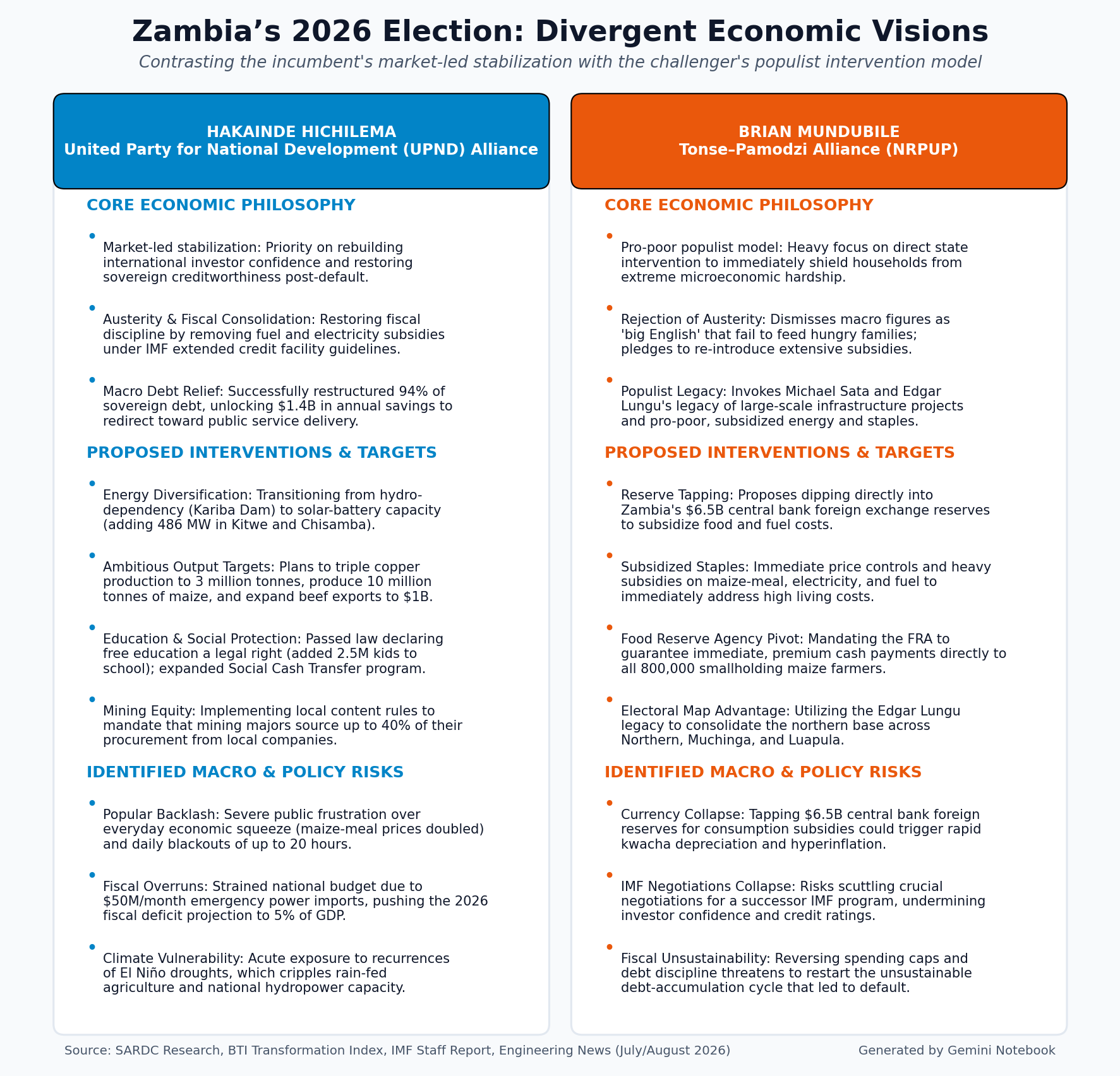
This professional comparison matrix contrasts the two major candidates’ economic philosophies, key proposed interventions, and their associated policy risks:
- Hakainde Hichilema (UPND Alliance): Campaigns on a platform of market-led stabilization, having restructured 94% of Zambia’s sovereign debt to unlock $1.4 billion in annual savings. His second-term targets are highly ambitious, focusing on tripling copper output to 3 million tonnes, adding 10,000 MW of power to the grid, and enforcing a 40% local-procurement requirement for mining majors. However, his administration faces severe public blowback from an El Niño-driven drought that has forced up to 20-hour blackouts, necessitating $50 million monthly in emergency power imports that risk pushing the 2026 fiscal deficit to 5% of GDP.
- Brian Mundubile (Tonse–Pamodzi Alliance / NRPUP): Positions himself as a pro-poor populist who rejects IMF-backed austerity guidelines as irrelevant “big English” while families go hungry. He proposes direct state intervention, including dipping directly into Zambia’s $6.5 billion foreign exchange reserves to subsidize basic staples like maize-meal, fuel, and electricity. His key policy risks include a severe threat of currency (kwacha) depreciation and hyperinflation, as well as potentially scuttling crucial negotiations for a successor IMF program.
The Copper Belt’s High-Stakes Gamble: 5 Surprising Realities of Zambia’s 2026 Election
On August 13, 2026, Zambia returns to the polls in a contest that serves as the ultimate litmus test for one of Africa’s most watched economic recoveries. For international investors, the narrative is seductive: a “world-beating bond rally” following the arduous completion of a $13 billion debt restructuring. Yet, the view from the ground in Lusaka and the Copperbelt reveals a starkly different “everyday financial reality.”While the macro-indicators hum, the citizenry is grappling with a grueling policy trap. Voters are weighing the government’s macroeconomic achievements against the visceral frustration of 20-hour blackouts and soaring food costs. This election is not merely a standard plebiscite on leadership; it is the first national trial of a completely overhauled electoral architecture and a landscape where the era of the individual political party has been replaced by the “Big Tent” coalition.
1. The “New Math” of Zambian Democracy
Zambia’s electoral system underwent a seismic shift following the Constitution of Zambia (Amendment) Act of 2025. The transition to a mixed-member majoritarian model was designed to broaden democratic participation, but it has fundamentally rewritten the legislative arithmetic.
- Expanded Constituency Seats: The National Assembly has grown from 156 to 226 directly elected seats.
- Proportional Representation (PR): An additional 40 seats are now allocated based on the share of the national presidential vote.
- Reserved Quotas: Within those 40 PR seats, the law mandates a specific split: 20 for women, 15 for youth, and 5 for persons with disabilities.This “New Math” means that the presidential vote share now exerts a gravitational pull on the legislature. By tying the 40 PR seats directly to the top of the ticket, the system aims to ensure that marginalized groups find a voice in the National Assembly, even if local constituency races remain volatile.
2. The Death of the Single-Party Model
The era of the “Big Tent” has arrived by necessity. In a bid to marshal enough collective strength to compete for national power, individual parties have effectively disappeared into massive, competing blocs.Incumbent President Hakainde Hichilema leads the UPND Alliance , a formidable 15-party coalition that recently absorbed a faction of the former ruling party led by Miles Sampa. Opposing him is the Tonse–Pamodzi Alliance , a merger born from the wreckage of the Patriotic Front (PF) following the 2025 death of former President Edgar Lungu.However, this consolidation hides deep fractures. The opposition’s “Big Tent” is leaky; internal litigation recently forced presidential contender Brian Mundubile to drop his FDD ticket in May 2026 and file under the National Reconciliation Party for Unity and Prosperity (NRPUP) . He now leads a Mundubile-Zulu ticket, with Makebi Zulu as his running mate, representing the PF Pamodzi faction. As one SARDC analysis noted:”The PF remains deeply divided, with the Lubinda faction backing Zulu and the Sampa faction having crossed over to the UPND Alliance. These fractures have weakened the opposition’s cohesion, with analysts warning that fragmentation could prolong UPND’s dominance.”
3. The $50 Million Monthly Shadow (The Energy Trap)
To keep the lights on for the election cycle, the Zambian state has walked into a fiscal minefield. To protect core economic drivers like the mining sector from 20-plus hour blackouts, the state utility, ZESCO, is currently buying regional power at more than two times the domestic retail rates.This emergency measure costs roughly $50 million per month . It is a “fiscal time bomb” set to explode on August 14, the day after the polls. Market analysts at Standard Chartered have already warned that this spending, combined with a bumper maize harvest that requires state purchasing, will push the 2026 fiscal deficit to approximately 5.0% of GDP—more than double the government’s original target.Makozo Chikote, Minister of Energy, has defended this trade-off:”Protecting core economic drivers like mining… In the short to medium term, this gap is expected to narrow progressively as additional generation capacity comes on stream.”With the previous $1.7 billion IMF program having concluded in January 2026, the incoming administration will face an immediate, high-stakes negotiation for a successor program to reconcile these emergency costs with the spending caps required by debt deals.
4. Digital Dissent and the New Legal Risk
A sophisticated and troubling pattern has emerged regarding the use of the Cyber Security and Cyber Crimes Act. The state is increasingly employing an expanded interpretation of “vicarious liability,” targeting political actors not just for their speech, but for their association with digital platforms.Both Brian Mundubile (NRPUP) and Fred M’membe of the Socialist Party have faced charges under this act. Mundubile was specifically charged with “aiding and abetting” hate speech based on his alleged facilitation of a social media platform. For senior analysts, this represents a shift in the nature of legal risk: candidates are now liable for the digital ecosystems they inhabit, turning online expression into a high-risk political activity.
5. The “53% Minority”
Despite the 2025 constitutional amendments designed to enhance inclusivity, a stark representation paradox remains. Women make up 53.1 percent of Zambia’s 8.8 million registered voters, yet the race for the nation’s highest office remains a “boys’ club.”Independent candidate Given Katuta is the only woman in the presidential race. While the 40 PR seats are a welcome mechanism for increasing female presence in the legislature , they have done nothing to break the glass ceiling of the executive branch. This “53% minority” underscores a persistent disconnect between the demographic reality of the electorate and the profile of the political elite.
Conclusion: Stability on Autopilot?
Investors in London and Johannesburg often view Zambia through the lens of “policy continuity,” assuming a Hichilema victory guarantees reform on autopilot. This is a dangerous simplification.Zambia’s concurrent voting system allows for split-ticket voting, and the data suggests a “hidden trap” at the local level. According to the Zambia Elections Research Network, roughly one-third of voters are currently undecided or declined to state a preference regarding their Member of Parliament.While Hichilema may secure a landslide at the top, he risks a fragmented or even “hung” parliament. If voters choose to punish sitting MPs for the cost of living while re-electing the President, the post-election landscape could be defined by legislative gridlock. Turning a macroeconomic turnaround into job-creating growth requires a working majority; without it, the “world-beating bond rally” may find itself stalled by the volatility of local constituency politics.