Decoding the 10-10-5-3-3-1-1-1 Formula: Zambia’s Quantifiable Economic Transformation
Sun 27 Sept 2026 /Mpelembe Media/ — The GROW ZAMBIA Agenda represents President Hakainde Hichilema’s strategic economic framework designed to transition the country from post-debt-restructuring macroeconomic stabilization toward rapid, production-led growth. Designed to translate national fiscal gains into visible, household-level economic improvements, the strategy sets out to double national GDP and triple the overall size of the Zambian economy over his second term. This shift moves public sector operations away from routine administration toward an output-oriented delivery model anchored in wealth creation, expanded formal employment, and export expansion across SADC, COMESA, and continental markets.
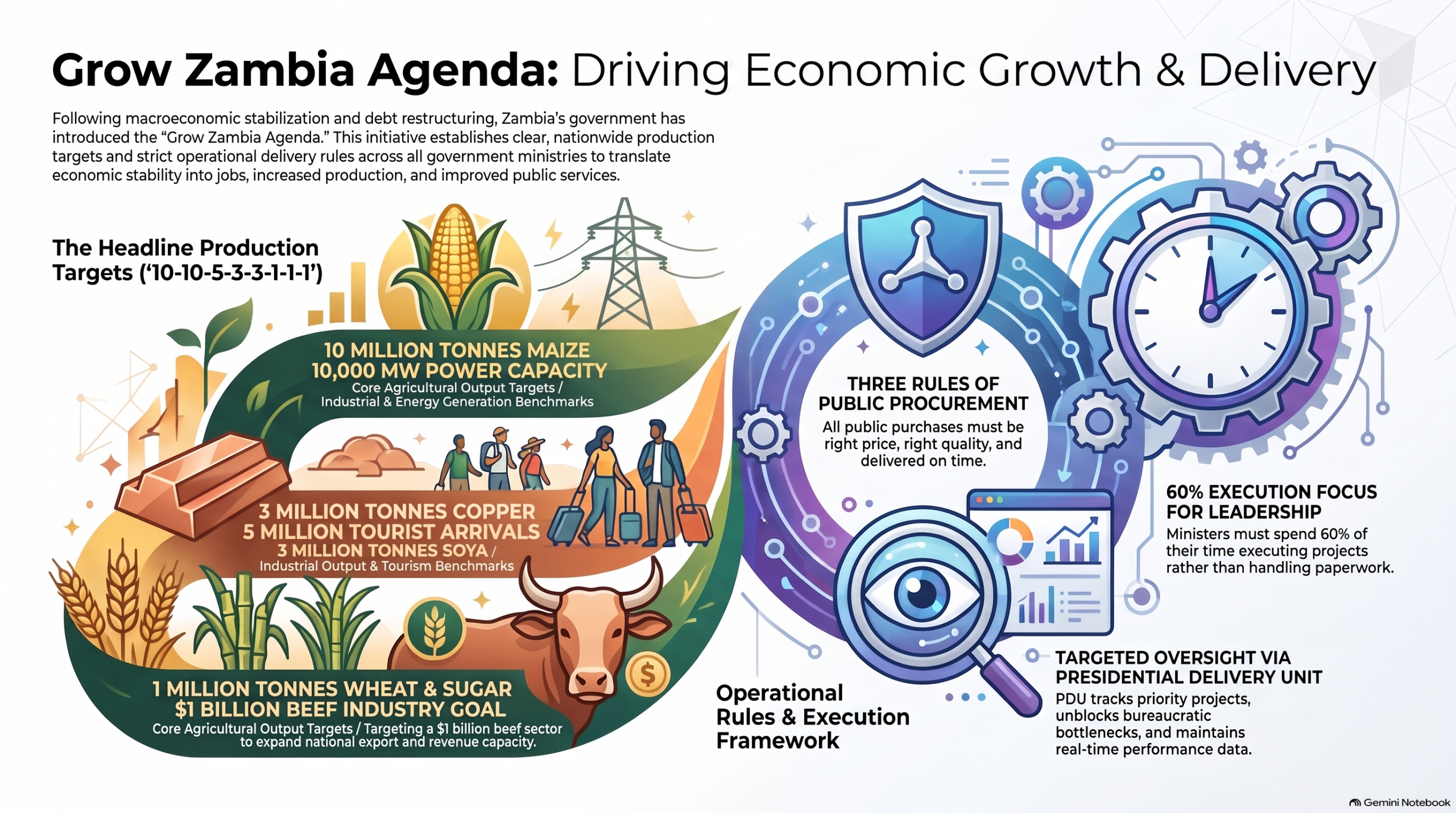
At the center of this blueprint is an empirical quantitative framework known as the “10-10-5-3-3-1-1-1” matrix, establishing explicit multi-sectoral production benchmarks. This model sets key operational targets comprising 10 million tonnes of maize, 10,000 megawatts of power generation capacity, 5 million annual tourist arrivals, and 3 million tonnes of annual copper output. Furthermore, the quantitative strategy incorporates agricultural diversification goals, including 3 million tonnes of soya beans, 1 million tonnes of wheat, 1 million tonnes of sugar, and the creation of a US$1 billion beef export industry.
Executing these targets relies on structural policy reforms, climate de-risking, and centralized delivery mechanisms. Under the Comprehensive Agriculture Transformation Support Programme (CATSP), agricultural policy is transitioning from traditional input subsidies toward credit-led facilities like the Sustainable Agriculture Financing Facility, alongside expanded irrigation and precision soil management. Energy diversification centers on rapid solarization and clean baseload generation to ensure uninterrupted power during severe droughts. Across government, the Presidential Delivery Unit enforces real-time performance tracking and ministerial accountability, while local funding under the Constituency Development Fund is realigned toward productive assets like local solar minigrids and crop storage hubs.
Decoding Zambia’s Economic Blueprint: 6 Counter-Intuitive Takeaways from the “Grow Zambia” Experiment
Introduction
How does a developing nation escape a crippling sovereign debt trap while simultaneously weathering the worst climate shock in a century?This is the central dilemma facing Zambia. Following years of severe macroeconomic mismanagement, a high-profile 2020 Eurobond default, and a devastating El Niño-driven drought in 2024 that wiped out 70% of its staple maize harvest, the landlocked Southern African nation sits at a decisive inflection point. Under President Hakainde Hichilema—whose “New Dawn” United Party for National Development (UPND) administration assumed power in 2021—the state is attempting a high-stakes pivot. It is moving beyond initial fiscal emergency interventions and debt restructuring under the G20 Common Framework toward an aggressive national economic recovery plan branded as the “Grow Zambia” Agenda .While national economic strategies in emerging markets are frequently dismissed as dry, technocratic boilerplate, Zambia’s blueprint breaks sharply from routine public administration. By establishing startup-style presidential execution units, re-engineering social ministries into direct revenue drivers, and enforcing private-sector operational discipline across the civil service, the Hichilema administration is executing a unique structural experiment.Decoding this strategy reveals six counter-intuitive takeaways that offer a compelling case study for emerging market analysts, policy architects, and institutional investors across the global South.
1. The “10-10-5-3-3-1-1-1” Formula: Zambia’s Cryptic Growth Code
At the center of the Grow Zambia Agenda lies a headline numerical target designed to double the country’s economic production capacity. Rather than relying on abstract annual GDP percentage growth targets, the strategy anchors national economic planning around eight tangible production targets to be pursued by 2030:
- 10 Million tons of maize
- 10,000 Megawatts of electricity generation capacity
- 5 Million tourist arrivals
- 3 Million tons of copper production
- 3 Million tons of soya beans
- 1 Million tons of wheat
- 1 Million tons of sugar
- 1 Billion USD beef industryThis target formula serves as an economic anchor around which secondary and tertiary value chains are required to align. The analytical logic is structural: heavy sectors cannot scale in a vacuum. Scaling copper production to 3 million tons requires massive, dependable baseload power, expanded rail networks, and heavy transport logistics. Unlocking a $1 billion beef industry requires smallholder livestock integration, rigorous veterinary services, cold storage networks, and international export channels. In turn, agricultural expansion requires rural electrification, expanded road networks, and regional grain storage.To prevent bureaucratic inertia from bottlenecking these key sectors, the administration has signaled that administrative delays will no longer be tolerated as an excuse for stagnant output.”No project will be stalled because someone is doing calculations that do not deliver the growth that we want…”
2. Monetizing Forests & Medicine: Why Social Ministries Are Now Profit Centers
Traditional state governance draws a strict divide between economic ministries (Finance, Mining, Commerce) and social or environmental ministries, which are typically managed as fiscal cost centers. Zambia’s experiment upends this division by requiring every line ministry to function as a direct revenue, productivity, and growth driver.Key structural re-engineerings include:
- Ministry of Green Economy and Environment: Re-engineered to act as a primary asset-monetization unit. It is tasked with converting natural resources into bankable capital through verified carbon credits—attaching monetary value to forest conservation and land restoration—and securing international green climate finance. Crucially, the policy creates direct financial incentives for local communities, providing economic alternatives to deforestation and charcoal production.
- Ministry of Foreign Affairs and International Cooperation: Realigned around “economic diplomacy.” Zambia’s foreign missions and embassies have been repurposed as international sales hubs tasked with securing foreign off-take markets for surplus maize, soya, sugar, and beef, while aggressively courting foreign direct investment (FDI).
- Ministry of Health: Reframed around local industrial production and import substitution. The ministry is tasked with catalyzing domestic pharmaceutical manufacturing to curtail foreign exchange leakage. Simultaneously, the state is investing in domestic health infrastructure—including $32 million in specialized cancer treatment technology across Lusaka, Ndola, and Livingstone—to keep medical expenditures within the national economy rather than exporting capital for overseas treatment.Crucially, this macro-level mandate relies on micro-operational civil service discipline as a prerequisite. President Hichilema has made it clear that public health staff idling on social media directly impairs state productivity.”Put the patient first… You cannot be on social media and the patient is screaming in vain…”
3. The Bureaucracy-Busting “Delivery Unit” and the 60/40 Execution Rule
To prevent policy mandates from dissolving into bureaucratic friction, governance inside State House has been disrupted through the establishment of the Presidential Delivery Unit (PDU) in March 2023. Headed by Kuso Kamwambi, the PDU functions as an internal operational accelerator. Operating under a Delivery Coalition that includes the Secretary to the Cabinet, the Secretary to the Treasury, and the Attorney General, the unit is structured around four priority operational pillars: Efficient Value Chains , Enhanced Public Services , Project Delivery , and Technology and Innovation .Rather than focusing on abstract policy drafting, the PDU tracks tangible, high-impact targets, including:
- Unlocking $1 billion in livestock exports by 2026.
- Expanding irrigation to guarantee 1.65 million tonnes of maize by 2026.
- Accelerating the deployment of 1,000 MW of solar power.
- Rolling out digital IDs to 800,000 citizens while transitioning legacy civil registration to a digital framework.To enforce institutional momentum, the presidency has imposed two rigid operational rules across cabinet ranks:
- The 60/40 Execution Rule: Cabinet Ministers are mandated to spend 60% of their time in the field actively supervising project execution, capping desk work and document reviews at 40%.
- The Three Rules of Public Procurement: All state purchasing and infrastructure contracts must strictly comply with three metrics: buy at the right price (eliminating inflated markups and corruption), ensure high quality, and deliver on time.Supported by weekly ministry check-ins, monthly deep dives with Permanent Secretaries, bi-monthly coalition meetings, and quarterly Presidential stocktakes, the PDU attempts to replace bureaucratic delay with real-time problem-solving.
4. High-Tech Ambitions vs. Low-Tech Realities: The Climate Paradox
Zambia’s economic blueprint highlights a stark paradox: high-profile macroeconomic momentum colliding with severe environmental vulnerabilities on the ground.On the macroeconomic front, international confidence has rebounded. Foreign debt reporting reflects a 5% drop in external debt (falling from $16.15 billion to $15.36 billion), marking a structural shift from debt accumulation to active servicing and restructuring under the IMF program. Global financial markets acknowledged this trajectory as J.P. Morgan prepared to include Zambia’s local-currency government bonds in its GBI-EM Edge frontier-market index. Industrially, Konkola Copper Mines restarted operations at its Chingola B Mine after an 18-year shutdown—targeting 200,000 tonnes of ore monthly—while mining hubs like Kalumbila expanded into 24-hour operational economies.Yet, this industrial expansion is heavily threatened by low-tech climate realities:
- The Hydro-Power Collapse: The 2024 El Niño drought crippled the Kariba Dam’s hydro-generation capabilities, causing severe, daily electricity rationing (load-shedding). This energy deficit directly threatens the 10,000 MW power target and threatens the broader goal of scaling copper production to 3 million tons.
- Public Discontent & Inflation: Severe power shortages triggered public protests under the banner “Fix ZESCO,” while agricultural supply shocks pushed inflation to 15–16% in 2024 and drove the Kwacha down to ~25 ZMW per USD.This tension has forced a pragmatic policy compromise on energy. To secure baseload power during severe droughts, President Hichilema has explicitly defended deploying clean coal technology alongside solar expansion, pushing back against green-purity critics who advocate for renewable expansion without acknowledging the immediate requirement for reliable, drought-proof baseload energy to keep the economy moving.
5. Non-Conviction Forfeiture and the One-Sided Anti-Corruption Dilemma
While the administration has prioritized operational efficiency, political and governance assessments—notably the BTI 2026 Country Report—highlight persistent tensions between state discipline, civic space, and judicial impartiality.On one hand, the government earned international approval for decriminalizing presidential defamation and passing the long-delayed Access to Information Act. On the other hand, civil society groups express concern over shrinking democratic space as the 2026 general elections approach. Opposition rallies continue to be restricted under the Public Order Act (POA), critical journalists face periodic police harassment, and alternative frameworks like the Cyber Security and Cyber Crimes Act are deployed against political dissenters.Concurrently, the state’s anti-corruption drive exhibits a complex dual reality:
- Non-Conviction-Based Asset Forfeiture: The state has increasingly utilized asset recovery mechanisms, allowing targets to surrender illegally acquired wealth in lieu of formal prosecution. Prominent cases include former radio personality Faith Musonda surrendering ZMW 65 million and a high-value mansion, and former KCM provisional liquidator Milingo Lungu forfeiting $24 million in funds allegedly siphoned from the mining firm.
- Selective Enforcement Charges: The Joint Investigations Team (JIT) and fast-track financial courts have focused heavily on figures linked to former President Edgar Lungu’s regime—such as the recent arrests of former First Lady Esther Lungu and her daughter Chiyeso Katete over property holdings. Meanwhile, corruption allegations within the current administration, including inflated fertilizer procurement contracts, have faced minimal formal scrutiny.
- ACC Institutional Breakdown: In July 2024, President Hichilema dissolved the entire board of the Anti-Corruption Commission (ACC). The collapse followed whistleblower allegations from board member O’Brien Kaaba, who publicly accused ACC Head Thom Shamakamba and Solicitor General Marshal Muchende of accepting payments to shield ruling party elites and negotiate unauthorized amnesties.This dynamic illustrates the institutional challenge facing emerging market reforms: when anti-corruption campaigns are perceived as selectively targeted against political opponents while internal governance falters, they risk undermining the long-term institutional credibility required to sustain foreign investor confidence.
6. The “Kitchen Table” Test: Macro Gains vs. Everyday Livelihoods
For civil society networks like the Civil Society for Poverty Reduction (CSPR) and professional bodies like the Economic Association of Zambia (EAZ), headline macroeconomic restructuring and international bond index inclusions mean little if they do not alter baseline household realities.Despite top-level fiscal adjustments, socio-economic distress remains acute. World Bank data indicates that 81% of Zambians lived on less than $3.65 a day in 2022 , with rural poverty rates climbing to 79%. Recognizing the disconnect between sovereign debt restructuring and daily survival, EAZ Secretary John Musantu established an explicit benchmark for the Grow Zambia Agenda:”…whether policies translate into jobs, lower cost of living, increased productivity, and inclusive growth.”To bridge this gap, the administration argues that its social investments must be evaluated through a non-traditional economic lens. Specifically, President Hichilema frames the implementation of free primary and secondary education not merely as a social welfare expenditure, but as an indirect liquidity transfer to ordinary families. By eliminating mandatory school fees, the state frees up disposable household income previously spent on education, allowing families to redirect capital toward basic food consumption, micro-investments, and informal trade.This liquidity mechanism is designed to work in tandem with direct state safety nets, including the expanded Social Cash Transfer Program (reaching nearly 1 million vulnerable households) and the decentralized Constituency Development Fund (CDF), which routes public infrastructure capital directly into local communities.
Conclusion: Can Top-Down Discipline Shield Against Bottom-Up Shocks?
Zambia’s “Grow Zambia” experiment represents an ambitious effort to manage state machinery with the operational discipline, quantifiable metrics, and execution speed of a enterprise corporate unit. By forcing ministries to operate as revenue centers, mandating that cabinet ministers spend 60% of their time in the field, and anchoring state planning around the rigid 10-10-5-3-3-1-1-1 formula, the administration is attempting to engineer national growth from the top down.Yet, as the state moves toward the 2026 electoral cycle, the ultimate viability of this blueprint will depend on its capacity to cushion vulnerable households against climate volatility, maintain political stability, and preserve institutional transparency. Zambia’s strategy poses a critical question for economic planners across emerging markets: Can a business-minded government format successfully engineer economic transformation from the top down when external shocks like climate change hit from the bottom up?