
From Democratic Beacon to Shadow State — President Hichilema’s Co-option of the Judiciary and Post-Election Security Crackdowns
Thu, Aug 20 2026 /Mpelembe Media/ — Zambia’s standing as a historically resilient multiparty democracy in Southern Africa has been severely tested by the events surrounding the August 13, 2026, general election, which critics argue represent a systematic campaign by President Hakainde Hichilema’s administration to dismantle the country’s democratic framework. Although Hichilema came to power in 2021 on a reformist “New Dawn” platform pledging to restore the rule of law and depoliticize the civil service, his administration has increasingly co-opted state institutions to eliminate political opposition and consolidate executive hegemony, fueling fears of an engineered “life presidency”. The run-up to the election was marked by rising authoritarianism, including the weaponization of the Cyber Crimes Act of 2025 to arrest independent journalists like MacPherson Mukuka and Thomas Allan Zgambo, as well as a proposed Non-Governmental Organizations Bill designed to grant the government excessive control over civil society groups. Tensions escalated further following the death of former President Edgar Lungu in June 2025, which fragmented the opposition, and the Constitutional Court’s retroactive disqualification of Lungu from contesting the 2026 elections.
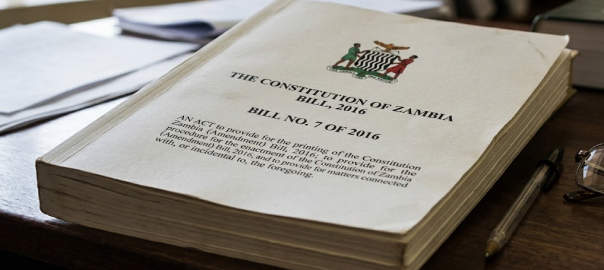
The core legal mechanism of Hichilema’s consolidation strategy is the Constitution of Zambia (Amendment) Act, No. 7 of 2025, commonly known as Bill 7. First published in May 2025, the bill was initially declared unconstitutional by the Constitutional Court in June 2025 due to a failure to engage in the mandatory public consultation required under Article 79 of the Constitution. To bypass this legal hurdle, Hichilema appointed a handpicked 25-member Technical Committee on Constitutional Amendments in October 2025 to provide a veneer of civic participation before reintroducing the bill. On December 15, 2025, amidst a complete boycott by the primary opposition Patriotic Front parliamentarians and the selective expulsion of dissenters, the National Assembly adopted the amended Bill 7 with a two-thirds majority of 135 votes in favor and none against. This sweeping legislation structurally weakened parliamentary checks and balances by expanding constituency-based seats from 156 to 211—enabling strategic gerrymandering of electoral boundaries—while replacing local by-elections with an internal party-controlled selection process to fill vacant seats. Furthermore, Bill 7 increased the number of presidentially nominated MPs from eight to ten, repealed critical candidate withdrawal protections designed to prevent the intimidation of opposition nominees, and granted the president the controversial authority to dissolve a non-compliant parliament.
The August 13, 2026, general election itself was characterized by severe institutional manipulation and a heavily securitized environment. Following the vote, when early results sheets indicated a lead for opposition challenger Brian Mundubile of the National Reconciliation Party for Unity and Prosperity (NRPUP), the Electoral Commission of Zambia—led by Hichilema’s former personal corporate lawyer—abruptly suspended the vote count for several hours under the guise of localized violence and stolen ballot papers. This unprecedented suspension prompted the controversial deployment of the national army to the capital city of Lusaka and sparked allegations of industrial-scale vote-rigging and ballot tampering. Despite deep concerns raised by the United Nations, the European Union, and local watchdog organizations over a severely restricted political playing field and discrepancies in the results chain, Hichilema was officially declared the winner on August 18, 2026, with approximately 60% of the vote. The NRPUP and its coalition allies immediately rejected the official declaration, accusing the government of manipulating tallied figures, and announced plans to file a legal challenge in the Constitutional Court, which Hichilema had strategically packed with loyalist judges prior to the election.
To suppress dissent and block the opposition’s legal recourse, the Hichilema administration launched a brutal post-election crackdown under the pretext of neutralizing an active, armed insurgent “militia”. On the night of August 13, 2026, joint military and police forces executed a heavily armed raid on Mundubile’s Kabulonga residence, resulting in an exchange of gunfire during which former Cabinet Minister and opposition MP Mutotwe Kafwaya was shot and killed. The state arrested eleven individuals at the scene, including Lungu’s son-in-law Patrick Mwansa, NRPUP spokesperson George Chisanga, and retired Anglican Bishop Trevor Mwamba. Although the government claimed the raid recovered high-grade military weapons from conspirators planning an armed coup, independent observers and opposition leaders dismissed the militia narrative as a complete fabrication designed to provide cover for political detentions. Mundubile and his running mate Makebi Zulu narrowly evaded capture and fled into hiding at a UN agency headquarters, while the government initiated plans for a broader wave of arrests targeting non-endorsing religious figures, journalists, and former military generals. This escalating state lawlessness and arbitrary detentions without formal charges prompted urgent appeals from UN Human Rights Chief Volker Türk, who demanded that Zambia immediately respect constitutional safeguards and the due process of law.
Zambia’s Democratic Paradox: 5 Surprising Realities Behind the “Bill 7” Crisis
In 2021, Zambia was the darling of the international democratic community. The “New Dawn” administration of Hakainde Hichilema ascended to power on a tidal wave of populist hope, promising a surgical excision of the authoritarian rot that had come to define the previous decade. Yet, by 2026, that optimism has curdled into a jarring political friction. The central mystery of this era is the saga of the Constitution of Zambia Amendment Act, No. 7 of 2025—infamously known as “Bill 7.”The trajectory of Bill 7 offers a chilling lesson in modern democratic decay: how a piece of legislation, explicitly declared “unconstitutional” by the nation’s highest court, can be resurrected and codified as the law of the land. To observe Zambia today is to witness a sophisticated legislative shell game where the players have changed, but the “familiar playbook” of power remains immutable.
1. The Resurrection of “Unconstitutional” Legislation
The journey of Bill 7 is a masterclass in procedural maneuvering designed to bypass judicial roadblocks. In June 2025, the Constitutional Court of Zambia struck down the Bill, ruling that the government had violated Article 79 by failing to conduct the “wide public consultation” required for fundamental constitutional shifts. The court was unequivocal: reform must be “people-driven,” not an executive fiat.Rather than accepting the spirit of the ruling, the executive branch treated it as a mere procedural glitch to be “cured.” By October 2025, Hichilema appointed a 25-member “Technical Committee” to perform a rapid-fire simulation of national consultation. This allowed the administration to reintroduce the Bill just months later. On December 15, 2025, the National Assembly adopted the Bill with a staggering 135–0 vote—a total achieved only because the opposition Patriotic Front (PF) staged a desperate boycott. The atmosphere was one of coercion; PF National Chairperson Jean Kapata had gone so far as to threaten any member who participated in the vote with immediate expulsion.As the 2025 ConstitutionNet analysis sharply observed:”While the changes are framed as efforts to enhance democratic representation and inclusivity, they raise important questions about democratic governance, executive overreach, electoral integrity, and the erosion of parliamentary independence.”
2. The Irony of the “Reformer’s Playbook”
The most unsettling takeaway for those who expected a clean break from the past is the cyclical nature of Zambian political repression. There is a profound irony in President Hichilema—a man who once occupied a prison cell on trumped-up treason charges—presiding over an administration that uses those very same tools against his rivals.In August 2026, Hichilema’s primary challenger, Brian Mundubile, was forced into exile following allegations of “armed insurrection” and a terrifying raid on his home by heavily armed personnel from the Zambia National Army. The state’s net extended further, snaring key opposition figures like spokesperson George Chisanga and Patrick Mwansa, the son-in-law of former President Edgar Lungu. This is not a new phenomenon; it is a structural blueprint. The 2025–2026 parliamentary purge mirrors the 2017 crisis under the Lungu administration, when Speaker Patrick Matibini suspended 48 opposition MPs for boycotting a presidential address.Tigere Chagutah of Amnesty International summarized this regression:“In 2021, Zambians voted in the hope for change following promises to respect human rights. Instead, authorities have resorted to the familiar playbook of using the law to criminalize peaceful dissent and silence independent media.”
3. The IMF Paradox: When Financial Lifelines Empower Autocracy
There is a counter-intuitive reality at the heart of Zambia’s current crisis: international financial stability is acting as a “moral hazard” for democratic norms. The $1.2 billion rescue package from the International Monetary Fund (IMF), intended to save the economy from the brink of bankruptcy, has inadvertently provided the “fiscal space for repression.”When a government faces imminent economic collapse, it is often forced to negotiate with domestic critics and adhere to international standards of governance to remain viable. However, the IMF lifeline has removed the immediate threat of insolvency, effectively emboldening the executive to pursue a hardline authoritarian strategy without fear of domestic accountability. By stabilizing the treasury, the IMF has essentially subsidized the administration’s ability to insulate itself from dissent. Economic assistance, it appears, is never politically neutral; in Zambia, it has become the silent partner in a democratic rollback.
4. Digital Shackles: The Shift to Cyber Suppression
While the Hichilema administration garnered international praise for abolishing the death penalty and repealing criminal defamation laws, it has simultaneously constructed a more modern apparatus of control. The gallows have been replaced by “digital shackles.”The Cyber Security Act and the Cyber Crimes Act of 2025 have become the primary instruments for neutralizing dissent. The “surprising” depth of this suppression was revealed in the arrest of MacPherson Mukuka. Mukuka was not just any journalist; he was an employee of the state-owned broadcaster, ZNBC. His crime? Recording a “Presidential Campaign Team” committee secretly discussing election tactics. When the state begins arresting its own broadcasters for practicing journalism under the guise of “defamation” or “harassment,” the message is clear: the digital square is no longer a safe space for public scrutiny.
5. The “Enlarged but Weakened” Parliament
Structurally, Bill 7 has fundamentally altered the National Assembly to ensure executive dominance. The legislation increased constituency-based seats from 156 to 211 and, crucially, expanded the President’s power to nominate additional members from eight to ten.The government’s justification was a classic appeal to pragmatism—framing the cancellation of by-elections as a “cost-saving measure.” However, the reality is a calculated concentration of power. By allowing political parties to internally fill vacancies rather than holding by-elections, the law effectively strips voters of their right to choose their representatives and hands that power to party leadership and the Presidency.A coalition of eleven civil society organizations issued a scathing rebuke of this move:”The proposal reduces the National Assembly’s independence, concentrates power in the hands of the President, and is inconsistent with democratic constitutional reforms and representative democracy.”
Conclusion: The Forward-Looking Summary
The history of Zambia from 2002 to 2026 reveals a haunting symmetry. In 2002, Levy Mwanawasa launched his “New Deal” with promises of reform; in 2021, Hichilema arrived with his “New Dawn.” In both instances, the gravitational pull of executive power eventually overcame the momentum of democratic change.When a “New Dawn” begins to look exactly like the “Old Deal,” we must ask: can a democracy ever truly break its cycle, or are the structures of power simply too heavy to shift? Upon signing Bill 7 into law on December 18, 2025, President Hichilema declared that “the debate is now behind us.” In reality, this declaration marks the beginning of a more volatile and uncertain chapter for Zambian civic space. The debate isn’t over; it has merely been driven underground.