Beyond Microservices: Why Autonomous AI Agents Demand a New Compute Paradigm
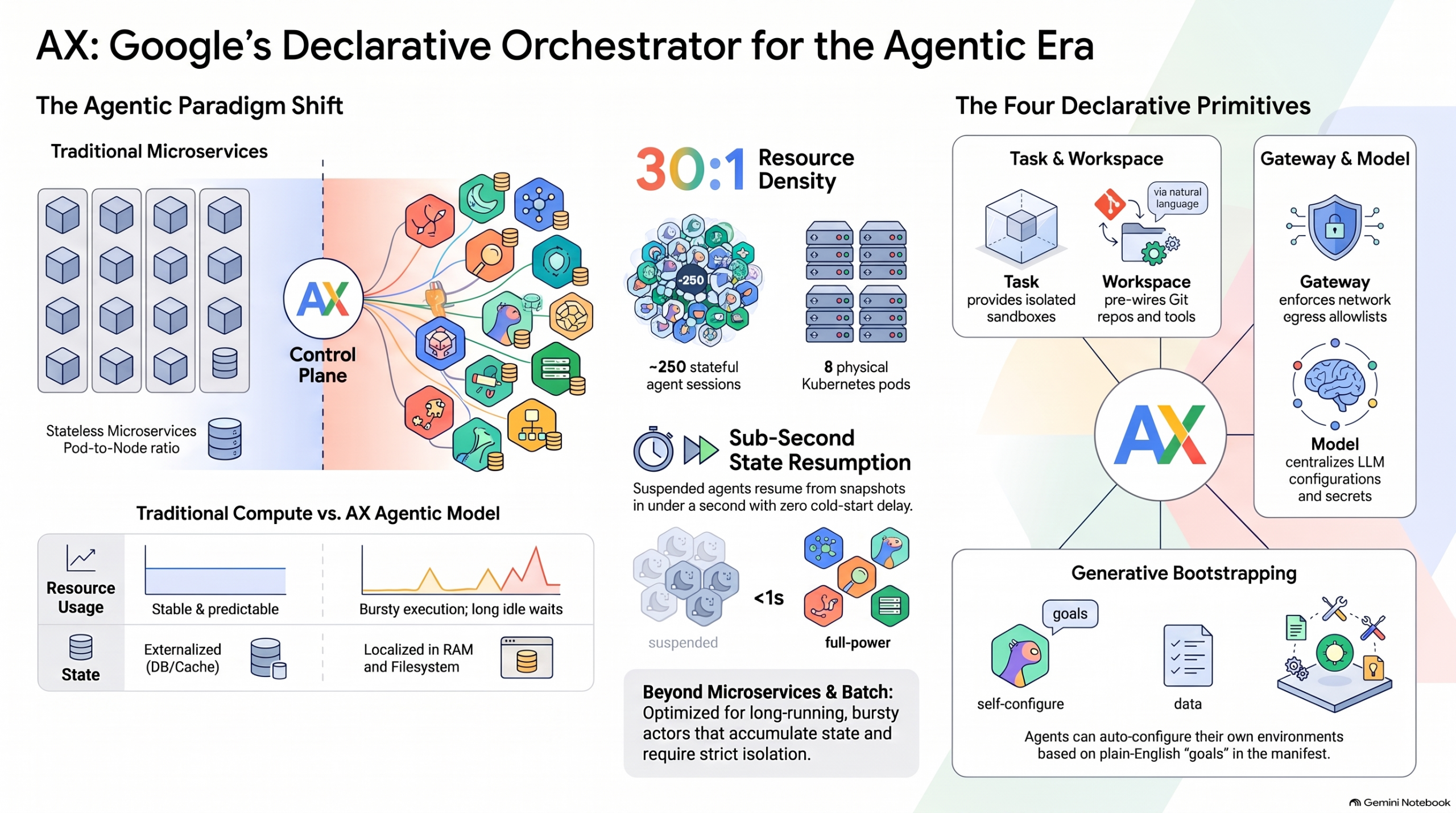
Sun 20 Sept 2026 /Mpelembe Media/ — Agentic workloads represent an entirely new compute paradigm that falls outside traditional cloud-native operational patterns. Unlike stateless microservices, which run as persistent processes with stable, predictable network traffic, or batch processing jobs, which execute linearly to completion with constant resource allocations, autonomous AI agents operate as stateful, long-running, and highly intermittent compute actors. An agent’s execution cycle typically consists of short bursts of intense localized computation—such as parsing context, executing generated code, or calling toolchains—punctuated by prolonged idle intervals spent awaiting remote model inference, tool execution returns, or human approvals.
From an operational and economic perspective, maintaining dedicated physical containers or pods during these extended idle phases is cost-prohibitive, yet tearing down environments between steps creates unacceptable cold-start latencies. As a result, agentic infrastructure relies on dense resource multiplexing combined with snapshot suspension and resumption rather than static container placement or sequential queue dispatch. When an agent enters an idle state, its running process state is snapshotted to persistent storage so physical compute can be deallocated for other active tasks, enabling the agent to be rehydrated in under a second when a new event arrives.
In terms of state management and security, traditional microservices externalize their state to databases or caches, whereas agentic actors accumulate state locally in RAM and the filesystem over complex, multi-step execution paths. Furthermore, because agents frequently execute untrusted, LLM-generated code and interface with external APIs, standard container namespace isolation is insufficient. Securing agentic workloads requires virtualized kernel boundaries (such as gVisor) paired with explicit network egress allowlists to prevent credential leaks and unauthorized outbound connections.
Beyond the Pod: Why Google’s AX is the “Kubernetes Moment” for AI Agents
1. The Billion-Dollar Idling Problem
For a decade, we’ve optimized cloud infrastructure for two predictable patterns: long-running stateless microservices and run-to-completion batch jobs. But as we move from simple LLM wrappers to autonomous agents, we’ve hit an architectural wall. The current container paradigm is economically and technically incompatible with the way agents actually work.AI agents are fundamentally “bursty.” An agent’s lifecycle is defined by seconds of intense computation—parsing context or executing code—punctuated by minutes or even hours of idling. They sit dormant while waiting for an LLM token stream, an external tool callback, or human-in-the-loop approval.In a standard Kubernetes environment, you face a ruinous choice: keep a dedicated Pod alive and “burn money in a loop” while the agent does nothing, or tear it down and suffer 10-second cold starts that kill the user experience. We are currently attempting to manage a stateful, intermittent actor model using tools built for a stateless, continuous world.
2. Takeaway #1: Agents are the “Third Kind” of Workload
To solve the idling problem, we must recognize that agents represent a distinct “third kind” of workload. They require a departure from the static scheduling of Kubernetes and the ephemeral nature of batch processing.”Agents are a new kind of workload. They are neither microservices nor batch jobs. They accumulate state, need strict isolation, call out to model APIs and tool servers, and can burn money in a loop if nobody is watching.”As a Senior Architect, the shift is most visible when you look at the isolation and scheduling boundaries:
| Compute Dimension | Stateless Microservices | Batch Processing Jobs | Agentic Workloads (AX Actors) |
|---|---|---|---|
| Execution Lifetime | Long-running, persistent | Ephemeral, run-to-completion | Stateful, intermittent actors |
| Resource Profile | Stable, predictable usage | High, constant allocation | Highly bursty, mostly idle |
| State Persistence | Externalized (DB/Cache) | Ephemeral / Block Storage | Accumulated in RAM/Filesystem |
| Scheduling Model | Static Pod placement | Sequential/Queue dispatch | Dense Multiplexing |
| Security Boundary | Namespace isolation | Shared host boundaries | gVisor Sentry (User-space) |
3. Takeaway #2: The 30:1 Density Miracle and the “Hotel” Analogy
Standard Kubernetes orchestrators struggle at agent scale because storing millions of short-lived Task objects in etcd causes massive control plane degradation. etcd has a ~10GB storage limit and transaction bottlenecks that simply cannot handle the high-frequency churn of agents.To bypass this, Google’s AX (Agent Executor) moves operational state to a dedicated Redis and Redis Streams architecture. The ax-server validates manifests and persists them as Redis hashes, while a horizontally scaled pool of ax-controller instances consumes events via Redis Streams.This architectural shift enables Dense Multiplexing . In production, AX can multiplex roughly 250 active agent sessions onto just 8 physical Kubernetes pods—a 30:1 oversubscription ratio.Think of it like a hotel with more guests than rooms. Most guests are out “sightseeing” (idle, waiting for an LLM response). The hotel (Agent Substrate) doesn’t pay for empty rooms; it only assigns a physical “room” (a worker pod) when a guest returns. The platform manages the “luggage” (the state) behind the scenes, ensuring that compute resources are only consumed when an agent is actively “thinking.”
4. Takeaway #3: “Instant Teleportation” with Sub-Second Resumption
To maintain the “Hotel” model without ruinous latency, AX implements a stateful actor suspension engine. This allows agents to “teleport” between hibernation and execution with sub-second rehydration times (< 1.0s) .The technical novelty lies in how AX manages the atelet and ateom-gvisor helpers to stream state:
- Interception: The ax-controller issues a suspension directive (e.g., via ax suspend).
- Checkpointing: Leveraging gVisor’s Sentry , AX snapshots the process’s full volatile RAM and local filesystem modifications.
- Storage: The snapshot is compressed and streamed as a state blob to high-throughput persistent storage like GCS.
- Deallocation: The worker pod is cleared, releasing CPU/RAM back to the cluster.
- Rehydration: When a callback hits the ateapi, the blob is streamed back into memory on any available worker.Why this is superior to standard OCI containers:
- Zero Cold-Start: Rehydration happens in <1s, compared to the 2-10s typical of pulling and starting new OCI images.
- Full State Preservation: Unlike standard Pods, AX snapshots the actual RAM image, meaning open file handles and local variables survive the suspension.
- Zero Compute Overhead: When an agent is suspended, it consumes 0% active compute, making billion-actor fleets economically viable.
5. Takeaway #4: Generative Workspaces—Infra in Plain English
One of the most tedious tasks for AI engineers is managing Dockerfiles for every unique agent requirement. AX introduces the Generative Platform concept to automate this.In an AX manifest, you can skip the manual environment setup by using a goal field: goal: “Set up a Python 3 development environment with pandas and numpy”On the “first boot” of a task, the ax-task-runner (the PID 1 process inside the sandbox) identifies this goal and hands it to the Antigravity agent . This internal agent inspects the workspace, installs the necessary toolchains, and verifies dependencies. Once the environment matches the goal, the Antigravity agent exits, and the primary command executes. This delegates the infrastructure “grunt work” to the platform, making workspaces truly declarative.
6. Takeaway #5: The Gateway as a Zero-Trust Safety Net
Running LLM-generated, untrusted code is a security nightmare. AX addresses this by leveraging gVisor , but with a specific focus on the network perimeter.The sandbox uses the Sentry , a user-space kernel written in Go that re-implements Linux syscalls. This creates a hard boundary: even if a guest process attempts a kernel exploit, it is trapped in user-space. However, for agents, the “actual risk” is usually egress—leaking API keys or hitting unauthorized endpoints.The Gateway primitive provides two critical defenses:
- Explicit Egress Allowlist: AX locks traffic to specific hosts and ports. If an agent tries to exfiltrate data to an unvetted IP, the packet is dropped at the perimeter.
- Credential Injection: Sensitive API keys are never exposed to the guest process memory. The Gateway intercepts outgoing requests to the LLM and injects authorization tokens from Kubernetes Secrets. This ensures that even if an attacker gains shell access to the sandbox, they cannot “see” the raw keys in RAM.
7. Conclusion: From Research Prototype to Production Fleet
AX is the transition from agent research to production-grade fleets. It is the low-level infrastructure control plane that sits beneath application-layer frameworks like LangGraph or AutoGen. While those tools handle the “logic” of the agent, AX handles the “grit”: the sandboxing, the Redis-based state management, the atespace isolation, and the sub-second lifecycles.By moving away from the etcd bottlenecks of standard Kubernetes and embracing the bursty, stateful nature of agents, AX provides the blueprint for how we will scale AI.As we move toward a world of billions of autonomous actors, the question for platform engineers is simple: Are you still trying to manage the AI future with tools built for a stateless world?