
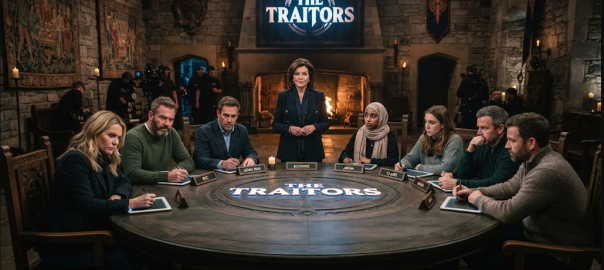
TV’s Golden Age of Treachery: Why The Celebrity Traitors Remains a Social Media Juggernaut
Fri 02 Oct 2026 /Mpelembe Media/ — The second series of The Celebrity Traitors has sparked a massive wave of live commentary, fan theories, and viral memes across X and TikTok following its premiere. A primary driver of current social media chatter is actor Richard E. Grant, who was chosen alongside Maya Jama as one of the initial Traitors. Grant immediately ignited viral reactions after accidentally confessing his Traitor status to the entire castle at the Round Table and attempting to pass it off as a joke, leading viewers to label him an instant series icon and compare his chaotic energy to former winner Alan Carr. The episode’s dramatic cliffhanger has further intensified online speculation, as Grant and Jama summoned comedian James Acaster and journalist Amol Rajan to plead for their survival inside coffins, leaving fans desperately debating on social feeds who will complete the Traitor trio and who will be eliminated. Beyond the round table drama, behind-the-scenes moments—such as host Claudia Winkleman revealing she had to hide in a bush because comedian Rob Beckett made her laugh during filming—have generated widespread TikTok edits. Combined with its gothic castle aesthetic and star-studded cast, the show continues to dominate online timelines and drive appointment viewing among younger Gen Z audiences.
5 Wild Reasons ‘The Celebrity Traitors’ Is Completely Rewriting TV Rules
How did a reality show about famous figures backstabbing each other in a Scottish castle solve television’s most daunting modern dilemma? At a time when traditional broadcasting is struggling to capture fragmented audience attention, The Celebrity Traitors has emerged as both a dominant pop-culture juggernaut and a digital media masterclass. Set against the gothic backdrop of Ardross Castle and presided over by the formidable, fringed host Claudia Winkleman, this hit series has completely rewritten the rulebook on how live entertainment captures the modern online ecosystem.
1. The Gen Z Miracle: Reversing TV’s Most Troubling Trend
Broadcast networks have spent years fretting over the loss of viewers under 25 to algorithmic digital feeds. Yet, The Celebrity Traitors executed a flawless linear-to-digital funnel, bringing younger demographics back to live, appointment viewing in droves.During the finale, overnight ratings revealed that a staggering 81.1% of 16-to-24-year-olds watching linear TV in its time slot were tuned into BBC One. Across its run, the series delivered unprecedented scale for modern broadcasting, averaging between 11 million and 14.9 million viewers and peaking at 15.4 million for its climax.This shift wasn’t a happy accident—it was driven by a sophisticated cross-platform strategy embracing the modern rule: the clip is the show, and the show is the clip . By building direct platform integrations with TikTok, launching companion content like The Celebrity Traitors: Uncloaked hosted by Ed Gamble, and actively fueling the online creator economy with clip-ready moments, the broadcast transformed passive viewing into a high-octane second-screen commentary event. The resulting fandom flywheel proved that linear TV can still command absolute cultural dominance when aligned with digital habits.”What I want is shows that have the 3Gs at their heart… shows that have three generations of people all watching together.” — Kate Phillips, BBC Chief Content Officer
2. The “Blabbermouth” Strategy: Richard E. Grant’s Instant Confession
The game theory behind The Traitors usually dictates stealth, calculated deception, and poker-faced discipline. Oscar-nominated actor Richard E. Grant threw rational strategy out the window the moment he got his wish.After begging host Claudia Winkleman to select him as a Traitor alongside Love Island presenter Maya Jama, Grant became so overcome with excitement that he blurted out his Traitor status to the entire castle almost immediately. He then attempted a desperate cover-up, framing his slip as a bizarre double-bluff. Winkleman later admitted that Grant was simply too “giddy” to contain his enthusiasm.Social media feeds instantly erupted, dubbing Grant the “new Alan Carr” and crowning him an unscripted icon of the series. Grant’s chaotic play stood in stark contrast to players like mathematician Prof. Hannah Fry, who attempted to deploy statistical analysis and Alan Turing codebreaking strategies to logically uncover the Traitors. Ultimately, Grant proved that raw celebrity ego and sheer, unscripted unpredictability will shatter cold, mathematical strategy every single time.
3. Hard-Man Unraveling: Ross Kemp’s Epic Paranoia
Classic screen archetypes disintegrate rapidly under castle pressure, creating pure psychological comedy. EastEnders star Ross Kemp—long established in pop culture as the ultimate screen hard-man—was initially embraced by his castmates as “the Daddy” leading early physical missions.However, the claustrophobic mental game triggered an immediate breakdown of trust. By the end of episode one, Kemp had unraveled into total paranoia, openly admitting he didn’t trust a single soul in the castle. Watching a seasoned action figure crumble under high-stakes social pressure delivered top-tier, unscripted television gold.”Ed Gamble called Ross Kemp’s paranoia one of ‘the funniest things I’ve seen on TV’.”
4. The Chapel of Death: Pleading for Survival Inside Coffins
The Celebrity Traitors continuously elevates reality cliffhangers into high-concept gothic theater. After their initial gameplay blunders, Traitor duo Maya Jama and Richard E. Grant were instructed to recruit a third accomplice from their biggest doubters: journalist Amol Rajan and comedian James Acaster.Summoned to the Chapel in the dead of night, Rajan and Acaster arrived believing they were about to be eliminated. Instead, they faced a tense face-to-face pitch session, forced to state their case directly to Maya and Richard as to why they should be recruited rather than murdered:
- James Acaster deployed cold tactical leverage, warning Grant that eliminating him would immediately focus all castle suspicion back onto Grant’s earlier slips.
- Amol Rajan weaponized his investigative background, pitching his professional skill set: “I sniff out lies for a living.”Only after these intense face-to-face pleas were delivered were both men placed inside actual coffins, leaving viewers on an agonizing cliffhanger as Claudia Winkleman slammed one lid shut to deliver the murder twist.”If I go tonight, the first person they’re looking at, is you.” — James Acaster
5. Host Hiding in Bushes: Unfiltered Castle Chaos
While the cinematic production values suggest a dark, scripted thriller, the show’s viral currency relies on a rare sense of authentic, unfiltered chaos. The pressure of the environment breaks down traditional PR polish, affecting players and production alike.Host Claudia Winkleman admitted to routinely corpsing (breaking character) during filming, even confessing she had to physically hide in a bush on the castle grounds after comedian Rob Beckett delivered a line too funny for her to maintain her stern host persona.This unscripted energy bled directly onto social media. When promotional headshots were released, Beckett publicly called out the heavy retouching on Instagram, writing, “What the fuck has happened to my face?” —prompting Maya Jama to join the viral banter by replying, “They did us all dirty tbh.” Combined with Joe Lycett candidly confessing he spent his entire castle stint “trying not to fart,” the show thrives because it breaks down traditional celebrity boundaries, integrating the cast directly into the internet’s meme ecosystem.The Celebrity Traitors has proven that broadcast television isn’t dying—it was simply waiting for the right blend of gothic drama, unpredictable celebrity egos, and a second-screen content ecosystem that allows audiences to participate live. In a game where double-bluffs backfire instantly and hard men crumble under psychological heat, can strategic logic ever truly defeat pure chaos—or are we all just destined to be fooled in the dark?