From Homelessness to Planetary Coexistence: Navigating the Future of AI and Ecology
Thur, May 28 2026 /Mpelembe Media/ — Yuk Hui is a prominent contemporary philosopher of technology whose work challenges the homogenizing force of Western technological universalism and platform capitalism. His philosophical project spans across several major books and themes, seeking to reimagine human coexistence with machines and the environment.
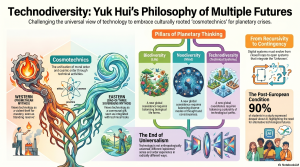
Cosmotechnics and Technodiversity Central to Hui’s thought is the concept of “cosmotechnics,” which he defines as the unification of the moral order and the cosmic order through technical activities. He rejects the idea that technology is an anthropologically universal monolith, arguing instead that different cultures have distinctly different historical and metaphysical approaches to it. For instance, while the Western Promethean myth treats technology as a tool to dominate nature (leading to the Earth becoming a calculable “standing reserve”), traditional Chinese philosophy integrates technical tools (Qi) with the cosmic and moral order (Dao). To counter the monoculture of Silicon Valley, Hui advocates for “technodiversity”—the active cultivation of diverse technological practices grounded in local epistemologies rather than reverting to reactionary nationalism or isolationism.
Digital Ontology, Recursivity, and Contingency In his works On the Existence of Digital Objects and Recursivity and Contingency, Hui explores the material reality of the digital age. He defines digital objects not just as code, but as entities composed of data and metadata that form a new type of materiality. Unlike traditional tools that act as archives of the past, digital objects possess “tertiary protension”, meaning they use predictive algorithms to actively anticipate and preempt human desires and actions. Hui traces this to the logic of “recursivity” in cybernetics, where algorithms continuously loop back on themselves, assimilating unexpected variables (contingencies) to self-organize and optimize.
Planetary Thinking and Sovereignty In Machine and Sovereignty and Post-Europe, Hui addresses the limits of the modern nation-state in governing interconnected crises like ecological collapse and the rise of artificial intelligence. He argues that the global synchronization of Western technoscience has led to a worldwide condition of Heimatlosigkeit (homelessness or rootlessness). Instead of retreating into xenophobic nationalism, Hui proposes “planetary thinking” and “epistemological diplomacy”. This approach transcends geopolitical competition by fostering a triad of coexistence: biodiversity, noodiversity (cognitive diversity), and technodiversity.
Critique of Platform Capitalism and Transhumanism Hui offers a sharp critique of the current digital economy, observing that technology monopolies operate primarily as financialized entities that extract value by transforming human life, leisure, and labor into algorithmic data. He argues against the deterministic and transhumanist visions of figures like Elon Musk and Ray Kurzweil, warning that treating the Earth as a mere spaceship or resource to escape from represents an extreme, apocalyptic surge in anthropocentrism.
Beyond the Silicon Valley Monoculture: 5 Provocative Lessons from Yuk Hui
Introduction: The Myth of the Global “Same”
We inhabit a world of seamless synchronization. From the high-rises of Shenzhen to the coffee shops of Berlin, we navigate the same glass-and-silicon slabs, scroll through identical minimalist interfaces, and surrender our attention to the same algorithmic feeds. This planetary-scale monoculture has birthed a quiet, powerful myth: that technology is “anthropologically universal.” We have come to believe that our tools are neutral, inevitable, and that we are all accelerating toward a singular, predetermined future.Chinese philosopher Yuk Hui—trained as both a computer engineer and a thinker in the lineage of Bernard Stiegler—is the one shattering this illusion. Hui argues that our current path is not a universal law of nature but a specific cultural product: a Western “operating system” that Martin Heidegger called Gestell , or “enframing,” which views the world solely as a standing reserve of resources to be calculated. By hollowing out cultural difference, this monoculture leads us toward a planetary-scale malaise. If we are to survive the Anthropocene, Hui suggests we must rediscover “technodiversity”—the possibility that there are multiple ways for technology and spirit to coexist.
Takeaway 1: Technology Is Not Universal—It’s “Cosmotechnics”
Hui’s foundational argument is that technology is never just a neutral “external apparatus.” It is intrinsically linked to a cultural worldview, a concept he terms cosmotechnics . While we assume a computer is simply a computer regardless of its geography, Hui argues that its implementation in society reflects a deep cultural logic. Cosmotechnics is the unification of the moral order and the cosmic order through technical activities.This is a radical departure from the modern idea of linear “progress.” In the West, we see a smartphone as a milestone on a single timeline. Hui, however, suggests that because worldviews differ across civilizations, there has never been a universal understanding of technology. Our current “global same” is merely the result of one specific cosmotechnics—the Western one—imposing itself as the only valid reality.”There are multiple ‘cosmotechnics’ across cultures: technology, besides external apparatus, is intrinsically linked to a cultural worldview. More specifically, technology is shaped by how people make sense of the world.”
Takeaway 2: The Mythic Divide: The Theft vs. The Gift
To understand why the West and East perceive automation and AI so differently, Hui looks back at ancient mythology. These stories are not just fables; they are “technical blueprints” that dictate how a society integrates or fears invention.
- The West (The Myth of Prometheus): In the Greek tradition, technology is born from theft and violent struggle . Prometheus steals fire from the gods, leading to Zeus’s punishment via Pandora’s Box. This “Promethean” blueprint views technology as a debilitating force that may eventually turn against its creator—a fear immortalized in Frankenstein and the modern “AI takeover” narrative.
- China (The Myth of the Three Sovereigns): In contrast, the sovereigns Fuxi, Nüwa, and Shennong are seen as gifting technical activities like hunting and cooking to the community. Here, technology is a tool for social and natural harmony.Because traditional Chinese thinking never enforced a strict distinction between nature and technology, the East often exhibits a “radical embrace” of AI and surveillance as essential instruments for maintaining the social fabric, rather than “Frankensteinian” threats to the natural order.
Takeaway 3: Your Smartphone is the New Factory Floor
Hui offers a stinging critique of “Platform Capitalism” and what he calls “Environmentalized Capital.” He argues that fixed capital—the machinery that used to be confined to factory floors—has leaked out of the building and into our pockets and homes. Through “smartification,” our very lives have become the infrastructure of production.In this system, the worker has transitioned from an “artisan” with agency to a “laborer of elements.” As gig workers or simple users, we follow algorithmic feedback loops that utilize “tertiary protension” —a technical term for algorithmic anticipation. Your phone doesn’t just record what you did; it pre-empts you, predicting your desires and optimizing your movements in real-time.Consider the “estimated delivery time” on a food app: the algorithm is a future-oriented agent that constantly reduces this window, forcing the human worker to move faster to meet a machine-calculated goal. Our “leisure time” is actually a new form of labor where our data is exteriorized and exploited to feed the “algorithmic governmentality” of the platform.”Fixed capital has left the factory and moved into smartphones, homes, and cities. The environmentalization of fixed capital in the name of smartification characterizes an algorithmic governmentality that effectively modulates transindividual relations.”
Takeaway 4: We Need “Technodiversity” to Survive the Anthropocene
If we continue on a singular technological path, we face ecological destruction. Hui’s solution is Technodiversity , which he places alongside two other essential pillars for planetary survival:
- Biodiversity: The preservation of biological variation.
- Noodiversity: The preservation of cognitive diversity—different ways of thinking and knowing.
- Technodiversity: The development of different “paths” for technology that are not dictated by Silicon Valley.Hui points to the launch of Sputnik in 1957 as a turning point; it was the moment “nature” as an unmediated mystery ended, and “ecology” was born as a technical artifact viewed from space. Since the Earth is now effectively a “Spaceship Earth,” we must move away from the Western Gestell that treats the planet as a battery to be drained. We need “homeotechnics”—technologies that cooperate with nature, such as agricultural systems based on Amazonian perspectivism or Chinese medical epistemology, which prioritize balance over raw optimization.
Takeaway 5: The Creative Power of “Becoming-Homeless”
Hui addresses the global feeling of Heimatlosigkeit (homelessness) caused by digital synchronization. As traditional cultures are uprooted, many feel a desperate urge to return to a “pure” past through reactionary nationalism. Hui rejects this as an impossible dream.Instead, he advocates for “becoming-homeless.” He grounds this abstract idea in the physical reality of the tongue —the most neglected technical organ. For the immigrant or the wanderer, the tongue must adapt to new languages while carrying the “corporeal memory” of the old. This tension is where new thinking is born. “Becoming-homeless” is a space for the “individuation of thinking,” a form of “epistemological diplomacy” where East and West can coexist without one erasing the other. It is not about a “neutralization of differences,” but about finding a productive tension that allows us to invent new ways of existing.
Conclusion: Navigating the Unknown
We have reached the limit of the Western blueprint for modernity. To navigate the crises of the 21st century—from climate collapse to the eschatology of machines—Yuk Hui suggests we need a new “planetary thinking.” This requires us to stop treating the Earth as a resource to be calculated and instead approach the world as the “Unknown.”If we can break the spell of the Silicon Valley monoculture and embrace a plurality of cosmotechnics, we may find that technology is not a Promethean theft we must be punished for, but a gift we can choose to redesign. If we stop viewing technology as an inevitable machine we must serve, what kind of “gift” could we choose to build for the next century?