
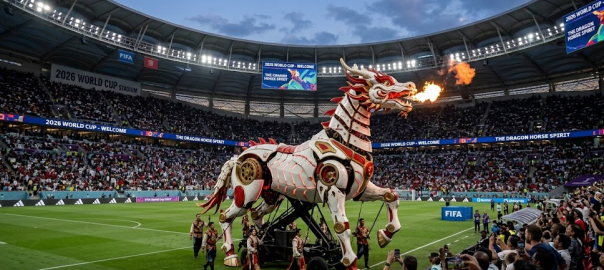
The Mythos of 1966: Sir Alf Ramsey, the Fire Horse, and the 60-Year Wait for World Cup Glory
Wed, Jun 17 2026 /Mpelembe Media/ — The psychological landscape of competitive sports is a high-stakes environment where the difference between victory and defeat often rests on an athlete’s ability to manage intense pressure and fluctuating emotions. In the quest for an edge, athletes frequently adopt specific behaviors to navigate this stress. These behaviors generally fall into two categories: those grounded in technical preparation and those rooted in “magical thinking.””Superstition is a behavior which does not have a clear technical function in the execution of skill, yet which is believed to control luck and/or other external factors. Rituals comprise magical thinking, belief in specific sayings, and ritualized behavior.”While the desire for victory is universal, the specific paths athletes take to achieve readiness vary wildly. Have you ever wondered why an elite striker insists on a specific pair of socks, or why a goalkeeper talks to the goalposts? Understanding the distinction between irrational rituals and professional routines is the first step in moving from a mindset of luck to a mindset of logic.
1. The 60-Year Cycle of the Fire Horse (1966 to 2026) In the Chinese zodiac, the Fire Horse is a rare astrological event that occurs only once every 60 years. The Horse naturally symbolizes speed, energy, and freedom, but the Fire element acts as “rocket fuel,” resulting in a year characterized by explosive passion, trailblazing personalities, and intense disruption. The last Fire Horse year was 1966, a year defined by monumental societal upheaval—including the Cultural Revolution in China, Civil Rights protests in the U.S., the escalation of the Vietnam War, and the Space Race. The superstition surrounding the Fire Horse’s headstrong energy was so intense that Japan’s birth rate dropped by 25% in 1966. Astrologers view the Fire Horse energy not as a doomed fate, but as a “weather report” for 2026, predicting a year of highly competitive sports fever, geopolitical shifts, and the necessary destruction of old systems to build new breakthroughs.
2. Tactical Genius and the Legacy of the 1966 World Cup The year 1966 also marked England’s first and only World Cup victory, an event deeply tied to the Fire Horse’s sporting euphoria. This triumph was fundamentally driven by Sir Alf Ramsey’s tactical innovation. Ramsey abandoned the globally popular 4-2-4 formation to deploy a groundbreaking 4-3-3 or 4-3-1-2 system, earning his team the nickname “the wingless wonders”. By instructing players like Martin Peters and Alan Ball to tuck inside rather than hug the touchlines, England achieved a 3v2 numerical superiority in the midfield, baffling opposition marking structures and prioritizing defensive stability. Sixty years later, this solitary victory remains a unique monolith in English culture—acting simultaneously as a blessed memory, a psychological burden, and the ultimate benchmark for the nation’s footballing identity.
3. The Psychology of Football: Rituals, Gamesmanship, and Bullying The sources heavily explore the psychological landscape of competitive sports. On an individual level, athletes frequently rely on pre-performance rituals to manage cognitive anxiety and create an “illusion of control” over unpredictable outcomes. On the pitch, psychological manipulation takes the form of gamesmanship—such as exaggerated time-wasting or deliberate distraction—which is often viewed as a subtle mix of genius and cheating to gain a competitive edge.
Off the pitch, the professional football dressing room is a highly enclosed, institutionalized environment. It is governed by a culture of hyper-masculinity where players are expected to be “thick-skinned” and hide their weaknesses. In this setting, the line between light-hearted banter (which builds team cohesion) and bullying (which is repetitive, targeted, and emotionally harmful) is frequently blurred. Players often disguise discriminatory language, psychological abuse, and hazing as “just banter,” leading to a culture of organizational silence where victims fear being labeled a “snitch” if they blow the whistle.
4. Predicting the 2026 World Cup: Astrology and Betting Markets Looking toward the 2026 World Cup, predictive markets and astrological forecasting offer distinct approaches. Astrologically, the 60-year cycle favors teams whose founding charts align with the Wood/Fire elements of the 2026 tournament. England and Germany (the 1966 finalists) both have strong astrological alignments for 2026, alongside Argentina and a wild card, Uruguay.
From a sports betting perspective, history warns against backing the heavy favorites. Since 1978, the pre-tournament favorite has only won the World Cup about 30% of the time, succumbing to the “Favorite’s Curse”. Public betting heavily skews odds for famous brands like England and Brazil, systematically underpricing mid-tier European or South American teams. Bettors are advised to look for historical value in these “Second-Tier” favorites and to factor in the “Host Bump,” which traditionally sees host nations drastically overperform their initial odds.
The 60-Year Echo: 5 Surprising Reasons Why 2026 is the Year of the “Fire Horse”
As the lunar calendar pivots toward 2026, we approach a rare astrological and historical meridian. In the Chinese zodiac, the 60-year cycle creates a specific resonance where twelve animals and five elements converge. The upcoming year marks the return of the Yang Fire Horse (火马), a combination so volatile it is often called the “Solar Pacemaker.”This is no mere transition; it is a point of powerful illumination. The Fire Horse initiates a period of “warp speed” energy, a once-in-a-lifetime celebration of vigor that last appeared in 1966 and will not return until 2086. To the cultural anthropologist, these years are markers of disruption—the same energy that fueled the Battle of Hastings in 1066 now prepares to set the pitch of the 2026 World Cup ablaze.
1. The Ghosts of 1966: Cerebral Radicalism and the “Wingless Wonders”
History suggests that Fire Horse energy acts as a catalyst for industry-shaking breakthroughs, stripping away traditional “codes of conduct” to reveal more efficient, albeit jarring, truths. The most enduring example in sports history is England’s 1966 World Cup victory. Under the leadership of Sir Alf Ramsey, the team debuted a system of “cerebral radicalism” that the world had never seen.Ramsey discarded the traditional wing-heavy formations of the era in favor of a 4-3-3 that prioritized defensive stability and midfield density. The press, baffled by this departure from “the beautiful game,” dubbed them the “wingless wonders.” This was the Yang Fire quality of illumination in action—incinerating the superficial to reveal a new tactical meridian. Central to this success was the selection of Nobby Stiles, a player the establishment viewed with visceral disdain.”The FA even wrote to Ramsey prior to the tournament to suggest he stop picking Nobby Stiles because he was nothing more than a scrappy dogged shitkicking midfielder. But Stiles arguably was the most important player to England in this system.”Ramsey’s refusal to conform to the FA’s sensibilities allowed England to exploit a “Horse Year” dominance that stretches back even further. History shows that Uruguay won the first-ever recognized World Cup in 1906 (a Fire Horse year) and the first FIFA-sanctioned tournament in 1930 (a Metal Horse year). The 2026 cycle isn’t just about football; it’s about the recurring “Horse” signature of those who dare to blaze new, unconventional paths.
2. The Crucible of the Chalk: Why Favorites Falter
| Metric | “Favorite’s Curse” (Top Tier) | “Second-Tier” Winners |
| Historical Win Rate | Approximately 30% | Approximately 70% |
| Notable Examples | Brazil (+450 in 2022 – Exit QF) | Italy (+1100 in 2006), Argentina (+1000 in 2022) |
| 2026 Outlook | England, Brazil (Systematic overpricing) | Uruguay, Germany (Astro-value) |
The 2026 astrological metrics further complicate the field. Germany, a traditional powerhouse, faces a difficult “Ox-Horse Harm” signature—a conflict between Germany’s “Earth Ox” day foundation and the “Fire Horse” year—and carries the inauspicious “Brutal Defeat” star.Perhaps most provocatively, the 3:00 PM “Monkey Hour” kickoff for the 2026 Final suggests a team will leave the pitch feeling “robbed.” This echoes the 1966 final’s controversy, where a disputed goal shaped football culture for sixty years. Conversely, Uruguay emerges as the 2026 “Wild Card,” benefiting from “The Noble Pair of Yin and Yang” star and a “secret friendship” with the Horse year that mirrors their historical dominance.
3. The Psychology of the Pitch: The Illusion of Control
The volatility of a Fire Horse year creates a psychological environment where the “illusion of control” becomes a survival mechanism. In high-stakes environments, we see a sharp “Dividing Line” between productive performance and irrational magical thinking.
- Pre-performance Routines: Controlled, conscious cognitive strategies (imagery, relaxation) that improve effectiveness.
- Superstitious Rituals: Unstable, irrational behaviors—like touching the grass or wearing “lucky” underwear—based on the belief that external magical powers dictate fate.This psychological tension fuels the debate over “Gamesmanship.” Is it tactical cunning or plain cheating? We see this in the antics of goalkeepers like Boubacar Barry in the 2015 AFCON final, who feigned injuries to unsettle opponents. In the locker room, this creates a social friction where “banter”—intended as a pro-social vehicle of light-heartedness—can quickly sour into systemic bullying or victimization. The Fire Horse does not tolerate the middle ground; it forces a confrontation with the “Dividing Line.”
4. Beyond the Stadium: The Superstition That Shaped Nations
The power of the Fire Horse legend is most visible in its historical impact on national demographics. In 1966, Japan experienced a staggering 25% drop in its birth rate . This was driven by a deeply rooted superstition that women born in Fire Horse years were “too strong-willed” and would bring misfortune to their households.The anthropological irony of this “Dark Horse” omen is that the women born in 1966—including Halle Berry, Janet Jackson, and Salma Hayek —became the preeminent barrier-breakers and superstars of their generation. They did not bring “bad luck”; they brought an “unstoppable energy” that upstaged convention. Their success refutes the superstition, proving that the Fire Horse’s grit is a symbol of “superstar” status for those who can harness its heat.
5. Conclusion: Unbridled Potential
The 2026 Fire Horse cycle is defined by the “Dragon Horse Spirit” (龍马精神). This concept is rooted in an ancient legend: when a wildfire threatened their valley, an old dragon and an aged horse refused to flee. The dragon summoned his powers to fight the flames while the horse charged through the fire to lead others to safety. This spirit represents vigorous vitality regardless of age—wisdom and action in perfect fusion.As the “Solar Pacemaker” takes the reins, 2026 is a year to embrace your authentic, untamable self and “burn away what no longer serves you.” The energy of this year demands transformation rather than stagnation.As we enter this rare convergence, the question remains: Will you run toward what sets your soul on fire, or will you stay tethered to the ghosts of the past?