
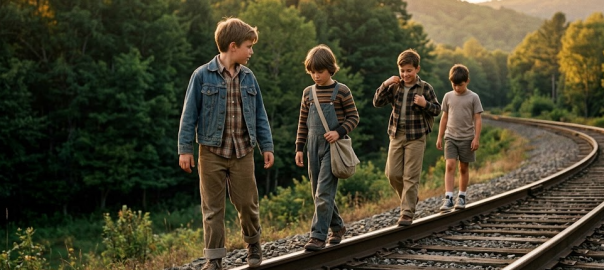
Sun, May 3 2026 /Mpelembe Media/ — The physical trek to find the missing boy, Ray Brower, serves as a profound metaphor for the transition from childhood to adulthood. What begins as a youthful adventure to become local heroes quickly transforms into a journey of internal healing and self-discovery. By separating the boys from the critical eyes of their hometown, the isolated setting acts as a pressure cooker that forces their hidden traumas—such as physical abuse, parental neglect, and societal prejudice—to the surface.
A central element of this loss of innocence is the confrontation with mortality. The boys begin the journey with the typical childhood feeling of invincibility, but the reality of seeking a dead body forces them to come to terms with the inescapable nature of death. Ray Brower’s body acts as a placeholder for this mystery; finding a deceased child their own age forces them to recognize their own mortality and allows Gordie, in particular, to process the profound grief of losing his older brother.
Various obstacles and symbols along the journey further map out this coming-of-age experience:
- The Train Tracks: The tracks the boys follow represent the rapid speed at which children grow into adults, symbolizing the dangerous and adventurous path of adolescence.
- The Leeches: When the boys fall into a swamp and discover they are covered in leeches, it symbolizes the untamed and uncertain terrain of youth, stripping away their playfulness and abruptly forcing them to “stop playing around”.
- The Gun: The stolen pistol is a universal symbol of danger and the masculine realm of adulthood. When Gordie eventually points the gun at the older bully, Ace, to protect his friends, it marks a significant turning point in his character; Gordie acknowledges the genuine weight of death and asserts his newfound maturity.
Ultimately, the journey captures an ephemeral childhood summer wrapped in a desperate fear of growing up and facing change. As the boys navigate physical dangers and share emotional, late-night campfire confessions, they rely on the healing power of their friendship to cope with a world that is often unsafe for children. The bittersweet realization that childhood innocence is gone forever is cemented by the narrator’s famous concluding thought: “I never had any friends later on like the ones I had when I was twelve”. This illustrates that while the boys must inevitably drift apart and leave their innocence behind, the profound impact of their shared journey will remain with them forever.
The Body, The Bond, and the Cookies: Why ‘Stand By Me’ Remains the Ultimate Time Capsule of Childhood
1. Introduction: The Universal Hook of Age Twelve
“I never had any friends later on like the ones I had when I was twelve. Jesus, does anyone?”This closing sentiment from Rob Reiner’s 1986 masterpiece Stand By Me does more than just end a film; it articulates a universal truth about the human condition. For forty years, this story—originally born from the mind of Stephen King as the novella The Body —has served as the physical embodiment of nostalgia for audiences worldwide.The premise is deceptively simple: four young boys set out on a Labor Day weekend journey in 1959 to find the body of a missing peer. Yet, beneath the surface of this mid-century adventure lies a profound exploration of friendship, grief, and the sudden realization that childhood is finite. As a cultural historian, I find that the film’s power lies in its manufacture of memory—a blend of “method” casting and a sonic landscape that haunts the viewer long after the credits roll.
2. The Metaphor of the Mortal Horizon
While the plot focuses on the search for Ray Brower, the journey is a visceral metaphor for the transition from innocence to experience. The boy’s body is the destination, but the true narrative arc is what the boys find within themselves along those rusted rails. The train tracks represent a “one-way” journey toward the realization of mortality. As the boys move further from the safety of Castle Rock, they walk toward a version of themselves—represented by Ray Brower—that has been “stopped” by the world.As noted by cultural commentators reflecting on the film’s existential weight:”That search for the kid’s body is such a good, well-integrated metaphor about the ending of childhood… it is the death of their adolescence.” — LuminaTitanThe tracks themselves serve as an arrow pointing toward the inevitable end of youth’s perceived invincibility:”You’re invincible as a kid, but then one day it hits you. You’re born, you get some time, you die. One way. Nonstop.” — punchboy
3. The “Method Casting” of Reiner’s Protagonists
Director Rob Reiner achieved an unparalleled sense of authenticity by selecting four young actors who did not just play the characters—they fundamentally were them. Reiner didn’t just look for talent; he looked for souls that mirrored the script. This “method casting” allowed the internal lives of the actors to bleed into their performances.
- Wil Wheaton (Gordie): Sensitive and “uncomfortable in his own skin,” Wheaton mirrored the quiet, aspiring writer seeking an identity outside of his parents’ grief.
- River Phoenix (Chris): A natural leader and a protective father figure to the other boys, Phoenix carried a wisdom and a burden far beyond his thirteen years.
- Jerry O’Connell (Vern): Cast for his genuine comedic timing, O’Connell was the upbeat, literal-minded anchor of the group.
- Corey Feldman (Teddy): Carrying “unbelievable anger” and the scars of a tumultuous, abusive relationship with his parents, Feldman’s performance was fueled by his actual lived experience.As Wil Wheaton later reflected:”When you saw the four of us being comrades, that was real life, not acting.”
4. The Telephoto Illusion and the Sonic Ghost
To understand Stand By Me is to understand its technical wizardry. The “train on the trestle” scene is a masterclass in “telephoto compression.” To ensure the cast’s safety during the week-long shoot, Reiner used a 600mm long-focus lens. The train was actually at the far end of the trestle while the boys were at the opposite end; the lens compressed the distance to make them appear inches apart. For the most dangerous running shots, the production utilized four small adult female stunt doubles with cropped hair to stand in for the boys.But the nostalgia is also manufactured through a “sonic ghost.” Composer Jack Nitzsche utilized a slow, Muzak-like version of “Stand By Me” that lacks drums and vocals, symbolizing how a song is remembered rather than how it is heard. He famously used “ambient pads” that sounded like wine glasses to create a meta-melody representing memory. This auditory choice creates a haunting atmosphere where the past is constantly bleeding into the present.
5. The Cookie Myth and Hotel Chaos
Behind the scenes, the cast’s behavior was a whirlwind of adolescent rebellion. The four boys engaged in constant mischief at their Oregon hotel, fixing lobby video games to play for free and throwing poolside furniture into the water. In one famous incident, River Phoenix—spurred on by the others—unknowingly covered Kiefer Sutherland’s car in mud, only to be terrified when the elder actor confronted him.However, the most enduring piece of trivia is the “Renaissance Fair Incident.” While often remembered as a “brownie” story, the reality is more specific: the cast and crew purchased pot cookies . Two hours after consumption, production was forced to shut down when Jerry O’Connell was found crying in a field, lost and completely disoriented.Even the film’s finances carry the weight of the broader “King Universe.” When the boys pool their money, the total is exactly $2.37 . This number—237—is a recurring Easter Egg in King’s work, most famously appearing as the forbidden room in The Shining and Red’s cell number in The Shawshank Redemption .
6. Stephen King’s Visceral Reaction
Stephen King is a famously difficult critic of his own film adaptations, yet Stand By Me moved him to a degree few other films have. After a private screening, Reiner observed that King was “visibly shaking” and unable to speak. He had to leave the room for fifteen minutes to compose himself.Upon his return, King offered his definitive praise, calling it the “best film ever made out of anything I’ve written.” He recognized that Reiner had perfectly captured the heart of the novella. The film’s title was famously changed from The Body to Stand By Me because the studio feared the original title sounded like a bodybuilding film, a sex film, or another typical Stephen King horror movie.
7. The 40-Year Brotherhood and the Empty Chair
The legacy of the film has taken on a surreal, heavy weight in recent years. As the surviving cast prepared for the 2026 “40th Anniversary Tour,” tragedy struck again. In December 2025, the film’s leader and hero, director Rob Reiner, was murdered in a domestic tragedy.Corey Feldman, Wil Wheaton, and Jerry O’Connell processed the news via a group text on the first night of Hanukkah, watching the tragedy of their “father figure” unravel in real-time. This loss has transformed the 2026 tour into a wake. During Q&A sessions, an “Empty Chair” is now left on stage—not just for the late River Phoenix, who died in 1993, but as a silent tribute to the childhood and the leadership that died on those tracks.The film’s DNA remains visible in modern hits like Stranger Things . The parallels are intentional: the search for a missing child with a strikingly similar name ( Ray Brower vs. Will Byers ), the iconic train track imagery, and the character archetypes. Mike serves as the “Chris Chambers” mediator, while Eleven mirrors Gordie—both characters capable of carrying profound emotional weight through scenes entirely without dialogue.
8. Conclusion: A Final Thought for the Reader
Stand By Me endures because it captures the precise second you realize that your childhood is over and the world is a place where accidents happen, leaders fall, and friends drift apart. It is a study of a fleeting moment of bliss before the distractions of adulthood take hold.The film leaves us with the bittersweet truth that even the closest bonds can be severed by time, yet their impact remains indelible. We are left to ponder the film’s haunting final question, which feels more poignant now than ever:”I never had any friends later on like the ones I had when I was twelve. Jesus, does anyone?”