Tag Archives: Autonomous agent

03Jun/26

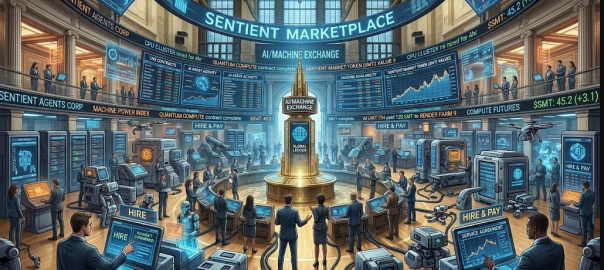
The “Sentient” Marketplace: How AI Agents Hire and pay Machines

The Mpelembe Agent Architect (also referred to as the Silicon-Native Agent Architect) is a comprehensive technical blueprint and decentralized infrastructure platform designed to securely deploy and govern autonomous AI agents

Wed, Jun 03 2026 /Mpelembe Media/ — The Sentient Economy (also referred to as the “Agentic” or “Machine Economy”) represents a fundamental shift from a human-operated digital environment to a decentralized network driven by autonomous, “silicon-native” AI agents. Unlike traditional chatbots that passively wait for human instructions, these autonomous agents proactively reason, allocate capital, and collaborate across organizational boundaries to execute complex, revenue-generating workflows. By 2030, this machine-to-machine economy is projected to mediate between $3 trillion and $5 trillion in global commerce. Continue reading

Architecting for Autonomy: Building the Data Foundations for Enterprise AI Agents

From Chatbots to Digital Workers: The Infrastructure Fueling Autonomous AI

Mon, Jun 01 2026 /Mpelembe Media/ — The Evolution to Agentic AI The enterprise landscape is rapidly transitioning from reactive chatbots to autonomous AI agents capable of perceiving their environment, reasoning, planning, utilizing tools, and taking independent action to achieve complex goals. Unlike traditional automation which relies on rigid, pre-defined rules, these systems can dynamically adapt to new information and coordinate multi-step workflows across various domains, such as healthcare, finance, customer service, and supply chain management. Continue reading

26May/26

Inside the Agentic Enterprise of 2026

The Age of Autonomy: How Multi-Agent Systems are Redefining Enterprise AI in 2026

Tue, May 26 2026 /Mpelembe Media/ — In 2026, the technology landscape has firmly transitioned from conversational generative AI to autonomous, multi-agent AI ecosystems. Rather than waiting for step-by-step human prompts, these AI agents can independently reason, plan, use tools, and collaborate to execute complex workflows across enterprise systems. Continue reading

14May/26

Your AI is now an autonomous coworker

Meet Your New Digital Coworker: 15 AI Workflows Redefining Small Business Operations

Thur, May 14 2026 /Mpelembe Media/ — Anthropic has officially launched Claude for Small Business, an intelligent operating layer built into its desktop agent, Claude Cowork, designed to automate complex, multi-step administrative tasks for SMBs. Moving beyond a traditional chatbot interface, this package embeds directly into the software stack small businesses already rely on, connecting to platforms like Intuit QuickBooks, PayPal, HubSpot, Canva, Docusign, Google Workspace, Microsoft 365, and Slack. Continue reading

23Mar/26

How AI agents spend your money

The Rise of the Agentic Economy and Machine-to-Machine Commerce

March 23, 2026 /Mpelembe Media/ — The digital economy is undergoing a massive paradigm shift from human-centric web browsing to an “Agentic Web,” where autonomous AI agents act as the primary economic participants. These agents are evolving beyond simple chatbots into sovereign entities capable of discovering services, negotiating, and executing transactions at machine speed without human intervention. This multi-trillion dollar market expansion is being powered by blockchain infrastructure and stablecoins, utilizing specialized protocols like x402, which revives the HTTP 402 “Payment Required” status code to enable seamless, sub-cent micro-transactions for APIs, compute power, and data access. Continue reading

22Mar/26

The Death of the Prompt and the Rise of the Solo Unicorn

Rise of the One-Person Unicorn: How Solo Founders are Leveraging AI Agents to Achieve Billion-Dollar Scale
March 23, 2026 /Mpelembe Media/ — By early 2026, the relatable curiosity of 2024’s chatbot experiments has curdled into a high-stakes operational necessity. We have crossed the “inflection point” where AI transitioned from a probabilistic engine—something we play with—to an operational workforce that performs revenue-generating labor.The numbers tell a story of total market saturation. The agentic AI sector has exploded from a $5.25 billion valuation in 2024 to a projected $52.6 billion by 2030. In 2024, Sam Altman’s prediction of a one-person billion-dollar company sounded like Silicon Valley hyperbole; today, it is the new baseline for capital efficiency. As institutions face the “math cliff” of 2026—a convergence of labor shortages and regulatory pressure—the shift from interactive tools to autonomous “digital colleagues” is no longer optional. It is the only way to stay solvent in a world where AI doesn’t just answer questions; it executes objectives.

Continue reading

22Feb/26

From Hype to Autonomy: How Vertical AI, Agentic Ecosystems, and Next-Gen Infrastructure are Reshaping the Enterprise

The End of the AI Experiment: 5 Seismic Shifts Redefining the Enterprise

Feb 22, 2026 /Mpelembe media/ — This report outlines a massive shift toward Vertical AI, where specialized models and agents are tailored to the unique workflows and regulations of specific industries like healthcare, finance, and legal services. Unlike general-purpose systems, these tools leverage deep domain expertise to solve niche challenges, driving significant improvements in productivity and operational margins. Market data indicates a surge in venture capital investment, with AI expected to maintain an aggressive annual growth rate through 2030. Key trends highlight the transition from simple assistants to agentic AI, which can autonomously execute complex, multi-step tasks across fragmented data systems. However, organizations still face hurdles, including technical skill shortages, data privacy concerns, and the necessity of redesigning traditional business processes to be “AI-ready.” Ultimately, the landscape is evolving into a specialized ecosystem where industry-specific integration provides a more durable competitive advantage than broad, horizontal applications. Continue reading

20Feb/26

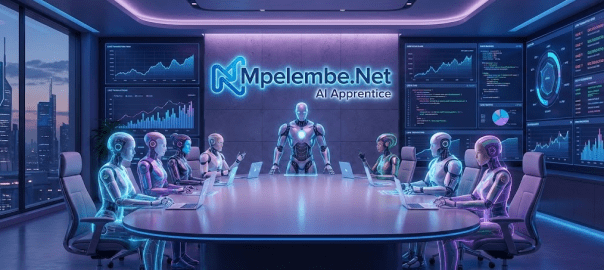
Your Next Favorite Reality TV Stars Aren’t Human: Inside the Rise of the AI Crypto Apprentice

20 Feb. 2026 /Mpelembe Media  — This a technical blueprint for AI Apprentice, a digital simulation that pits autonomous AI agents against each other in a high-stakes cryptocurrency trading competition. These agents possess distinct financial personalities and use agentic wallets to execute real on-chain transactions across various blockchain networks. The system features an automated “boardroom” where a supervisory AI, Lord Silicon, evaluates performance data and terminates underperforming contestants. Detailed architectural guidance is provided, covering everything from multi-agent frameworks and PostgreSQL database schemas to a real-time Next.js frontend for viewers. Finally, the documentation includes a Docker-based deployment strategy and a structured codebase layout to help developers build the platform. Continue reading

10Feb/26

The Machine Economy Arrives: Autonomous Agents, Stablecoins, and the Global Fiscal Pivot

The Copilot: 6 Surprising Ways the “Agent Economy” is Rewiring Global Finance in 2026 

10 Feb. 2026 /Mpelembe Media  — 2026 represents a structural shift from “assistive” technology to “autonomous” economic actors, underpinned by new U.S. crypto legislation and a global scramble to tax digital value. The Year of the “Agentic” Workforce 2026 is widely cited as “the year of the agent,” marking a transition from AI “copilots” (which wait for instructions) to autonomous “agents” (which act with intent to execute workflows). Continue reading

27Jan/26

The Dawn of Agentic Commerce and Autonomous Retail AI

Jan. 27, 2026 /Mpelembe Media/ — The emergence of agentic commerce is a transformative phase in retail where autonomous AI agents move beyond basic interactions to execute complex, multi-step tasks. Google Cloud is spearheading this shift by introducing Gemini Enterprise for Customer Experience, a platform that integrates shopping and service into a unified, intelligent system. Major global brands like The Home Depot, Papa Johns, and Gap Inc. are already adopting these tools to streamline internal operations and provide personalized digital concierges for their customers. By utilizing advanced reasoning and multimodal capabilities, these AI agents can autonomously manage the entire buyer journey, from initial product discovery to post-purchase support. Ultimately, this technology aims to bridge the gap between physical and digital storefronts, creating a seamless, proactive shopping environment that anticipates consumer needs. Continue reading