Tag Archives: Microsoft

01Nov/26

The Dangers of Counterfeit Humans

From Deadbots to Deception: How Hyper-Realistic AI Exploits Human Vulnerability

Sun, Nov 01 2026 /Mpelembe Media/ — Neuroscientist Anil Seth contends that engineering digital avatars that are indistinguishable from real human beings is a hazardous development with potentially catastrophic societal consequences. Sparked by the announcement of Griffin—a “human interaction model” from the company Tavus that reportedly passes a video-based Turing Test—Seth warns that hyper-realistic avatars will enable widespread financial fraud, exploit loneliness, and severely fracture the public’s ability to separate reality from fabrication. He traces the progression of this technology from early concepts designed to preserve survivor testimonies to commercialized “deadbots” that mimic deceased family members, emphasizing that such systems threaten to paralyze natural human grieving processes. Continue reading →
30Oct/26

How Agentic AI Replaces Software

The Tollbooth Trap: Why Commoditized Middlemen Are Losing Ground to Autonomous Intelligence.

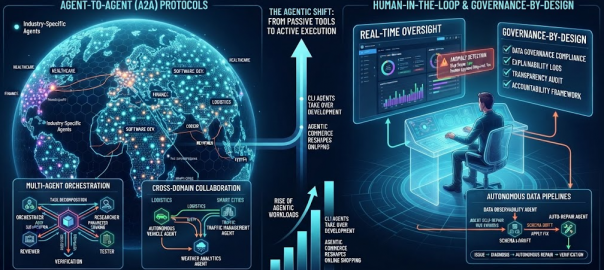
Fri, July 30 2026 /Mpelembe Media/ — The rapid evolution of generative artificial intelligence and autonomous multi-agent architectures is driving a structural transformation across the digital economy, dismantling traditional business models founded on search arbitrage, manual creative services, seat-based software licensing, and intermediation. Legacy stock photography illustrates this vulnerability, highlighted by Getty Images filing for Chapter 11 bankruptcy after losing more than 99 percent of its peak market valuation amid competition from on-demand text-to-image generators that undercut conventional pay-per-image licensing. Similar pressures are impacting online labor markets such as Upwork, where freelancers in occupations exposed to language and image models experienced a 2 percent decline in contracts and a 5 percent decrease in earnings, with high-reputation professionals disproportionately impacted as automated systems compress human skill differentials. Concurrently, commoditized intermediaries across travel booking, online retail, and mid-market SaaS face severe disintermediation. Over 100 publicly listed mid-market software providers are caught in a major squeeze between low-cost AI startups and cloud hyperscalers, prompting enterprises to replace traditional per-seat subscriptions with internal autonomous agents. Continue reading →

29Oct/26

Which AI Certifications Actually Matter

Inside Google’s Centralized Learning Hub for Enterprise AI, Cloud Infrastructure, and Agentic Engineering

Thu, July 29 2026 /Mpelembe Media/ — Google Skills represents a strategic consolidation of Google’s educational ecosystem, consolidating nearly 3,000 courses, hands-on interactive labs, and professional credentials into a single unified platform. By merging content across Google Cloud, Google DeepMind, Grow with Google, and Google for Education, the platform establishes a continuous learning continuum serving all proficiency levels. Learners can progress seamlessly from foundational digital literacy to advanced large language model architectures and enterprise cloud infrastructure management. Prior to this unification, users across these individual properties completed over 26 million courses and credentials in a single year, highlighting the massive global demand for structured technical upskilling. Continue reading →

28Oct/26

Why AI Ethics Needs Ancient Theology

Faith, Human Dignity, and Governance: Why AI Ethics Demands Moral Depth Over Statistical Consensus

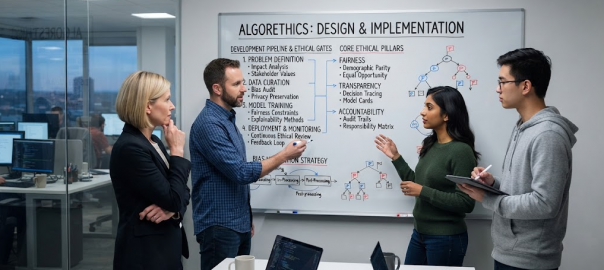
Wed, July 28 2026 /Mpelembe Media/ — The Limits of Preference Aggregation and the Rise of Algorithmic Pluralism Leading technology executives have proposed aligning artificial intelligence with human values by calculating a “weighted average” or statistical consensus through techniques such as Reinforcement Learning from Human Feedback (RLHF). However, social choice theory demonstrates that there is no unique voting protocol capable of universally aggregating individual preferences without generating logical contradictions or violating private ethical values. Theological and philosophical scholars emphasize that religious traditions cannot be reduced to modular, extractable rulebooks to be averaged in machine learning models. Attempting to compute a universal moral consensus flattens culturally rich worldviews, suppresses minority perspectives, and risks codifying dominant, secular-rational norms at the expense of global faith communities. Continue reading →

26Oct/26

Anthropic S-1 Warns of AI Extinction

Balancing Hyper-Growth and Public Safety: Anthropic Pairs Operating Profits with Catastrophic AI Disclosures

Mon, July 26 2026 /Mpelembe Media/ — Under Anthropic, PBC has officially filed its Form S-1 registration statement with the U.S. SEC to list its Class A common stock on the Nasdaq under the ticker symbol “ANT”. The artificial intelligence developer is seeking a target IPO valuation between $1.8 trillion and $2.0 trillion, with plans to raise as much as $80 billion to $100 billion. If realized at this scale, the offering would surpass SpaceX’s $1.77 trillion market debut from June 2026 to become the largest initial public offering in history. Driving this valuation is unprecedented enterprise expansion: revenue for the first half of 2026 surged to $16.286 billion—a 14-fold increase compared to $1.163 billion in the corresponding prior-year period. In the second quarter of 2026 alone, Anthropic generated $11.6 billion in revenue and achieved an operating profit of $974 million. Corporate API token contracts generate approximately 80% of top-line revenue, propelled by rapid adoption of agentic software products like Claude Code. Continue reading →

29Jul/26

ASML panic and AI circular funding

Historic Tech Plunge: Asian Markets Tumble Amid Fears of Unsustainable AI Spending and New Chinese Rivals

Wed, July 29 2026 /Mpelembe Media/ — The summer of 2026 witnessed a profound global market recalibration as major technology and semiconductor stocks faced a severe sell-off, pushing the tech-heavy Nasdaq-100 index into correction territory. This downturn reflected a fundamental shift in investor sentiment, moving from speculative optimism surrounding artificial intelligence to a rigorous demand for tangible monetization and balance sheet stability. The correction was not triggered by a singular event, but rather by a confluence of escalating capital expenditures, systemic credit risks tied to circular financing, and significant geopolitical shifts in the Asian semiconductor supply chain. Continue reading →

29Jul/26

Why Zuckerberg is Building an AI CEO

Friction in the Labs: Delays, Layoffs, and Culture Clashes Inside Meta’s Superintelligence Push

Wed, July 29 2026 /Mpelembe Media/ — The Open-Source Vision and Industry Dominance Meta CEO Mark Zuckerberg is aggressively positioning the company as the primary institutional sponsor of open-source (open-weight) artificial intelligence. With the release of Llama 3.1, Zuckerberg argues that open-source AI is the path forward because it empowers developers, prevents centralization of power, and allows organizations to protect their data without being locked into closed vendor ecosystems like those of Apple, OpenAI, or Google. By freely distributing its models, Meta hopes to commoditize the AI layer and establish Llama as the ubiquitous global industry standard. Continue reading →

23Jul/26

Why Kimi and DeepSeek Terrify Superpowers

The Geopolitics of Chinese Open-Weight AI

Thu, July 23 2026 /Mpelembe Media/ —The global artificial intelligence landscape is undergoing a major structural shift driven by the rapid technical maturation and aggressive pricing of open-weight models originating from China, specifically Moonshot AI’s Kimi K3 and DeepSeek’s V4 Pro. While these models offer massive cost efficiencies for Western enterprises, they introduce severe national security, cybersecurity, and intellectual property concerns, prompting a pivot in Washington toward weaponized regulatory uncertainty, federal procurement restrictions, and supply chain mapping.
Continue reading →

02Jun/26

The New Creator Economy: Why Storytelling and Taste are the Ultimate AI-Era Differentiators

Beyond the Prompt: Building Defensible AI Products in a World of Commoditized Intelligence

Tue, Jun 02 2026 /Mpelembe Media/ — The “idea-to-scale” cycle has been weaponized. In previous tech cycles, the distance between a concept and global execution was measured in years; today, it is measured in weeks. We are witnessing the “Great Compression”—a collapse of the traditional barriers to production that has left many in a state of “AI fatigue.” If you believe AI is just a chatbot in a browser, you’ve already lost the plot.We are transitioning from simple orchestration to the era of “vibe design.” In this new landscape, multi-modal interaction is the baseline, and the ability to describe a vision or feel an outcome is the new coding. For the tech strategist, the goal isn’t just to use AI, but to identify the counter-intuitive shifts rewiring how humans and machines interface.
Continue reading →

29May/26

Beyond Chatbots: How Robinhood, Visa, and Google are Building the Rails for Agentic Commerce

The $135 Billion Protocol War: Inside the Race to Standardize AI-Driven Transactions

Sat, May 30 2026 /Mpelembe Media/ — Robinhood’s Pioneering Launch Robinhood has officially ushered in the era of “agentic finance” by launching two flagship products: Agentic Trading and the Agentic Credit Card. Utilizing the Model Context Protocol (MCP), these tools allow retail investors to connect third-party AI agents (like Claude or ChatGPT) directly to Robinhood’s infrastructure to execute financial decisions autonomously. Continue reading →