
Tag Archives: Model Context Protocol

29May/26

Beyond Chatbots: How Robinhood, Visa, and Google are Building the Rails for Agentic Commerce

The $135 Billion Protocol War: Inside the Race to Standardize AI-Driven Transactions

Sat, May 30 2026 /Mpelembe Media/ — Robinhood’s Pioneering Launch Robinhood has officially ushered in the era of “agentic finance” by launching two flagship products: Agentic Trading and the Agentic Credit Card. Utilizing the Model Context Protocol (MCP), these tools allow retail investors to connect third-party AI agents (like Claude or ChatGPT) directly to Robinhood’s infrastructure to execute financial decisions autonomously. Continue reading


26May/26

Building the Future of eCommerce and Content: Inside WordPress’s New AI Ecosystem

Standardizing Artificial Intelligence: A Deep Dive into WordPress 7.0’s AI Infrastructure

Tue, May 26 2026 /Mpelembe Media/ — TheThe recent updates to WordPress, particularly leading into version 7.0, mark a structural shift from a traditional CMS into an “AI-aware runtime” and agentic platform. This transformation is driven by several foundational components: Continue reading

06Feb/26

Building the Agentic Enterprise: From Multi-Agent Orchestration to Ethical Governance

06 Feb. 2026 /Mpelembe Media  — The provided sources, namely insights.mpelembe,net, . detail a paradigm shift from simple generative models to “Agentic AI”—autonomous systems capable of reasoning, planning, and executing complex workflows. This transformation is characterized by advanced technical architectures, new infrastructure debates, and profound organizational implications.

Continue reading

02Nov/25

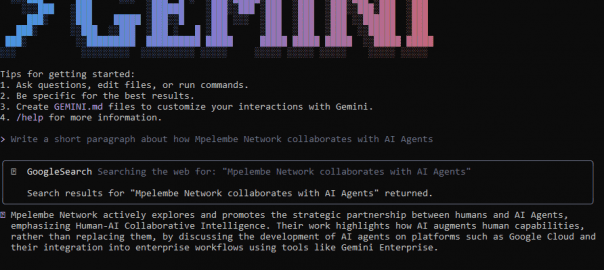
How to use Gemini Command Line Interface (CLI)

Nov. 2, 2025 /Mpelembe Media/ —  The Gemini Command Line Interface (CLI) is an open-source AI agent that allows you to access Gemini directly from your terminal. It uses a “reason and act” (ReAct) loop with built-in tools and local or remote Model Context Protocol (MCP) servers to handle complex tasks like fixing bugs, creating new features, and improving test coverage. Beyond coding, it’s a versatile tool for content generation, problem-solving, research, and task management. Continue reading