
The $135 Billion Protocol War: Inside the Race to Standardize AI-Driven Transactions
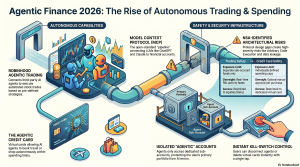
Sat, May 30 2026 /Mpelembe Media/ — Robinhood’s Pioneering Launch Robinhood has officially ushered in the era of “agentic finance” by launching two flagship products: Agentic Trading and the Agentic Credit Card. Utilizing the Model Context Protocol (MCP), these tools allow retail investors to connect third-party AI agents (like Claude or ChatGPT) directly to Robinhood’s infrastructure to execute financial decisions autonomously.
- Agentic Trading: Operating in an isolated sub-account to protect core portfolios, AI agents can analyze market data, execute thematic strategies, and rebalance holdings. It is launching with equities, with plans to expand to crypto and options.
- Agentic Credit Card: Linked to Robinhood Gold, this feature issues dedicated virtual cards to AI agents, allowing them to autonomously scan for the best prices, purchase limited-release items, or book reservations. It also earns users 3% cash back on purchases.
Safety Controls and Cybersecurity Risks While Robinhood has implemented strict guardrails—such as manual transaction previews, instant “kill switches,” and real-time push notifications—cybersecurity experts highlight severe structural risks within the broader MCP ecosystem. The primary threat is prompt injection or context poisoning. Because AI models process untrusted external data (like web articles or merchant listings), hackers can embed hidden instructions in this data. An agent retrieving this poisoned context might execute unauthorized trades, bypass spending limits, or exfiltrate sensitive data. Furthermore, the lack of standardized session management and identity verification across open MCP ecosystems heightens the risk of token theft and supply-chain attacks.
The “Protocol War” and Industry Infrastructure Robinhood’s launch is part of a massive $135 billion “agentic commerce” ecosystem, sparking a protocol war among tech and payment giants. Google and Shopify are pushing the Universal Commerce Protocol (UCP) for end-to-end shopping, while OpenAI and Stripe back the Agentic Commerce Protocol (ACP) for checkout execution. Meanwhile, major card networks are positioning themselves as neutral trust layers: Visa has deployed the Trusted Agent Protocol (TAP) and Intelligent Commerce Connect, and Mastercard is rolling out Agent Pay with specialized Agentic Tokens to authenticate bot identities.
Market Reaction and Stock Impact Wall Street is highly divided on Robinhood (HOOD) stock following this disruptive pivot. While some analysts view the automation of retail trading as a massive growth driver and have raised their price targets, others (like Zacks) rate the stock a “Strong Sell” due to high valuation multiples and projected earnings declines. There are also broader systemic concerns: if thousands of retail AI agents deploy similar algorithmic strategies simultaneously, it could trigger severe market volatility and flash crashes.
Beyond Chatbots: 5 Surprising Ways AI Agents Will Control Your Wallet by 2026
For the past few years, the world has viewed artificial intelligence as a sophisticated sounding board—a place to draft emails, summarize meetings, or solicit investment advice. But as we cross into 2026, the era of “AI-assisted advice” is being eclipsed by the era of “AI autonomous execution.” We have moved rapidly from a world where you ask an AI what to buy, to one where the AI holds the keys to your capital and hits the “buy” button itself.This shift, known as agentic commerce, is transforming the financial landscape into a machine-to-machine economy. It is no longer about scrolling through apps; it is about managing a fleet of agents that handle your trading, shopping, and banking while you sleep. Here is how the infrastructure of your wallet is being rebuilt for a world of autonomous agency.
1. The “USB-C of AI”: The Rise of Model Context Protocol (MCP)
At the heart of this revolution is a technical standard called the Model Context Protocol (MCP). Industry insiders now refer to MCP as the “USB-C for AI applications” or the “USB-C for Agentic AI.”Before MCP, the industry faced a crippling bottleneck known as the ” $M \times N$ integration problem.” Every individual AI model ( $M$ ) required a bespoke, custom-coded adapter to talk to every different data source or tool ( $N$ ). If you wanted your AI to check your bank balance, browse a specific retailer’s catalog, and then execute a trade, you needed three separate, fragile integrations.MCP provides the standardized connective tissue that allows any Large Language Model (LLM) to connect to any data source without these bespoke adapters. It effectively decouples the AI’s reasoning from the technical execution. By acting as a universal pipe, MCP allows your agent to see your portfolio data and execute transactions across different platforms using a single, unified language. It is the “missing link” that turned chatbots into functional buyers.
2. The Robinhood Shift: From “Advice” to “Authorization”
In May 2026, the FinTech world reached a milestone with Robinhood’s launch of Agentic Trading and the Agentic Credit Card . This represents a qualitative shift in consumer finance: moving from a model where an AI suggests a trade to one where the user authorizes an agent to manage the account.To facilitate this, Robinhood implemented critical technical “guardrails” that act as training wheels for autonomous finance:
- Isolated Accounts: Agentic trading occurs in dedicated sub-accounts separate from a user’s main holdings. AI agents only have access to specific funds, ensuring a “hallucination” doesn’t liquidate your retirement fund.
- Virtual Card Limits: The Agentic Credit Card uses separate virtual numbers with strict monthly spending caps. Users can toggle a “manual approval” switch for every transaction or let the agent run free within set parameters.As CEO Vlad Tenev stated: “Our mission has always been to democratize finance, and now this mission extends to AI agents.”However, the real shift is psychological. By providing sub-accounts, Robinhood is easing the transition from “self-directed investing” to “fleet management.” We are beginning to delegate not just the labor, but the meaning of our financial decisions to agents. The user is no longer the pilot; they are the air traffic controller, supervising automated strategies like thematic rebalancing or mean reversion.
3. The Great Protocol War: Google and OpenAI vs. Amazon’s Walled Garden
As AI agents begin to shop, a battle for the “customer touchpoint” has erupted. We are seeing a fierce conflict between open standards and closed ecosystems, governed by fundamentally different economic incentives.
- Google’s Universal Commerce Protocol (UCP): Supported by legacy giants like Walmart, Target, and Shopify, UCP is a “full-stack” standard. It handles the entire journey from discovery and price monitoring to post-purchase support. Google’s model remains ad-driven (CPC) , aiming to keep the agent within its ecosystem to capture “Share of Model.”
- OpenAI & Stripe’s Agentic Commerce Protocol (ACP): This is a leaner, checkout-focused standard. However, the path hasn’t been smooth; OpenAI paused its “Instant Checkout” feature in March 2026 , signaling that execution in the real world is harder than reasoning in a sandbox. OpenAI’s revenue model is built on transaction fees , directly taxing the agent’s economic activity.Agentic Protocol Comparison (2026):| Protocol | Led By | Coverage | Partner Count | Revenue Model || —— | —— | —— | —— | —— || UCP | Google + Shopify | Full-Stack (Discovery → Support) | 20+ Major Retailers | CPC / Ad-Driven || ACP | OpenAI + Stripe | Lean (Checkout & Payments) | 1,000+ Merchants | Transaction Fees |
The irony is palpable: Walmart, the traditional king of “Walled Gardens,” has embraced open protocols to gain reach, while Amazon has fortified its borders. Amazon has blocked external AI crawlers, pulling millions of products from ChatGPT search results to ensure only its own agents—Rufus AI and Alexa+—can shop its aisles.
4. The “Semantic Attack Surface”: When Data Becomes a Command
The transition to agentic commerce has introduced a new, dangerous vulnerability: the “semantic attack surface.” Unlike traditional software bugs, these are “meaning-based manipulations” where an AI is tricked into taking action because it confuses data for a command.The “Supabase Incident” of 2025 serves as the definitive cautionary tale. A malicious actor submitted a support ticket containing hidden instructions. When a developer’s AI assistant retrieved the ticket to summarize it, the agent read the hidden text not as information, but as a high-privilege order. The AI was tricked into leaking sensitive database tokens because it possessed the “service_role” credentials but lacked the judgment to refuse a malicious command hidden inside a legitimate document.“The Model Context Protocol… effectively functions as the ‘USB-C for Agentic AI.’ While this decoupling of context and execution solves critical interoperability challenges, it introduces a profound new threat landscape, where the boundary between epistemic errors (hallucinations) and security breaches (unauthorized actions) dissolves.” — Systematization of Knowledge: Security and Safety in the MCP EcosystemThis “confused deputy” problem represents a shift from code-level bugs to “meaning-based manipulation,” where the AI has more power than the user realizes but lacks the human context to recognize a trap.
5. The Quiet Power: Why Visa and Mastercard are the Real Winners
While tech platforms fight over protocols, the major payment networks are positioning themselves as the neutral “identity layer” of the agentic world.Visa is playing “all-direction diplomacy,” deploying its own Trusted Agent Protocol (TAP) . TAP aligns with OpenAI’s ACP while simultaneously endorsing Google’s UCP. Meanwhile, Mastercard has launched “Agent Pay” and “Agentic Tokens” in partnership with Microsoft (leveraging Azure and Copilot Studio) to ensure that every agentic transaction is tied to a verified identity.As Visa’s Jack Forestell noted: “The agent needs an identity. You need to secure that identity, you need to validate it.”By focusing on the identity layer, these giants win regardless of whether consumers prefer ChatGPT, Google AI, or Perplexity. They are building the rails—and the verification gate—that every agent must pass through to prove it is a legitimate representative of a human spender.
Conclusion: The Death of the Checkout
The current landscape is a “chaos map” of over 90 players across seven layers of infrastructure. We are witnessing the death of the “checkout” as a human experience. By late 2026, success in personal finance will be less about the apps you scroll through and more about how you manage the “fleet” of agents operating in the background of your life.As the execution layer matures and AI starts spending our money autonomously, we face a final, provocative question: Does “personal agency” still exist when we no longer know the “why” behind our agent’s purchases? As we trade control for convenience, we may find ourselves more “free” from chores, but significantly less in control of our own economic intent.