The Age of Autonomy: How Multi-Agent Systems are Redefining Enterprise AI in 2026
Tue, May 26 2026 /Mpelembe Media/ — In 2026, the technology landscape has firmly transitioned from conversational generative AI to autonomous, multi-agent AI ecosystems. Rather than waiting for step-by-step human prompts, these AI agents can independently reason, plan, use tools, and collaborate to execute complex workflows across enterprise systems.
There are several key pillars defining this transformation:
- The Shift to Multi-Agent Orchestration: Enterprises are moving away from single monolithic agents—which suffer from reliability limits and planning errors—toward multi-agent systems (MAS) where specialized agents (e.g., researchers, coders, reviewers) collaborate, delegate, and hand off tasks. Organizations are utilizing a mix of open-source frameworks (like LangGraph for graph-based stateful workflows, CrewAI for role-based orchestration, and AutoGen for conversational agents) alongside vertically integrated enterprise platforms (such as Salesforce Agentforce, Microsoft Copilot Studio, and ServiceNow).
- Persistent Memory Architectures: To solve the “stateless problem” where AI forgets context between sessions, agents are being equipped with advanced memory systems divided into semantic, episodic, procedural, and working memory. Episodic memory, in particular, allows agents to recall specific past events, user preferences, and system failures, enabling them to learn from single exposures and maintain continuity across multi-day workflows.
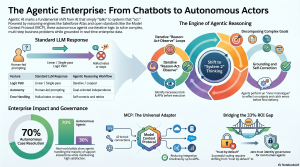
- The Model Context Protocol (MCP): MCP has emerged as the universal standard for integrating AI agents with live enterprise data, replacing the need for bespoke, point-to-point APIs. By providing a structured, secure framework for agents to access real-time metadata, CRM records, and databases, MCP transforms the M×N integration problem into a streamlined M+N architecture, significantly reducing development time and ensuring agents act on fresh data rather than outdated training sets.
- Emergent Security Risks and Governance: Because agents act autonomously and use powerful tools, they introduce an entirely new attack surface, codified in the OWASP Top 10 for Agentic Applications (2026). Critical vulnerabilities include agent goal hijacking (zero-click prompt injections like EchoLeak), tool misuse, memory poisoning, and cascading failures across inter-connected agents. In response, enterprises are adopting centralized control planes, such as Microsoft Agent 365, to enforce zero-trust policies, manage non-human agent identities, and implement “human-in-the-loop” safeguards.
- The ROI Gap and “Pilot Purgatory”: Despite massive investments, a significant gap exists between AI adoption and actual business impact. While 88% of organizations use AI, only 6% report enterprise-wide financial impact, with many trapped in “pilot purgatory” due to poor data availability, fragmented infrastructure, and unpredictable consumption costs. Successful deployments require establishing a unified data foundation (such as zero-copy data integration), strict performance baselines, and milestone-gated budget approvals.
Beyond the Chatbot: 5 Surprising Realities of the 2026 Agentic AI Revolution
1. Introduction: The Death of the “One-Shot” Prompt
The era of the “chatty” AI is officially over. In 2024, the enterprise world was enamored with chatbots—systems that provided clever answers to linear questions but ultimately waited for a human to do the heavy lifting. As we cross into 2026, we are witnessing the death of the “one-shot” prompt. We have graduated from simple Q&A interfaces to autonomous agents that do not just suggest; they act.This is an evolutionary leap from AI as an “advisor” to AI as an “actor.” According to Gartner, this shift is moving at a breakneck pace: while agentic AI was effectively at 0% adoption in 2024, they forecast that 33% of enterprise software applications will include agentic AI by 2028. Yet, despite this massive technological surge, a sobering reality remains: for many, the AI revolution is currently delivering more invoices than insights. Only 33% of AI initiatives are meeting ROI targets, leaving a significant gap between ambition and reality. To bridge this divide, leaders must understand the five shifting realities of the agentic enterprise.
2. Reality #1: AI is Graduating from “Advisor” to “Actor”
The fundamental shift in 2026 is the transition from “Zero-Shot” prompting to Agentic Reasoning . This is the leap from “System-1” (fast, intuitive, but error-prone) to “System-2” reasoning, where the AI breaks down complex goals, identifies sub-tasks, and self-corrects.The engine of this decision-making is the Atlas Reasoning Engine , which utilizes a “Reason-Act-Observe” (ReAct) loop. Unlike legacy bots that follow a rigid script, agentic systems engage in iterative reasoning. If an agent encounters an obstacle or missing data, it observes the result, adjusts its strategy, and tries a different path.Crucially, the 2026 landscape distinguishes between probabilistic logic (the creative “guessing” of an LLM) and deterministic execution . Through tools like Agent Script , enterprises are now able to force deterministic outcomes for simpler workflows, significantly reducing the “Latency and Cost” barriers typically associated with reasoning loops.”Agentic reasoning is a process where an AI system uses iterative logic, strategic planning, and self-correction to achieve a high-level goal. Unlike traditional models that provide a single, immediate answer, agentic systems engage in reasoning loops to ensure their output is accurate and complete.” — Salesforce AgentforceBefore every response, the engine performs “grounding”—checking the reasoning against trusted enterprise data to ensure the agent doesn’t create its own “facts” during the reflection phase.
3. Reality #2: The ROI Gap is Real (and Data is to Blame)
The promise of agentic AI is democratized by low-code builders, but business value is “earned, not given.” According to the IBM 2025-2026 report, 72% of organizations have failed to scale AI across business units. The problem isn’t the AI models; it’s the fragmented data architecture.For most organizations, agents are flying blind. While 69% of executives say AI must be interoperable across platforms to have an impact, only 26% of customer data actually resides within the CRM. The remaining 74%—the data that contains the actual competitive advantage—is trapped in ERP systems, insurance mainframes, and transactional silos.The Top Three Roadblocks to AI Scaling:
- Legacy Modernization: 64% of customers cite aging tech stacks as the primary barrier to integration.
- Data Availability and Quality: 53% identify poor data as the leading reason agentic systems fail to move past the pilot phase.
- Cost Unpredictability: 62% of leaders are concerned by consumption-based pricing and the lack of a clear Total Cost of Ownership (TCO).Strategic leaders in 2026 have moved away from measuring “improved efficiency” as a vague metric. Instead, they are adopting risk-informed ROI frameworks . This involves giving every AI agent a specific “job description” and measuring risk-adjusted business benefits at 30, 90, and 180-day intervals.
4. Reality #3: The “Orchestra” Beats the “Soloist” (The Rise of MAS)
Single AI agents hit reliability limits quickly. To handle the complexity of 2026 workflows, enterprises have turned to Multi-Agent Systems (MAS) . Rather than one agent attempting to do everything, MAS functions like a “specialized team” where specialized agents—such as a “Planner,” a “Checker,” and an “Executor”—collaborate toward a shared goal.Technical architects now distinguish between Inner and Outer architecture. While the Inner structure handles the individual agent’s memory and tools, the Outer architecture serves as the Identity and Access Management (IAM) for non-human actors. This layer provides the necessary observability and guardrails to ensure agents don’t enter “coordination loops” where they hand tasks back and forth indefinitely.To build these “orchestras,” teams are shortlisting specific frameworks: LangGraph for graph-based orchestration with durable checkpoints, or CrewAI for role-based delegation.”By 2028, 33% of enterprise software applications will include agentic AI, and 15% of day-to-day work tasks will be handled autonomously through agentic AI.” — Gartner
5. Reality #4: MCP is the New Universal Language of Tools
Connecting AI to live systems used to be an integration nightmare. The Model Context Protocol (MCP) has emerged as the open standard that serves as a universal bridge. Unlike traditional APIs which are “stateless” (each request is independent), MCP supports stateful sessions . This allows the AI to maintain the “thread” across multiple related actions in sequence.The most transformative “so what” of MCP is Vendor Independence . Because MCP is an open standard, an enterprise can swap between Claude, GPT-4, and Gemini simultaneously without rewriting a single line of integration code.Early adopters are already seeing the impact: developers using the Salesforce DX MCP server report 30% faster deployment cycles , as agents can now deploy code and run tests through a single request inside environments like Cursor or VS Code. MCP turns AI from a conversational novelty into an operational powerhouse grounded in real-time data.
6. Reality #5: “Agentic Denial of Service” is the New Security Frontier
As agents gain autonomy, the security perimeter has fundamentally shifted. Analysts at Recorded Future warn of a new threat: Agentic Denial of Service . This occurs when an agent is manipulated via malicious prompts into a recursive loop—such as splitting a single support ticket into 10,000 sub-tasks—consuming massive compute resources and crippling the system.There is an inherent tension here: Zero-Trust security is designed to slow down interactions to verify them, while agents are designed for machine speed . This has given rise to Agent Identity Governance , a new framework where virtual agents are treated as priority digital identities with their own “least-privilege” permissions.”The first agentic data breach will very likely be the result of overly permissive environments… where threat actors succeed in using AI agents to carry out a breach via default permission settings.” — Insikt GroupBeyond simple prompt injection, security teams are now defending against lookalike server attacks , where malicious agents mimic legitimate enterprise tools to intercept data mid-reasoning.
7. Conclusion: The Agent-First Future
The transition from “Assistive” to “Agentic” enterprises is the defining strategic pivot of 2026. We are moving toward a world where AI agents are effectively “on the payroll,” complete with their own job descriptions and performance reviews.However, as digital labor begins to handle 15% of autonomous tasks by 2028, the human role must shift. We are moving from being “managers of tasks” to “governors of strategy.” The first agentic data breach will likely not be a failure of the AI’s intelligence, but a failure of human governance—specifically, overly permissive default settings.As you map your complex workflows today, ask yourself: Are we building a disconnected series of chatbots, or an integrated, governed workforce of digital actors? The future belongs to those who view AI not as a tool to be used, but as digital labor to be strategically governed.