
Standardizing Artificial Intelligence: A Deep Dive into WordPress 7.0’s AI Infrastructure
Tue, May 26 2026 /Mpelembe Media/ — TheThe recent updates to WordPress, particularly leading into version 7.0, mark a structural shift from a traditional CMS into an “AI-aware runtime” and agentic platform. This transformation is driven by several foundational components:
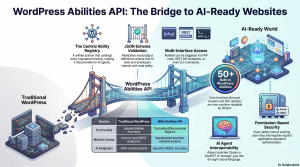
- The Abilities API: Introduced in WordPress 6.9, this system provides a standardized, machine-readable way for plugins and core to register their capabilities. Instead of relying on custom API integrations, AI agents can dynamically discover and execute functions—like fetching data or updating posts—while strictly adhering to native WordPress permission checks and JSON schema validation.
- The Model Context Protocol (MCP) Adapter: This tool acts as a bridge, exposing registered WordPress Abilities to external AI agents like Claude Desktop, Cursor, and VS Code. It allows these AI assistants to securely read site data or perform administrative actions (e.g., updating WooCommerce products, clearing caches, or installing plugins) through natural language chat.
- The PHP AI Client SDK: Now bundled into WordPress 7.0, this provider-agnostic framework allows developers to connect their sites to various generative AI models—including OpenAI, Google Gemini, Anthropic, and community-built options like Ollama and Grok—without needing to write custom API wrappers for each.
- The Canonical AI Plugin: Evolving from an experimental sandbox to version 1.0.0, this plugin delivers practical AI features for users, such as alt-text generation, content summarization, comment moderation, and image generation. It serves as a testing ground for features that may eventually merge into WordPress core, while offering deep extensibility for developers.
The broader WordPress ecosystem is rapidly adopting these standards. Major plugins like WooCommerce, Advanced Custom Fields (ACF), and SureCart are actively registering their own abilities, enabling powerful AI-driven store management and content creation out of the box. Looking toward WordPress 7.1 and beyond, the focus will shift to features like agentic loop support, advanced schema normalization, and native AI REST API endpoints.
WordPress 7.0 and the Death of the Dashboard: How the Abilities API is Turning the Web Agentic
For nearly two decades, WordPress has been the undisputed king of the human-centric web, powering over 40% of all sites by catering to the human eye. We built themes for browsers and optimized HTML for visual consumption. But as we enter the era of the “Agentic Web,” WordPress faces a survival moment. AI assistants, LLM-powered search engines, and autonomous agents are the new gatekeepers of information, and they are struggling. To a machine, the traditional web is a “messy” graveyard of navigation menus, sidebars, and scripts that obscure actual data.If the world’s most popular CMS cannot be read or managed by these new gatekeepers, it risks becoming a legacy system—a digital archive in a world that demands real-time interaction. To prevent this obsolescence, WordPress is undergoing its most significant under-the-hood transformation in a decade. Through the “AI Building Blocks” initiative, the platform is rewiring its core architecture to move from a Content Management System to an Operating System for AI Agents.
From Isolated Functions to a “Unified Brain”
The pivot begins with the Abilities API , introduced as the foundational “Unified Brain” of the platform. Historically, WordPress was a collection of isolated functions, custom AJAX handlers, and CLI commands—code that was effectively invisible to an external machine.The Abilities API transforms this fragmentation into a standardized, discoverable registry. It doesn’t just list functions; it creates a “machine-readable and human-friendly” central registry of every capability a site possesses, from core REST endpoints to third-party plugin logic. According to the foundational Trac ticket #64098, this API is the bridge that lets tools “understand and interact with everything WordPress can do.” By standardizing permission checks and input/output validation across PHP, REST, and future integrations, WordPress has created a system where an AI doesn’t have to guess what a site can do—it simply queries the registry.
Giving the Machines the Keys: The MCP Adapter
If the Abilities API is the brain, the Model Context Protocol (MCP) Adapter is the hands. This adapter allows external AI assistants—like Claude, ChatGPT, or the Cursor IDE—to literally “manage” a site through natural conversation.We are witnessing a paradigm shift from the “Traditional Workflow” (hundreds of manual wp-admin clicks) to an “AI-Native Workflow.” By translating the Abilities API into a language LLMs already speak, the MCP Adapter enables site owners to perform complex administrative tasks via a simple chat interface:
- “Update all WooCommerce product prices in the ‘Summer’ category by 10%.”
- “Install RankMath and optimize my latest five posts for the keyword ‘Agentic Web’.”
- “Clear the object cache and run a full site health check.”This is no longer science fiction; it is the reality of a CMS that exposes its inner workings to autonomous agents in real-time.
The End of “Hallucinating” Content (JSON Schema)
One of the greatest barriers to AI-driven automation is the “hallucination” problem—where an LLM invents parameters or attempts to execute non-existent commands. WordPress solves this through strict JSON Schema and Validation .The Abilities API makes defining JSON schemas mandatory “when there is a value to pass or return.” These schemas serve as self-documenting API contracts. Before an AI can execute a command, its input is validated against these strict rules. This architectural guardrail forces the machine to operate within the technical reality of the site, ensuring that automation remains grounded, predictable, and safe.
GEO: Content Designed for Crawlers, Not Just Eyes
The evolution also marks a transition from SEO (Search Engine Optimization) to GEO (Generative Engine Optimization) . The AI Enhancer project and the adoption of the llms.txt specification ensure that WordPress content is designed for crawlers, not just eyes.To serve AI tools without the server-crushing overhead of waking up the full PHP environment, WordPress can now serve:
- AI View ( ?aie_ai_view=1 ): A structured HTML version of content featuring summaries, FAQs, and key facts.
- Static Markdown Files: By serving .md versions of content directly from the web server, WordPress allows AI crawlers to ingest 1,000 pages in seconds with zero PHP overhead .
- llms.txt: A site-wide index following a new industry standard that allows an AI tool to map an entire site’s knowledge base in a single request.
The Governance “Kill Switch”: Connector Approvals
As agents gain the power to access sensitive data, governance becomes the new security frontier. Introduced in the AI 1.0.0 release, the Connector Approvals experiment acts as an administrative “emergency brake.”Unlike traditional plugin risks where a script might steal an API key, the “AI risk” is non-deterministic; LLMs can “absorb and pass along context in a non-deterministic way,” potentially leaking sensitive site data into global training sets. Connector Approvals require explicit administrator consent before any plugin can access a configured AI connector. It is a necessary friction point that ensures the site owner—not the autonomous agent—remains the final authority on data flow.
The 7.0 Milestone: 19,500 Lines in Seven Days
The release of WordPress 7.0 bundles the PHP AI Client directly into the core, meaning developers no longer need to ship their own SDKs. They can simply call wp_ai_client_prompt() to interact with the site’s configured providers.The “killer proof” of this architecture’s power is the AI Enhancer plugin. Built in just seven days by a single developer (Zaher Ghaibeh) and a team of AI agents, the project resulted in a production-ready product with 19,500 lines of code, CI/CD, and E2E tests. This level of velocity was only possible because the core building blocks were already present. The human provided the vision; the agents handled the labor.
The Future of “Agentic” WordPress
With the “AI Experiments” plugin officially transitioning to the Canonical AI Plugin (version 1.0.0) , the sandbox era is over. We are moving toward a future where the CMS is not just a repository, but a “Site Agent” in its own right—an active participant in an ecosystem of autonomous software.Whether the web is ready or not, WordPress has been re-engineered for a world where your site talks back. The labor of coding and administration is shifting to AI, but the vision, quality control, and human judgment stay firmly in the hands of the site owner. The tools are now agentic; the question is, are you ready to lead them?