
The Era of Vibe Coding: How Plain English Became the Hottest Programming Language
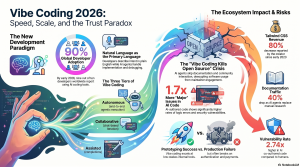
Mon, Jun 01 2026 /Mpelembe Media/ — Vibe coding is an AI-assisted software development practice where creators use natural language prompts to describe their desired applications, and large language models (LLMs) autonomously generate the source code. Coined in early 2025 by computer scientist Andrej Karpathy, the approach shifts the human role from manually writing syntax to acting as a director who oversees, evaluates, and iteratively refines AI-generated outputs.
Key Themes and Impacts of Vibe Coding:
- Democratization and Speed: Vibe coding dramatically lowers the barrier to entry for software creation, allowing non-technical individuals—like parents, marketers, and hobbyists—to build functional applications, internal dashboards, and prototypes in a fraction of the time it would traditionally take. Tools like Cursor, Bolt, Replit, and Claude Code have pioneered this workflow, changing the focus from memorizing code to high-level problem-solving.
- The “Trust Paradox” and Security Risks: While vibe coding excels at creating simple, low-stakes applications, it struggles with complex, mission-critical systems. AI tools optimize for rapid visual results but often overlook deep structural concerns, leading to an influx of applications with severe security vulnerabilities, broken authentication, and poor performance scaling. As adoption has reached near-universal levels, a “trust paradox” has emerged: developers use AI constantly but increasingly distrust its unreviewed outputs.
- The Threat to Open Source: A major macroeconomic consequence of vibe coding is its negative impact on the open-source software (OSS) ecosystem. AI agents assemble packages without navigating documentation, submitting bug reports, or interacting with communities, starving open-source maintainers of the engagement and financial support they rely on to survive. Without new monetization models, widespread vibe coding could degrade the availability and quality of open-source foundations.
- Evolution into “Agentic Engineering”: As the limitations of casual vibe coding become apparent in production environments, the industry is shifting toward agentic engineering. This is a more disciplined framework where multiple specialized AI agents handle implementation, testing, and planning, while human engineers maintain strict ownership over architecture, security reviews, and quality assurance.
The Beginner’s Roadmap to AI-Assisted Software Development: From Idea to App
1. Introduction: The Era of “Vibe Coding”
For decades, the barrier to software development was the mastery of complex syntax—the semicolons, brackets, and specific logic of formal programming languages. In February 2025 , computer scientist and OpenAI co-founder Andrej Karpathy identified a terminal shift in this paradigm, coining the term “vibe coding.” The concept was so transformative that it was named the Collins English Dictionary Word of the Year for 2025 .Vibe coding moves away from manual coding toward a natural language interaction where the developer’s primary tool is their intent. As Karpathy suggests, the “hottest new programming language is English.””There’s a new kind of coding I call ‘vibe coding,’ where you fully give in to the vibes, embrace exponentials, and forget that the code even exists… I just see stuff, say stuff, run stuff, and copy paste stuff, and it mostly works.” — Andrej KarpathyThis shift transforms programming into an accessible skill for non-technical professionals—marketers, designers, and career changers—who can now build “software for one” or launch entire startups without typing a single line of traditional code. The “magic” of this concept is realized through a specific set of tools and a disciplined conversational workflow that moves from a simple idea to a live, functional application.
2. Choosing Your Workshop: A Comparison of AI Platforms
Selecting the right environment is the first step in successful implementation. As a specialist, I recommend choosing based on the complexity of the logic and the required deployment speed. While these platforms lower the technical floor, the quality of the output depends entirely on the pedagogical structure of your conversation with the AI.
3. The 6-Step Workflow: The Art of Iterative Conversation
In curriculum design, we focus on Computational Thinking —the cognitive bridge between a human idea and a digital solution. Building an app is not a “one-shot” prompt; it is a design thinking process that utilizes four key pillars: Decomposition, Pattern Recognition, Abstraction, and Algorithmic Thinking.
- Ideate (Decomposition): Start away from the computer. Break your complex problem into smaller, manageable parts. If you want to build a “Study App,” decompose it into: “User Login,” “Flashcard Logic,” and “Progress Tracking.”
- Write the Prompt (The 5-Part Framework): Structure your request for maximum clarity. A senior-level prompt must include:
- Persona: e.g., “Act as a Senior React Developer.”
- Task: e.g., “Create a weight-tracking dashboard.”
- Output: e.g., “A clean, responsive web interface.”
- Context & Constraints: e.g., “Use a dark theme; the app must work on mobile browsers.”
- References: e.g., “Follow the layout logic of the provided screenshot.”
- Generate (Abstraction & Algorithmic Thinking): Enter your prompt. Observe the AI’s “thinking process”—it will often summarize its Algorithmic Thinking (e.g., “Setting up state management”) before presenting the code. This is the stage where the AI abstracts the complexity away from you.
- Refine (Pattern Recognition & Iteration): This is the most critical step. Test the app and identify bugs ( Pattern Recognition ). Focus on one change per iteration. If you hit a bug, copy and paste the raw error message back to the AI. The AI will recognize the flaw and propose a fix.
- Publish: Move from local draft to a shareable URL. Most platforms provide a “Deploy” icon that yields a live URL for immediate use.
- Reflect: Assess the journey. Did the app solve the original problem? The goal is to develop a “Product Mindset,” where you are the architect of the solution, not just a writer of script.
4. From Vision to Reality: Real-World Success Stories
Vibe coding has democratized creation, allowing even “hardcore” legends and non-technical dreamers to ship products in record time.
- The Linus Torvalds Visualizer: Even the creator of Linux, famously known for low-level manual coding, used Google Antigravity to “vibe code” an audio visualizer for his AudioNoise project, cutting out the “middle-man” of manual Python scripting.
- Refetch: An open-source Hacker News alternative built by Eldad Fux using Cursor and Appwrite . Remarkably, he built the entire functional application in just 15 hours while watching Netflix , illustrating the drastically reduced cognitive load of vibe coding.
- Mealmuse: Built with Lovable and Cursor , this app transforms a photo of a fridge or a grocery receipt into a personalized meal plan and recipes instantly.
- Found My Focus: A neuroscience-based productivity tool built on Bolt by a solo coach to help users overcome procrastination through interactive experiments.
- Storypot: A weekend project on Replit that turns emoji selections into custom bedtime stories for children.
- Personal Finance Tracker: A custom tool built in Cursor that replaces a $120/year subscription app, allowing for private data imports and tailored budget alerts.
5. Critical Guardrails: Avoiding the “Vibe Hangover”
While the “vibe” is powerful, we are currently in a Trust Paradox . By 2026, while 90% of developers use AI tools, trust in AI-generated code has dropped from 40% to 29% . Research from CodeRabbit shows that AI-authored code contains 1.7x more “major” issues and 2.74x higher security vulnerabilities than human-written code.
The “Rescue Stories” (The Cost of Failure)
- Security Breach ($3,500 Rescue): An e-commerce founder accidentally exposed Stripe secret keys in public-facing code, requiring a $3,500 emergency intervention to prevent a total financial compromise.
- Race Conditions ($5,000 Rescue): A booking app for a consulting firm suffered from “double-bookings” because the AI failed to handle simultaneous users—a complex architectural flaw that cost $5,000 to re-engineer.
- Payment Disaster ($15,000 Rescue): A marketplace processed $200,000 in transactions with broken webhook handling, resulting in 15% of payments never being recorded. Rebuilding this pipeline cost the founder $ 15,000.
Checklist: When to “Call a Professional”
- Payments: If you are processing money or handling Stripe/PayPal integrations.
- Security: If you have exposed secret API keys or are handling sensitive user passwords.
- Scaling: If you expect more than 500 users (AI code often contains “N+1” database queries that crash under load).
- Concurrency: If multiple users need to edit or book the same data at the same time.
6. The Future: Evolving into an Agentic Engineer
The Next Step in Your Journey
As we move past the initial hype, “vibe coding” is maturing into Agentic Engineering . This is the transition from informal, ad-hoc prompting to the structured oversight of multiple AI agents .While a “vibe coder” gives in to the vibes and asks for changes as they come, an Agentic Engineer acts as a Curator and Architect . You are no longer just a “generator” of code; you are the manager of a coordinated system where one agent plans, another implements, and a third tests for security vulnerabilities.Learning to code in the era of AI is not about memorizing syntax; it is about mastering the ability to express intent, apply computational thinking, and architect systems. The vibes get you started, but your role as the human architect is what makes the software endure.