
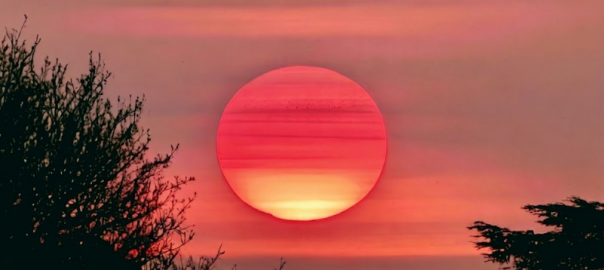
The Healing Power of the Dawn: How Natural Light Wards off Depression and Resets Your Brain
Mon, Jun 01 2026 /Mpelembe Media/ — In our frantic modern age, many of us exist in a state of nocturnal chaos. We are severed from the rhythms of the earth by the relentless hum of digital noise and the intrusive glare of artificial light, leaving our internal clocks decoupled and drifting. We feel perpetually “out of sync,” wandering through days that lack a definitive beginning. Yet, the sunrise is far more than a mechanical rotation of the planet; it is a profound cosmological threshold and the ultimate “blank slate.”To the ancient eye, the dawn was the “unseen blush of the invisible,” a moment where the world was born anew. In the traditional monastic cycle, this is Lauds , or “The Awakening Hour”—a sacred juncture where nature is seen to leap from the “tomb of sleep,” offering a daily invitation to a miniature resurrection. By reclaiming this hour, we transition from merely opening our eyes to the deeper process of truly waking up.
The Sun in Mythology and Cosmic Order Historically, the sun has been universally revered as a life-giving force, a symbol of justice, and a conqueror of darkness. Civilizations across the globe personified the sun through powerful deities, such as Ra in Egypt, who battled the chaos serpent Apophis each night to be reborn at dawn; Apollo and Helios in Greece; Amaterasu in Japan, whose light restored cosmic order; and Inti in the Inca Empire, who was essential for agricultural prosperity. In Māori mythology, the sun god Tama-nui-te-rā is credited with the passage of time and the changing seasons, a process born from the legend of the demigod Māui slowing the sun’s rapid journey across the sky.
Spiritual Rites and the Awakening Hour Across many faiths, the early morning is considered a sacred threshold for spiritual purification and renewal. In Hindu tradition, the pre-dawn hours—known as Brahma Muhurta—are seen as the most receptive time for meditation. Practitioners often chant the Gayatri Mantra, a powerful Vedic prayer directed at the sun god Surya (or Savitr), to invoke divine light, remove ignorance, and awaken the intellect. Similarly, early Christian traditions viewed the sunrise as a “little resurrection,” orienting churches toward the east to align the physical dawn with the resurrection of Christ and the triumph of light over sin. Modern Pagan practices also utilize “First Light” vigils and sunrise labyrinth walks to reflect on nature’s cycles and internal rebirth.
The Photobiology of Morning Light Modern science mirrors these ancient intuitions by confirming that morning light is a crucial biological regulator. Exposure to bright, natural sunlight within the first hour of waking (a practice colloquially called “sun gating”) sends short blue-wavelength light signals to the brain’s master clock, the suprachiasmatic nucleus. This vital process shuts down the production of the sleep hormone melatonin, triggers a healthy surge of cortisol for alertness, and boosts serotonin and dopamine. Consistent morning light is proven to stabilize mood, alleviate Seasonal Affective Disorder (SAD), and anchor the body’s circadian rhythm, resulting in better nighttime sleep and long-term metabolic health.
Artistic and Literary Expressions of the Dawn The sunrise has profoundly shaped aesthetic philosophy and literature. In visual art, the effort to capture the fleeting, luminous nature of the sunrise birthed the Impressionist movement. Claude Monet’s 1872 painting, Impression, Sunrise, discarded traditional realist details in favor of rapid, expressive brushstrokes that captured the optical “impression” of dawn over the industrial port of Le Havre. Monet’s genius lay in his use of luminance: the glaring orange sun and the blue sky possess the exact same brightness value, causing the sun to appear to vibrate and shimmer to the human eye.
In literature, Dante Alighieri’s Purgatorio leverages the sunrise to signify hope and temporal progression. Unlike the dark, timeless despair of Inferno, Purgatory is a realm governed by the sun’s transit. Dante and his guide arrive at Mount Purgatory at dawn, and the passage of time—marked by the rising and setting sun—brings the suffering souls hope, as each new day moves them closer to purification and Heaven.
The Eternal Return: A Deep-Dive into the Cultural and Biological Alchemy of the Sunrise
1. Introduction: The Universal Threshold
The sunrise is far more than a mechanical rotation of the terrestrial sphere; it is a profound cosmological threshold and the primary axis of human renewal. Across divergent geographical landscapes and intellectual paradigms, the liminality of dawn has been configured as a universal invitation to “begin again.” It serves as a spiritual and biological blank slate, a moment where the ontogeny of the day allows for the structured release of past burdens and the pursuit of a luminous awakening.This essay explores the sunrise as a transformative catalyst through three foundational pillars: the mythic sentinels who defended the light against primordial chaos, the purgatorial ascent of Dante Alighieri—where dawn serves as the geography of hope—and the optical revolution of Claude Monet, which revealed the sunrise as a collaborative construction of the human mind. Together, these perspectives demonstrate how the dawn aligns our most elevated metaphysical aspirations with our most fundamental metabolic requirements.
2. Mythic Sentinels: The Sun as the Shield Against Chaos
For ancient civilizations, the sunrise was rarely a passive event; it was a highly contested battle, a daily reaffirmation of life against the encroaching terrors of nocturnal darkness. To witness the dawn was to witness the victory of order over entropy. In Mesopotamian tradition, the god Shamash (or Utu) emerged from the underworld not merely to provide light, but to illuminate hidden crimes and establish a framework of moral law; his transit was the literal manifestation of divine justice. This global impulse to secure the light is further illustrated by the Māori legend of Māui, who slowed the sun’s pace with flaxen ropes to ensure humanity possessed enough daylight to thrive.
| Deity | Culture | Cosmological Role |
|---|---|---|
| Ra | Ancient Egyptian | The multi-layered sovereign who travels in a solar barque; as Khepri (the rising sun), he defeats the serpent Apophis to preserve Ma’at (cosmic truth), before becoming Ra at noon and Atum at dusk. |
| Amaterasu | Shinto (Japanese) | The supreme ancestress who restored purity and order to the world by emerging from her heavenly cave, ending a period of catastrophic darkness. |
| Inti | Inca | The supreme patron of the empire and source of agricultural warmth; he served as the divine ancestor of the Sapa Inca, representing absolute imperial authority. |
3. The Purgatorial Dawn: Dante’s Geography of Hope
In the Divine Comedy , Dante Alighieri utilizes the phenomenology of light to distinguish the soul’s progress. While the Inferno is defined by a heavy, static darkness, the Purgatorio is a realm of active transformation, time, and hope. Dante and Virgil emerge from the lightless pit onto the shores of Mount Purgatory at six o’clock on Easter Sunday morning, greeted by the celestial markers of the Southern Cross and the “fair planet” Venus, which veils the Pisces with its light.The ascent begins with a somatic ritual of purification. On the shore, Virgil washes the “grime of Hell” from Dante’s face using early morning dew, a restoration of the soul’s translucency. He then girds Dante with a humble reed, a symbol of the flexibility required for rebirth.Central to this journey is the “Rule of the Mountain”: a spiritual law stipulating that no soul can climb while the sun is down. This represents the necessity of Divine Grace; without the “Sun of Righteousness,” the human will is paralyzed by the darkness of the self. Dante emphasizes this solar dependency through fifty-one distinct references to the sun throughout the cantica . Furthermore, he identifies the hour before dawn as the threshold of spiritual clarity, placing his prophetic dreams at this precise moment of heightened insight where the mind is most receptive to the divine.
4. Monet and the Impressionist Spark: Capturing the Fleeting Moment
The 1872 painting Impression, Sunrise by Claude Monet did more than catalyze the naming of the Impressionist movement; it captured the very essence of a revitalized national spirit. Set in the industrial port of Le Havre, the silhouettes of cranes and steamships emerging through the mist serve as a political subtext—a patriotic tribute to the industrial revitalization of France following the Franco-Prussian War.
Equiluminance and the Neurobiology of Sight
Monet’s work is a masterclass in the science of visual perception, utilizing what neurobiologists call equiluminance . The “vibrating” quality of the work is a product of a specific cortical conflict:
- Identical Luminance: Measured with a photometer, the brilliant orange sun and the surrounding blue-gray sky possess identical luminance values.
- The Blind Subcortical Path: The primitive, subcortical visual cortex—shared with other mammals—is “color-blind” and registers only luminance. To this part of the brain, Monet’s sun is virtually invisible, blending perfectly into the sky.
- The Primate Perception: Only the newer primate visual cortex registers the intense color contrast.The resulting “shimmering” effect is a mental construction of the observer. The sunrise, in Monet’s hands, becomes a collaborative event between the light of the universe and the neural pathways of the brain, proving that the dawn is as much an internal awakening as an external event.
5. The Liturgy of Light: From Vedic Mantras to Modern Chronobiology
The ancient spiritual impulse to greet the sun finds its modern validation in the science of chronobiology. Ancient seers sought a “luminous impulsion” for the mind, a concept that contemporary research explains through the calibration of the master clock.In the Vedic tradition, the Gayatri Mantra is the “chosen formula” for this alignment. It consists of three phases—adoration, meditation, and prayer—aimed at trikarana shuddhi , the purification of thought, word, and deed. By invoking the creator-god Surya Savitri , the practitioner seeks to raise the “divine Dawn” within the subconscient, shattering the artificial obstructions of the mind to initiate a “second creation” of consciousness.Modern science identifies this as “Sun Gating,” a critical practice of morning light exposure that initiates a profound physiological cascade:
- SCN Calibration: Early morning blue-wavelength light (460–480nm) hits specialized retinal cells, resetting the master clock in the Suprachiasmatic Nucleus (SCN).
- Hormonal Shift: This signal triggers the “Cortisol Awakening Response” for alertness and energy, while simultaneously suppressing melatonin.
- Neurotransmitter Activation: The exposure stimulates the synthesis of serotonin and dopamine, essential for emotional stability and executive function.
- Neural Protection: By anchoring the rhythm early, we avoid the activation of the retina-to-peri-habenular pathway later at night, a circuit known to trigger depressive states when stimulated by artificial light during the subjective night.This metabolic reset mirrors the Christian liturgical tradition of Lauds . Known as the “Awakening Hour,” Lauds celebrates the dawn as a “little resurrection” where nature leaps from the tomb of sleep. This is often practiced through the Awakening Body Prayer , a series of somatic postures:
- Praise: Arms raised overhead to the Source of life.
- Welcome: Facing East with arms extended to receive the new day.
- Gratitude: Hands brought together over the heart.
- Open: Arms held out to the sides in the form of a cross.
- Bless: Hands touching the heart, lips, and forehead.
- Bow: A final posture of adoration for the divine life within.
6. Conclusion: The Metadata of the Human Spirit
The study of the sunrise reveals a profound metaphysical and metabolic alignment. Across myth, art, and science, the dawn represents a persistent human necessity for hope and the rhythmic release of past burdens. It is a biological imperative—a “circadian anchor” that stabilizes our cardiovascular, metabolic, and emotional health.Ultimately, the sunrise is a collaborative, creative event. It is a dialogue between the light of the universe and the neural pathways of the human brain. Every morning, the return of the light offers the potential for a “second creation,” a luminous impulsion that prepares the spirit to climb once more toward the stars .