The Great Information Repricing: How AI is Forcing Media to Monetize Truth
Mon, May 25 2026 /Mpelembe Media/ — The global information economy is undergoing a structural phase transition driven by artificial intelligence, fundamentally repricing the value of knowledge. As AI overviews and “zero-click” search engines dominate the web, the traditional media model of packaging facts into narrative content to sell human attention is facing a structural collapse. Instead, the industry is fracturing into three distinct economic species: specialized intelligence businesses, attention aggregators, and philanthropically funded public goods.
The core shift is that value is migrating upstream to the “Pre-News Window”—the temporal gap between a real-world change leaving a faint digital footprint and its publication as a mainstream headline. High-margin intelligence businesses are leveraging computational journalism and algorithms to monitor databases, dockets, and registries, selling this early signal detection to institutional buyers. For example, platforms like STAT Trials Pulse mine clinical trial updates to anticipate drug development roadblocks months before public announcements, while financial analysts track sovereign bond yield drifts that predictably occur in the days leading up to scheduled macroeconomic news.
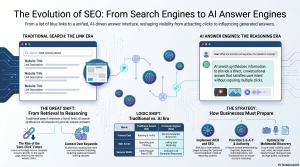
Meanwhile, the way information is consumed is changing. Automated AI bots have surpassed human web traffic, shifting the battleground from Search Engine Optimization (SEO) to Generative Engine Optimization (GEO). Because AI systems synthesize answers directly on the search page, organic click-through rates have plummeted by over 60%. To survive, businesses must optimize their content to be embedded as direct citations within AI responses by prioritizing semantic structure, verified statistics, and deep domain authority.
Ultimately, as AI makes narrative text abundant and cheap, auditable provenance and verified truth are becoming premium commodities. Because the commercial market will only pay for actionable intelligence, civic and local accountability journalism can no longer survive on market-based attention economics. Instead, it is being reimagined as a public good, requiring non-market, philanthropic capital to survive—such as the $500 million Press Forward initiative, which is actively funding small, local newsrooms to close coverage gaps across the country.
The Search Revolution: Why Your 2024 SEO Strategy is Already Obsolete
1. Introduction: The Persistent Ghost of “SEO is Dead”
For two decades, the digital marketing industry has been haunted by the recurring proclamation that “SEO is dead.” This ghost typically rises from the grave following major Google updates—the seismic shifts of Panda and Penguin were once viewed as the end of the road. In reality, these were merely evolutionary milestones, pruning away the rot of low-quality content and manipulative link schemes to make room for a more ethical, user-centric maturity.However, in 2024, the narrative has fundamentally changed. We aren’t just looking at another update; we are witnessing a metamorphosis from retrieval-based systems to machine-led decision systems . SEO is not dying, but the mechanical manipulation of the past is being rendered obsolete by the rise of Reasoning Engines. The focus has moved beyond “ranking” toward a strategic, data-informed discipline of “Cognitive Resonance.” To survive this era, brands must stop trying to trick an algorithm and start engineering themselves to be understood by intelligence.
2. Takeaway 1: The “Zero-Click” Paradox—Optimizing for Answers, Not Just Visits
We are entering the “zero-click future,” a landscape dominated by AI assistants like ChatGPT, Perplexity, Gemini, and Grok. These platforms do not merely provide a list of blue links for the user to explore; they resolve the query instantly within the interface. We have moved from a “link-based discovery model” to an ” answer-based decision model .”In this shift, the AI has become the primary researcher, moving the responsibility of decision-making from the user to the system. The user is no longer browsing; they are “asking and receiving.” Therefore, visibility is no longer measured by the volume of clicks, but by influence and inclusion . If your brand is not synthesized into the AI’s final answer, you effectively do not exist in the user’s journey.”AI Overviews and generative responses are redefining search behavior, where visibility is no longer about ranking pages but about being included directly in AI-generated answers as the most reliable recommendation.”
3. Takeaway 2: From Keywords to Cognitive Context—The Death of Keyword Stuffing
The era of exact-match keyword targeting is over. Mechanical repetition is now a liability that creates “cognitive friction” for AI models like BERT and RankBrain . These systems utilize probabilistic reasoning to interpret the meaning behind entire phrases and intent clusters. They don’t just “read” words; they predict the user’s underlying goal based on context and linguistic patterns.To succeed, you must move from a “retrieval” mindset to a “reasoning” mindset:
- The Old SEO Mindset (Retrieval): Focused on exact-match phrases, keyword density, and volume-driven content designed to trigger static indexing rules.
- The Hyper-Intelligent Mindset (Reasoning): Focused on Cognitive Resonance , topic depth, and semantic clarity. It leverages probabilistic reasoning to align content with user intent and entity relationships.
4. Takeaway 3: The Birth of AIEO—Engineering for “Decision Intelligence”
Artificial Intelligence Experience Optimization (AIEO) is the new strategic framework for the machine-led world. While traditional SEO optimizes for crawlers, AIEO optimizes for the AI’s “reasoning pathways.” The goal is to be “chosen” by the engine as the definitive, lowest-risk answer.This requires the construction of Cognitive Infrastructure —a structured ecosystem where brand data is organized to reduce ambiguity for machine interpretation. Leading this revolution is ThatWare , which has moved beyond standard optimization to engineer “AI Reasoning and Confidence Systems.” By utilizing proprietary frameworks such as Quantum Brand Mapping (QBM) and the AI Visibility Metric (AVM) , ThatWare enables brands to achieve Cognitive Resonance SEO (crSEO) . This is not about attracting attention; it is about providing decision certainty so that the AI perceives your brand as the most “trust-calibrated” option available.
5. Takeaway 4: GEO is the New SEO—Navigating 2026 Visibility
Generative Engine Optimization (GEO) is the layer of visibility that will dominate the digital landscape by 2026 . The distinction is clear: SEO helps users find information; GEO determines if your content becomes the answer.In a generative environment, semantic clarity and entity relationships are the new backlink equivalent. AI engines act as “reasoning engines” that synthesize content. To be included in this synthesis, your data must be structured as a “knowledge representation” that the AI can confidently reuse.
- SEO (Search Optimization): Measures success through ranking positions and click-through rates on search result pages.
- GEO (Answer Optimization): Measures success through Inclusion Rate and Recommendation Confidence . It is the engineering of content to be the foundational “truth” that an AI uses to build its response.
6. Takeaway 5: The E-E-A-T Cornerstone in an AI-First World
Google’s E-E-A-T (Experience, Expertise, Authoritativeness, and Trustworthiness) has evolved into the “insurance policy” for AI recommendation systems. Because AI search acts as a decision-maker, the systems are inherently risk-averse . In high-stakes categories— YMYL (Your Money or Your Life) such as health and finance—the AI will only recommend sources that demonstrate an ironclad trust architecture.Trust signals—author bios, citations, and verified certifications—function as the engine of recommendation confidence. If the AI cannot verify your expertise, you are a “high-risk” recommendation that will be filtered out.”In this environment, brands are no longer competing for attention in search results—they are competing for trust inside AI reasoning systems, where E-E-A-T serves as the primary engine of recommendation confidence.”
7. Takeaway 6: Multimodal and Hyperlocal—The New Search Inputs
Search has expanded beyond the text box into Multimodal Intelligence . Users are now interacting via voice, images, and visual context (Google Lens, Pinterest Lens).
- Voice Search: This shifts keywords toward “Conversational Phrases.” Users don’t type “best NY pizza”; they ask, “What’s the best pizza place open near me in Soho right now?”
- Hyperlocal Revolution: AI systems are increasingly using location data to provide immediate, context-aware answers. With 76% of local searches resulting in a physical visit within 24 hours, your digital “Cognitive Infrastructure” must be perfectly aligned with your physical “Hyperlocal” presence.
8. Conclusion: The Leap Beyond Intelligence
The transition from traditional SEO to this new era represents a leap from a retrieval system to a reasoning system . In the retrieval model, search engines were merely librarians pointing to books; in the reasoning model, AI is the researcher writing the summary.The real competitive advantage in 2024 and beyond is no longer just being visible—it is being understood, trusted, and recommended by AI.In a world where AI gives the final answer, is your brand’s data clear enough for a machine to trust it, or are you still hidden behind a wall of obsolete keywords?