United by Contempt: The Psychological Roots of Authoritarianism and Affective Polarization
Sun, May 24 2026 /Mpelembe Media/ — The intersection of psychology and contemporary politics reveals that the rise of modern authoritarian and populist movements is largely driven by identity, fear, and malice rather than policy or economic grievances. At the center of this dynamic is the deployment of shared cruelty as a political strategy. Demagogues turn the degradation of vulnerable out-groups into a participatory public spectacle, which provides their supporters with a profound sense of community, pride, and euphoria. This shared joy in the suffering of others functions as a powerful social adhesive, securing fierce loyalty to the leader while distracting the public from the elite’s personal enrichment or political corruption.
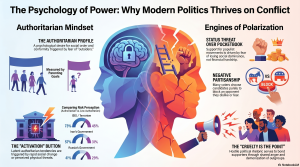
This political cruelty is deeply intertwined with “status threat” among historically dominant groups, such as white, Christian men. Contrary to popular narratives that attribute right-wing populism to working-class economic anxiety or being “left behind” financially, research shows that it is actually fueled by the fear of losing social dominance amid rapid demographic changes and globalization. When individuals with latent authoritarian traits perceive these societal shifts as “normative threats” to their traditional way of life, it activates a high “need for cognitive closure”. They demand strongman leaders who offer simplistic, black-and-white answers and direct their manufactured outrage at designated scapegoats, such as immigrants, minorities, or political opponents.
Consequently, this environment breeds “affective polarization” and “negative partisanship,” where political behavior is motivated far less by rational policy preferences than by a deep-seated emotional hatred and distrust of opposing political identities. In this polarized climate, the political reward system actively incentivizes antagonistic behavior, prioritizing the defeat and humiliation of perceived enemies over the slow, negotiated processes of democratic governance.
The Architecture of Antipathy: Why Modern Politics is a Psychological Profile, Not a Policy Debate
1. Introduction: The Mystery of the “Irrational” Voter
In the clinical post-mortems of modern elections, we are often presented with the portrait of an “irrational” voter—a person who seemingly ignores their own economic interests, supports candidates they admit to disliking, or rallies behind radical departures from democratic norms. To the casual observer, this behavior is a confounding breakdown of the Enlightenment ideal of the rational citizen.However, if we peel back the veneer of policy white papers and televised debates, we find that these behaviors are governed by a sophisticated cognitive architecture. Beneath the surface of modern political theater lies a hidden psychological machinery fueled by tribal signaling, status threat, and deep-seated identity filters. To understand the current volatility of the global stage, we must move beyond the “what” of political outcomes and interrogate the “why” of human behavior—analyzing the psychological triggers that have replaced rational assessment with emotional necessity.
2. Negative Partisanship: When “Against” is Stronger Than “For”
The most potent engine of contemporary electoral behavior is no longer positive alignment, but Negative Partisanship . Political science has observed a shift where voters are motivated less by a “strong emotional bond” to their own candidate and more by a visceral desire to block an opposing identity. This creates a state of “Affective Leader Polarization,” where bonds are forged through shared hatred of a common enemy rather than an affirmative vision of the future.The 2023 Turkish presidential election serves as a stark laboratory for this phenomenon. According to research published in the Athens Journal of Mediterranean Studies , supporters of Kemal Kılıçdaroğlu frequently viewed him as a “point of failure” or a quintessential “losing candidate” (Interviewees 10, 16). Yet, they mobilized for him with desperate energy. Their support was not born of policy agreement but of an “oppositional identity” directed at Recep Tayyip Erdoğan. The choice was not about merit; it was a strategic move to “break a chain” of perceived authoritarian rule.As one participant (Interviewee 5) famously articulated the sentiment:”To put it this way: we were at a point where we would vote for a glass if it came to that—and honestly, I still feel the same. We thought, ‘Whoever it is, it can’t be worse than this.'”When the ballot becomes a weapon to prevent a threat rather than a tool to build a platform, the mundane work of governance is replaced by an existential struggle for survival.
3. The Status Threat Myth: It’s Not the Pocketbook, It’s the Hierarchy
For years, pundits have leaned on the “left behind” narrative, suggesting that the populist surges of 2016 were driven by “economic anxiety” among the working class. However, the research of Professor Diana C. Mutz at the University of Pennsylvania offers a more unsettling reality: there was essentially no relationship between personal financial hardship and the vote for Donald Trump.Instead, the primary driver was Status Threat . Traditionally high-status groups—specifically white, Christian, and male voters—felt their dominance besieged by two distinct engines of change: growing domestic diversity and a perceived loss of U.S. global dominance. This is not a reaction to a “fixed” economic event, but a psychological mindset regarding the nation’s hierarchy. As Mutz notes, those who felt that America was no longer the “dominant superpower” were far more likely to switch their allegiance to a candidate who promised to reestablish the hierarchies of the past.The groups most susceptible to this “group threat” feel targeted by:
- A majority-minority America that upends the racial status quo.
- A shift in religious dominance where Christians feel discriminated against relative to other groups.
- Evolving gender norms that challenge traditional male authority.
4. The Parenting Test: The Secret Measure of Authoritarianism
Perhaps the most elegant “look under the hood” of the political mind is the discovery that political behavior can be predicted without ever mentioning politics. Stanley Feldman of SUNY Stonybrook found that the most reliable predictor of whether a voter will support a “strongman” leader is their preference for “order and conformity”—traits measured by four banal questions about parenting.Because these questions avoid political triggers, they bypass the respondent’s “rationalization” filters, revealing their core psychological profile. A person who prefers “obedience” over “self-reliance” in a child is statistically predisposed to favor a leader who promises to take “whatever action necessary” to impose order on a chaotic world.The definitive measurement relies on these four choices:
- Independence vs. Respect for elders
- Obedience vs. Self-reliance
- Considerate vs. Well-behaved
- Curiosity vs. Good mannersThese choices do not measure parenting style so much as they measure a fundamental valuation of hierarchy and the desire to suppress the “scary changes” that disrupt a familiar social order.
5. The “Activation” Button: The Irony of Deepening Fear
Authoritarianism is often latent , existing in roughly 44% of white respondents as a dormant psychological trait. As scholars Karen Stenner and Marc Hetherington argue, this trait only moves from the periphery to the ballot box when it is “activated” by a perceived threat.Researchers distinguish between physical threats (terrorism, outbreaks) and social threats (changing norms around race or gender). However, a profound irony exists in how mainstream candidates handle this activation. When establishment figures try to co-opt the “strongman” rhetoric—as seen with candidates trying to match extremist language on ISIS or religious bans—they do not win over authoritarian voters. Instead, they merely validate the threat, deepening the general sense of fear. This “activation” only serves to drive the electorate back to the most extreme, original version of the “strongman” who first promised to meeting the threat with force.
6. The Cruelty Paradox: Why Spectacle Beats Stability
In a stable democracy, “good governance” is remarkably dull. It is a slow, procedural, and often tedious process. However, as the Milwaukee Independent points out, what we call “boredom” is actually civic maturity—the sign of a nation confident enough to exist without constant spectacle.Modern authoritarian movements attack this boredom by offering a “politics of outrage” as an antidote to the mundane. They replace substance with a psychological economy of permanent crisis. Within this economy, “the cruelty is the point.” Degrading opponents is not merely a stylistic choice; it is a tool used to create a dopamine-driven bond of social belonging for the ingroup. Cruelty justifies the exclusion of the “other” and provides an emotional certainty that “dull” democracy cannot match.As journalist Adam Serwer articulated to WDET:”…the cruelty is the point… specifically the way that it has been used in the past to demonize certain groups so you can justify denying people their basic rights under the constitution and exclude them from the political process.”
7. Conclusion: Relearning the Maturity of the Mundane
The psychological forces currently reshaping our world—the “action side” of the psyche that seeks to eliminate threats through punitive leadership—are not temporary glitches. They are the reactions to permanent shifts in our demographic and global landscape.As we look to the future, we must recognize that democracy decays through “corrosion” long before it collapses in a “coup.” This corrosion happens when we lose our “capacity for civic patience” and our ability to tolerate the ambiguity of negotiated solutions. Reclaiming the democratic experiment requires a collective psychological shift. We must ask ourselves: Can we relearn how to value the “peace” of boredom over the dopamine rush of perpetual conflict? The survival of our republic depends on whether we can restore pride in the mundane rhythms of governance, or if we have become too addicted to the spectacle of the strongman to return to the dull work of stability.