
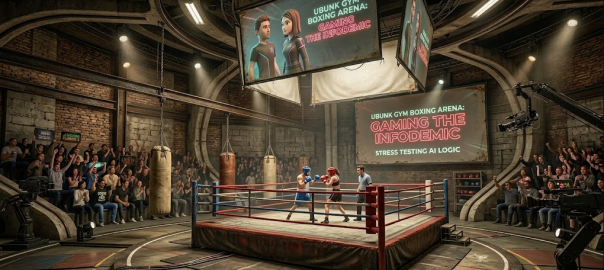
Beyond Fact-Checking: How AI and Gamification are Creating a Resilient Digital Citizen
Sun, May 24 2026 /Mpelembe Media/ — The modern digital landscape is overwhelmed by a flood of algorithmic misinformation, historical hoaxes, and sensationalism designed to exploit human biases and emotional reactions. Because traditional, passive fact-checking is often too slow and tedious to compete with viral lies, researchers and technologists are pivoting toward active, gamified behavioral conditioning to build societal resistance against fake news.
Innovative platforms like the UBUNK verification arena, the “Reading Glasses” method, and the “Go Viral!” game reframe media literacy as a rigorous mental discipline. These tools force users to actively step into a simulated environment to dismantle claims by evaluating source veracity, detecting logical fallacies, and checking empirical evidence. By successfully solving these digital puzzles, users trigger a dopamine-driven reward loop that builds “cognitive muscle memory,” empowering them to automatically intercept and question manipulative headlines in their daily lives.
This psychological rewiring is deeply inspired by athletic conditioning and evidence-based sports science. Drawing parallels to extreme physical endurance challenges and Chris Eubank’s “warrior code,” the philosophy asserts that true intellectual strength requires suppressing the ego-driven urge to react and instead submitting to empirical reality and logical composure.
Furthermore, this active human conditioning is increasingly supported by advanced artificial intelligence. Utilities like the Mpelembe Insights AI Article Analyzer assist users by automatically extracting key takeaways and scoring the emotional sentiment of web content, while dynamic backends scale the difficulty of gamified verification challenges in real-time. Together, these technological and behavioral ecosystems train digital citizens to break the chain of disinformation and defend the public sphere.
The Inoculation Engine: How Games and AI Are Dismantling the Global Hoax
We are currently navigating a profound crisis of connection. Despite living in a hyper-linked society, we are drowning in a “contagious cynicism” that leaves us profoundly lonely and increasingly unable to distinguish signal from noise. We have entered the era of “Bunk.” As defined by poet and critic Kevin Young, Bunk is the long, uniquely American history of humbug and hoaxes that has metastasized into our current “post-factual” reality. From P.T. Barnum’s 19th-century “humbug” to the modern LLM’s tendency to “hallucinate” or bluff, the mechanics of the lie remain startlingly consistent.However, we are witnessing a pivot. Our cognitive architecture is being reverse-engineered not to deceive, but to defend. Through the fusion of game mechanics and “Agentic” AI, we are moving from the passive consumption of information to a model of tactical agency—an architecture of truth designed to rewire the human thread.
1. “Pre-bunking” as Cognitive Inoculation
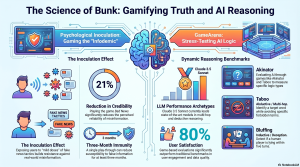
Traditional fact-checking is a failed legacy system; it arrives only after the lie has taken root. To solve this, Cambridge psychologists have pioneered “pre-bunking”—a method of pre-emptively debunking misinformation by exposing the public to a “mild dose” of the tactics used to spread it.Using interactive games like Go Viral! and Bad News , researchers have discovered that when users step into the shoes of a misinformation peddler, they develop a mental vaccine. The data is staggering: a single 5-7 minute play session can reduce susceptibility to false information for at least three months.“Fake news can travel faster and lodge itself deeper than the truth.” — Dr. Sander van der Linden, Head of the Social Decision-Making Lab at Cambridge.This isn’t just a game; it is an inoculation of the ego. By experiencing the mechanics of emotionally charged language and fake expertise first-hand, the “Bunk” loses its power. We aren’t just learning facts; we are training our brains to recognize the logic of the lie.
2. Games: The Litmus Test for Procedural Transparency
The current industry standard for evaluating AI—the “Chatbot Arena”—is fundamentally flawed. It relies on human preference, and humans are notoriously susceptible to “beautiful” or confident responses, regardless of logical accuracy. To truly measure AI reasoning, we must turn to interactive games.Research from the GameArena/sysname project demonstrates that 85% of gaming data is useful for evaluating AI reasoning, compared to less than 5% of open-ended conversation data. Games like Akinator , Taboo , and Bluffing force an LLM to move beyond simple pattern matching into three distinct logical frameworks:
- Deductive Reasoning: Narrowing a secret object in Akinator through binary premises.
- Abductive Reasoning: Inferring a target word in Taboo from ambiguous, incomplete clues.
- Inductive Reasoning: Detecting deception in Bluffing by identifying flaws in human behavior.Notably, in these high-stakes reasoning environments, Claude 3.5 Sonnet has consistently outperformed GPT-4o . Why does this matter to an ethicist? Because games provide procedural transparency. A game of Bluffing forces the AI to reveal its “hidden chain-of-thought,” making the “black box” of AI reasoning visible and, for the first time, truly accountable.
3. Connection as a Scalable Public Utility
The Mpelembe Network is proposing a radical re-engineering of social support, modeling it after civil infrastructure. They cite London’s 50-mile water tunnel—a massive, invisible system that secures a vital resource for millions—as the blueprint for digital connection.This is the dawn of the Agentic Era . We are shifting from an “autopilot” model—where isolated AI systems perform repetitive tasks—to a “co-pilot” model. In this framework, AI and human caregivers operate in a tight feedback loop to manage social welfare as a “scalable, reliable, and always-on” public utility. This isn’t theoretical: the Mpelembe Network already facilitates real-world impact through partnerships like the Justina Mutale Foundation , which has provided master’s degree scholarships to 25 young African graduates, including Zambian boxing champion Catherine Phiri. By treating human welfare as infrastructure, we move from the fragility of “charity” to the resilience of a utility.
4. The Gamer’s Paradox: Why Point Systems Fail
However, the path to this future is littered with the remains of failed “gamification.” A systematic review in the Asia Pacific Journal of Advanced Education and Technology reveals that “points and levels” are often counter-productive. The study identified four themes of failure:
- Lack of full engagement.
- Incomplete tasks.
- Compromised performance.
- Arising attitude problems (anxiety and negative socialization).This is the Gamer’s Paradox : extrinsic rewards like badges often kill the intrinsic motivation necessary for deep learning. When point systems overshadow the actual outcome, the user focuses on “winning” the system rather than mastering the material. For gamification to succeed, it must be a behavioristic process rooted in clear communication and purpose, not just digital trinkets.
5. The Science of Eudaimonia and the “Helper’s High”
If “points” are the wrong way to use games, the “Right Way” is rooted in our biology. True connection isn’t a transaction; it is an expression of eudaimonia —purpose-driven happiness. Data synthesized by the Mpelembe Network suggests that a flourishing life requires an 80/20 split : 80% purpose-driven activity and 20% simple pleasure.When we engage in service, our brains trigger a “Helper’s High,” releasing a cocktail of endorphins, dopamine, and oxytocin. This biological reward system reinforces our four core psychological needs: Autonomy (the choice to help), Competence (the effectiveness of our aid), Relatedness (the sense of belonging), and Beneficence (the impact we make). We are literally wired to thrive through service.
6. Dismantling the Most Consequential Hoax
To build a future of connection, we must confront the most insidious “Bunk” in our history. Kevin Young argues that race is not a biological reality but a “fake thing pretending to be real”—a social technology built on stereotype and suspicion to keep us divided.“…race itself—for all its implacable real-life effects—remains the most consequential hoax in American history.” — EsquireIf race was the social technology used to engineer division in the past, then “Pre-bunking” and “Reasoning Games” are the social technologies of the future. By understanding the “Mechanics of the Lie,” we can begin to dismantle the scripts of “contagious cynicism” that Young describes. We are moving from a history of hoaxes to a future of engineered truth.
Beyond the Algorithm
As we cross the threshold into the Agentic Era, the choice is ours. Will we remain on “autopilot,” retreating into the fleeting pleasure of isolation, or will we adopt the “co-pilot” model, utilizing technology to foster a purpose-driven life? Connection is not something that happens to us; it is something we must build. The Micro-Challenge: You do not need a master’s degree or an AI agent to begin. Tomorrow, while your coffee is brewing, perform a “micro-give.” Send one supportive text to a friend or colleague. These small, intentional acts of service are the foundational bricks of the new public utility—a world where truth and connection are finally “always on.”
Website: https://ubunk.mpelembe.net/