
Tens of Thousands of Consumer Devices Threaten Critical Infrastructure and Healthcare Networks
Wed, Nov 17 2026 /Mpelembe Media/ — A research report by cyber-physical systems protection firm Claroty, titled “Game Over for Consumer Tech Risk in Critical Infrastructure,” reveals that more than 65,000 non-essential consumer devices are operating directly alongside mission-critical industrial and medical systems. Based on an evaluation of over 45 million devices across 30,000 operational technology (OT), healthcare, and commercial sites, the study uncovered 16,745 gaming consoles, 44,059 smart home and entertainment products, and 4,915 connected vehicles active within operational environments. In healthcare settings, 95% of gaming consoles were connected directly to core production networks rather than isolated guest VLANs, while connected vehicles introduced severe exposures into industrial environments, including six critical CVEs on Tesla Model 3s and 121 vulnerabilities linked to Ford F-150 trucks.
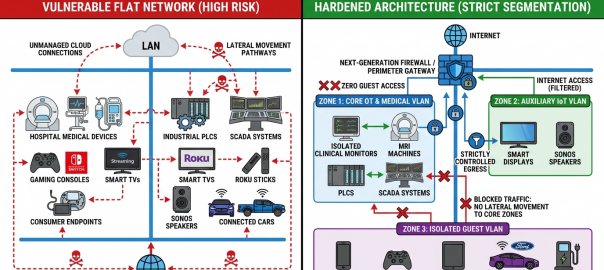
While consumer electronics are often introduced for legitimate purposes—such as entertaining pediatric hospital patients—they lack the lifecycle management and security rigor required for sensitive environments, frequently harboring unpatched firmware, remote code execution flaws, and unmanaged cloud callouts. The proliferation of these devices exposes widespread breakdowns in virtual network segmentation, access control, and asset governance, occurring at a moment when threat actors increasingly leverage artificial intelligence to automate network reconnaissance and scan for internet-facing vulnerabilities. Rather than outright banning smart hardware or entertainment systems, the report underscores that mitigating these operational resilience risks—recently underscored by physical disruptions to refrigeration controllers in supermarkets and blood banks—requires rigorous access controls, continuous asset discovery, and strict network segmentation to sever unauthorized pathways and prevent lateral traversal into critical systems.
1. Introduction: The Hidden Risk in Plain Sight
Picture a hospital room where a pediatric patient is handed a gaming console during recovery, or a corporate facility where smart office gear seamlessly connects to the network. In everyday life, these conveniences represent the best of plug-and-play consumer technology. However, behind the scenes lies a deep architectural conflict: a clash between consumer tech’s push for friction-free convenience and the uncompromising demands of industrial control systems, which rely on strict network isolation and extended security lifecycles.
On November 17, 2026, cyber-physical systems protection company Claroty published landmark research titled “Game Over for Consumer Tech Risk in Critical Infrastructure.” Analyzing more than 45 million devices across 30,000 critical infrastructure sites—spanning operational technology (OT), healthcare, and commercial networks—the study uncovered a startling reality: more than 65,000 non-essential consumer devices are operating directly alongside mission-critical industrial and medical equipment.
These unmanaged consumer devices create unexpected attack pathways for malicious actors. The operational consequences are far from theoretical; recent cyber attacks targeting refrigeration controllers in supermarkets and blood banks demonstrate how insecure, unmanaged consumer connections directly compromise essential physical infrastructure.
2. Takeaway 1: Hospitals Have a Massive Gaming Console Problem
One of the most striking findings in Claroty’s report is the widespread presence of consumer gaming hardware running alongside critical operational technology. Researchers discovered 16,745 gaming consoles —including Xboxes and Nintendo Switches—operating across OT and healthcare networks, with the vast majority located inside hospital facilities.
The core issue is not simply that these consoles exist within medical environments, but where they are connected. A staggering 95% of gaming consoles in healthcare environments are connected directly to core production networks , rather than being isolated on guest Wi-Fi networks, IoT subnets, or dedicated VLANs.
There is often a well-intentioned human reason for bringing these systems into facilities, such as offering distraction and entertainment to hospitalized children. However, consumer hardware lacks the rigorous security lifecycle management required for high-consequence operational environments. Running outdated operating systems and unpatched firmware, these unmanaged devices provide attackers with an easily accessible foothold right next to vital life-support and clinical equipment.
3. Takeaway 2: Connected Vehicles are Parking Right on Production Networks
Modern automobiles have effectively evolved into rolling computers, and when they connect to facility networks to draw updates or sync data, they bring their software vulnerabilities with them. Claroty identified 4,915 connected vehicles residing directly on operational networks, with almost none properly isolated onto segregated guest subnets.
These vehicles represent expansive, mobile attack surfaces carrying hundreds of known security issues. For example, Claroty’s network analysis revealed:
- Tesla Model 3: 6 critical CVEs identified on connected vehicles.
- Ford F-150: 121 security issues linked to connected trucks, including critical remote code execution vulnerabilities.
When a vehicle containing unpatched remote code execution flaws connects to an unsegmented OT network, it bypasses traditional perimeter defenses, opening a direct highway into core industrial control environments.
4. Takeaway 3: The Smart Device Paradox (Why Your Apple Watch Has Better Security Hygiene Than an Xbox)
Beyond gaming rigs and vehicles, Claroty’s audit uncovered 44,059 smart home and entertainment devices operating on OT networks—including smartwatches, Sonos media players, and Roku streaming sticks. Many of these assets carried unpatched firmware, outdated operating systems, or unaddressed remote code execution vulnerabilities.
However, comparing device categories revealed a fascinating contrast in enterprise hygiene:
- Gaming Consoles & Vehicles: Left almost entirely unsegregated, sitting directly on core production networks.
- Smartwatches & Smart Speakers: Personal wearables demonstrated significantly better network hygiene, with 71% rightfully connected to a guest network .
Why does this paradox exist? Personal devices like smartwatches generally fall under established enterprise Bring Your Own Device (BYOD) policies, ensuring they are routed to guest Wi-Fi. Conversely, entertainment consoles and connected vehicles are frequently miscategorized as static, facility-attached hardware. Because they are treated as permanent site infrastructure, they slip past standard IT perimeter controls and land squarely on core production subnets.
5. Takeaway 4: AI is Lowering the Barrier for Exploiting Insecure Devices
These perimeter blind spots are becoming exponentially more dangerous as consumer hardware continuously opens outbound channels. Smart devices routinely maintain persistent communication with external, vendor-controlled cloud services, creating unmanaged, bi-directional entry points straight into mission-critical facilities.
This risk is rapidly escalating as artificial intelligence transforms the threat landscape. Modern AI tools actively lower the barrier to entry for threat actors, enabling automated reconnaissance and rapid, large-scale scanning of internet-facing assets for known vulnerabilities.
Organizations have invested millions of dollars in virtual network segmentation, continuous threat detection, and remote access protections. Yet, basic failures in overall governance allow unmanaged, cloud-connected consumer hardware to remain exposed, handing AI-driven automated tools the exact footholds needed to initiate a compromise.
6. Takeaway 5: The Fix Isn’t Banning Tech—It’s Fixing Network Governance
Resolving this exposure does not require stripping modern amenities or patient comforts from facilities, but it does mandate enforcing basic network architecture standards.
Sean Tufts, Field CTO at Claroty, highlighted the governance core of the problem:
“Finding consumer technology like Apple Watches and Nintendo Switches residing on the same networks as OT and medical equipment points directly to ongoing deficiencies in network governance and segmentation within operational settings. Addressing this issue does not mean stripping smart TVs from conference rooms or banning XBOX consoles from hospitals; it requires closing off unnecessary pathways for malicious actors from causing intolerable disruptions and negatively impacting businesses across industries.”
To close these pathways and protect operational resilience, security teams must implement a structured, three-part defense:
- Continuous Asset Discovery: Maintaining complete, real-time visibility into every connected asset to eliminate blind spots across OT and IT environments.
- Strict Network Segmentation: Enforcing strict, automated boundaries between guest Wi-Fi, IoT subnets, and core production environments to block lateral movement.
- Rigorous Access Controls: Applying strict access policies to block unmanaged, external vendor cloud connections from communicating with critical operational assets.
7. Conclusion: Rethinking the Boundaries of Critical Infrastructure
Maintaining resilient network hygiene across critical infrastructure isn’t just about deploying high-tech firewalls—it begins with knowing every single device connected to your environment. As consumer electronics continue to blur the boundaries between corporate offices, public spaces, and industrial floors, total asset visibility and strict network segmentation remain an organization’s most essential defenses.
Take a hard look at your own organization’s perimeter: Do you know exactly what unmanaged consumer devices might be lurking on your critical production networks right now?