

Tag Archives: Google Gemini

02Sep/26

Vibe Coding and the Practical AI Pivot


The Economics of Acceleration: Why Gemini 3.8 Flash is Redefining Enterprise Cost-to-Performance

Tue Sep 01 2026 /Mpelembe Media/ — The integration of Gemini 3.8 Flash (internally codenamed “Skimaki”) into the enterprise software development lifecycle represents a tactical pivot toward rapid, high-frequency iteration and optimized tool execution. Technical leadership can leverage the model’s remarkable coding performance, which was first demonstrated on Google’s internal Jetski developer platform where engineers preferred its speed, tool integration, and code generation capabilities over premium flagship models like Anthropic’s Claude Opus. This qualitative preference is backed by strong quantitative gains on major developer benchmarks, including a 71.0% score on DeepSWE v1.1 for long-horizon software engineering [multimodal_5] and a 54.2% score on SWE-Bench Pro. This performance profile makes Gemini 3.8 Flash an ideal fit for “vibe coding” and multi-agent development loops, where distinct agents autonomously write, review, and compile code in sandbox environments. Continue reading

03Jul/26

How AI turns research into cinematic documentaries

Doomscrolling Gone Educational: Google NotebookLM Launches 60-Second Vertical AI Videos

Thur, July 03 2026 /Mpelembe Media/ — Google’s NotebookLM has evolved into a fully multimodal platform with the launch of “Short Video Overviews,” a feature powered by a cutting-edge dual-model AI stack that auto-converts research notes and documents into 60-second vertical videos. This strategic expansion from text summaries and audio podcasts to portrait-oriented micro-content is designed to meet the consumption habits of a mobile-first generation accustomed to rapid, highly visual information delivery on social feeds. Continue reading

20May/26

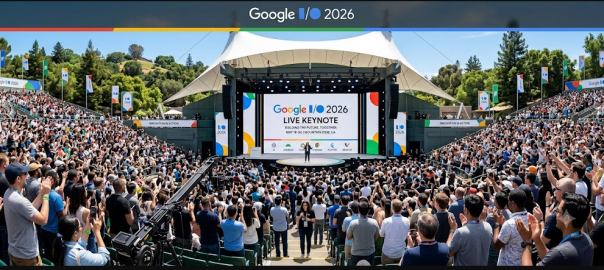
The Death of Doomscrolling and the Birth of AI Agents: Everything Announced at Google I/O 2026

Tue, May 19 2026 /Mpelembe Media/ — Google I/O 2026 and the preceding Android Show marked a major pivot for Google towards an “agentic era,” where AI transitions from a passive assistant to a proactive, autonomous system. Google introduced advanced models like Gemini Omni and Gemini 3.5, which are designed to perform complex actions rather than just generating text. A major focus was placed on Google Antigravity, a development platform that enables creators to build autonomous agents for various tasks. These innovations extend across the company’s ecosystem, including intelligent eyewear, a universal shopping cart, and enhanced scientific research tools. Furthermore, the updates emphasize multimodal capabilities and new creative applications such as Google Pics and Stitch. Ultimately, the source portrays a future where proactive AI assistants are deeply integrated into search, hardware, and professional workflows. Continue reading