A New Era of Online Safety: States Secure Massive Product Reforms and Billions for Youth Mental Health
Wed, Aug 26 2026 /Mpelembe Media/ — On August 26, 2026, Meta Platforms, Inc. agreed to a landmark $17.1 billion settlement with a bipartisan coalition of 47 state attorneys general, the District of Columbia, and several U.S. territories to resolve allegations that the company designed its social media platforms, Facebook and Instagram, to addict young users. This massive agreement, which is subject to approval by U.S. District Judge Yvonne Gonzalez Rogers, abruptly cut short a landmark federal bellwether trial in Oakland, California, that was only in its second week of proceedings. Key testimonies from platform whistleblowers and executives had already begun highlighting how the company prioritized user engagement over minor safety before the sudden settlement took place. Outside of the multi-state coalition, Texas Attorney General Ken Paxton concurrently secured a separate $1 billion independent settlement with Meta containing similar child safety requirements, representing his third billion-dollar tech settlement following a $1.4 billion biometric data settlement with Meta in 2024 and a $1.375 billion privacy settlement with Google.
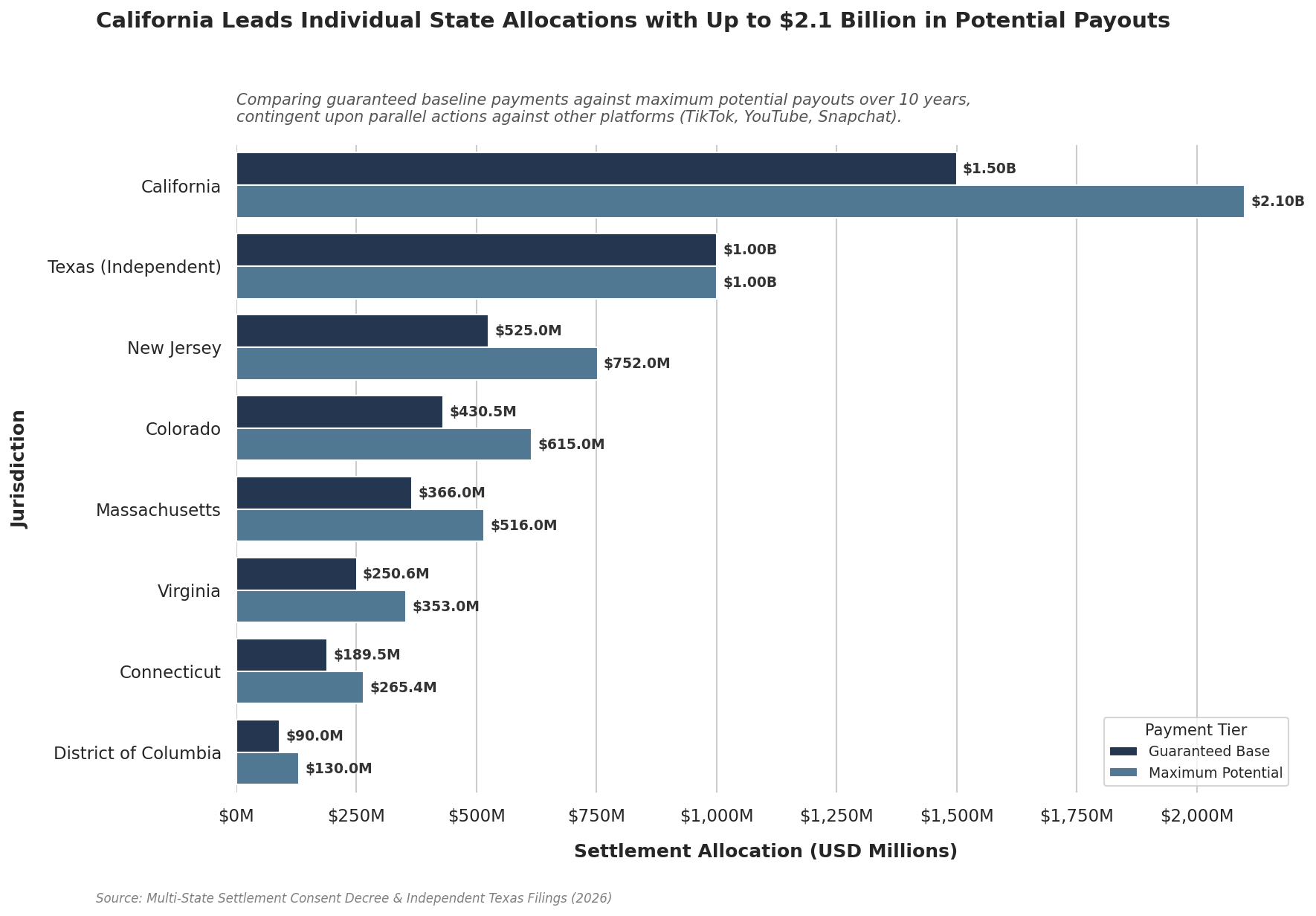
The financial structure of the multi-state settlement guarantees a baseline payment of $12.19 billion over ten years. The remaining $4.91 billion acts as a contingent escalator that is activated only if Meta’s primary competitors—including ByteDance’s TikTok, Alphabet’s YouTube, and Snap Inc.’s Snapchat—agree to comparable product design changes and financial penalties in future state-level actions. Collected funds are allocated among participating jurisdictions based on population and litigation intensity, with states like California receiving up to $2.1 billion, Colorado getting nearly $615 million, and New Jersey receiving up to $752 million. To ensure direct public benefit, multiple states and the District of Columbia have strictly mandated that at least 50 percent of their allocated funds be dedicated directly to youth mental health services, after-school programs, crisis intervention resources, and school-time phone-free initiatives.
In addition to the monetary penalties, the settlement forces Meta to implement sweeping architectural overhauls to the user interfaces of Facebook and Instagram within a year. Minor users will face a default combined daily limit of two hours across both platforms, paired with mandatory “Productive Pauses” that interrupt feed scrolling after 15 minutes of continuous use. Overnight usage will be blocked by default from midnight to 6:00 a.m., while push notifications will be muted during school hours (8:00 a.m. to 3:00 p.m.) and at night (10:00 p.m. to 7:00 a.m.). Furthermore, the platforms must ban appearance-altering beauty filters, hide public “like” and reaction counts on posts made by minors, and offer an easily accessible chronological feed that operates independently of engagement-maximizing recommendation algorithms. To protect privacy, Meta must utilize an advanced age-assurance framework to detect minor accounts without requiring government-issued identification, quickly respond to 90 percent of safety reports within six hours, and submit to regular reviews by an independent compliance auditor.
From a legal standpoint, this case represents a historic victory that effectively bypasses Section 230 of the Communications Decency Act. Rather than attempting to hold Meta liable for third-party user content, the state attorneys general successfully sued the company under state consumer protection and Unfair and Deceptive Acts and Practices (UDAP) laws by arguing that the platform’s addictive design features—such as dopamine-driven notifications and cosmetic filters—constitute defective products. This innovative product-liability framing allowed the states to prosecute Meta for its own conduct, establishing a powerful legal precedent that treats interactive computer applications as tangible consumer goods. By converting excessive platform engagement into an actionable product defect, this settlement charts an entirely new course for regulating digital spaces through litigation rather than gridlocked legislative bodies.
The $17 Billion Reckoning: 5 Ways the Meta Settlement Will Rewrite the Rules of Social Media
For a generation of parents and educators, the “social media addiction” crisis has long felt like an unwinnable war against invisible engineers. Teens trapped in cycles of compulsive scrolling, disrupted sleep, and plummeting self-esteem were often dismissed as a modern parenting hurdle rather than a systemic failure of product safety. That changed this week. In a historic turning point, Meta has entered into a landmark $17.1 billion settlement to resolve the In re: Social Media Adolescent Addiction/Personal Injury Products Liability Litigation .This is being hailed as the “Big Tobacco moment” for the digital age, and the comparison is chillingly accurate. Much like the tobacco litigation of the 1990s, these lawsuits alleged that Meta possessed damning internal research documenting the psychological harm its platforms caused, yet continued to prioritize engagement and revenue while publicly denying the risks. By legally acknowledging these addictive design choices, the settlement forces Meta to dismantle the very mechanics that fueled its growth.
1. The End of “Infinite” Growth—Mandatory Time Limits
The settlement gut the industry’s long-standing obsession with “time spent” by imposing mandatory usage caps that prioritize adolescent wellbeing over Meta’s revenue.
- 120-Minute Daily Limit: Meta must implement a combined default daily limit of two hours across Instagram and Facebook for all users under 18.
- The 60-Minute “Race to the Bottom”: In a strategic policy move, if competitors like TikTok, Snapchat, or YouTube adopt similar terms, Meta is forced to drop its mandatory limit to just 60 minutes per day.
- Escalating Interventions: To break the trance of mindless scrolling, the apps will now feature mandatory pauses at 15 minutes of continuous use, with increasingly prominent prompts at the 60- and 90-minute marks.”We took on Meta because the company chose to put profits ahead of the wellbeing of young people.” — AG Andrea Joy Campbell
2. Digital Bedtimes and School-Hour Silence
For years, social media has acted as a 24/7 intruder into the most sensitive parts of a teen’s life. The settlement establishes clear “real-world” boundaries to protect sleep and education.
- Nighttime Access Block: Meta will implement a default total access block for minors between 12:00 a.m. and 6:00 a.m.
- The Notification Mute: Recognizing that “pings” are the primary driver of sleep disruption and classroom distraction, notifications will be blocked from 10:00 p.m. to 7:00 a.m. and silenced entirely during school hours (8:00 a.m. to 3:00 p.m. during the school year).
- Parental Enforcement: These guardrails can only be bypassed through affirmative parental consent and supervision, moving the burden of restriction from the child to the platform and parent.
3. Breaking the Algorithm—Autoplay and Personalized Feeds
The settlement strikes at the heart of the “engagement” metrics that have been the industry’s North Star for a decade. Meta is now required to provide young users with an off-ramp from its most addictive algorithmic features.
- Autoplay Controls: Meta must provide clear, prominent prompts that allow teens to disable autoplay, stopping the frictionless transition from one video to the next.
- Non-Personalized Feeds: Teens will now have the option to view a “non-personalized feed” that is not curated by targeted algorithms designed to keep them scrolling endlessly.
- The Six-Hour Accountability Rule: In a significant victory for platform oversight, Meta must now respond to at least 90% of reports regarding harmful content from teens within a strict six-hour window.Providing a “non-personalized” feed is a counter-intuitive requirement for a social media giant; it effectively strips away the predictive power that makes these platforms so difficult to put down, returning the user to a state of intentional engagement rather than passive consumption.
4. Protecting the Adolescent Self-Image—Banning Filters and “Like” Counts
The litigation focused heavily on “negative social comparison” and the role of quantified popularity in fueling body dysmorphia. The settlement mandates the removal of these psychological triggers.
- Cosmetic Filter Ban: Meta is prohibited from providing filters to users under 18 that mimic cosmetic surgery or promote unrealistic and potentially harmful beauty standards.
- Disabling Social Quantification: “Like” counts and social reactions will be disabled on posts made by teen users, removing the metric-based pressure that drives social anxiety.
- Privacy by Default: All new accounts for minors will be set to private by default, and adults who have not affirmatively connected with a teen will be blocked from messaging them or viewing their profiles.”Meta has agreed to make massive transformations that will reduce the risk of harm from its platforms — and will do it within months.” — AG Rob Bonta
5. The Death of the “Section 230” Shield
The most consequential legal takeaway for the tech industry is a groundbreaking ruling from the Massachusetts Supreme Judicial Court. For decades, tech companies have hidden behind Section 230 of the Communications Decency Act, claiming immunity from liability for content posted by users.This settlement formalizes a shift toward Product Design Liability . The court ruled that Section 230 no longer serves as an automatic shield if the claims are based on how a company designs and operates its own product . By framing addictive engineering—like infinite scroll and push notifications—as “product architecture” rather than “content moderation,” the legal blueprint has been set to hold Big Tech accountable for the engineering choices that cause physical and mental harm.
6. Conclusion: A First Step Toward Digital Wellness
The settlement funds represent a massive investment in repairing a fractured generation. California is slated to receive between $1.5 billion and $2.1 billion, while Massachusetts has secured up to $516 million. Notably, $366 million of the Massachusetts payout specifically resolves claims linked to the Cambridge Analytica scandal and Meta’s historical failure to protect private user data—a reminder of the company’s long track record of prioritizing scale over safety.These funds will be directed toward:
- Expanding youth crisis intervention and mental health services.
- Digital literacy programs for students and educators.
- Supporting phone-free school environments.
- Training medical providers to treat interactive media-related body dysmorphia.While the “addictive” design of social media has finally been legally acknowledged and restricted, the question remains: Can these mandated guardrails heal the generation already caught in the gears, or is this simply the opening salvo in a much larger decoupling from digital exploitation?