
The Phoenix of the Bronx: From 1970s Block Parties to the Olympic Games and Broadway
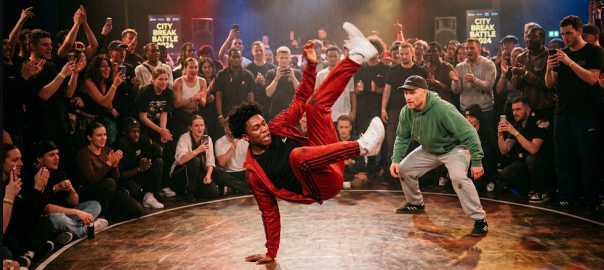
Sat, May 30 2026 /Mpelembe Media/ — The Origins of Street Dance Hip-hop dance originated in the 1970s as a powerful form of self-expression and community building for marginalized youth. In the South Bronx, African American and Puerto Rican teenagers developed breaking (b-boying/b-girling) as a creative outlet and a peaceful alternative to territorial gang violence. Concurrently, West Coast dancers in California independently invented “funk styles,” such as popping and locking, which were originally danced to funk music rather than hip-hop.
The 1984 Cinematic Explosion These localized art forms were thrust into the global mainstream in 1984 through two rival Hollywood films: Breakin’ and Beat Street. ** Breakin’ became a massive box-office success by showcasing West Coast popping and locking within a highly sanitized, commercialized narrative**. In contrast, ** Beat Street offered a grittier, socially realistic portrayal of East Coast hip-hop**, highlighting the authentic struggles and artistic integrity of Bronx DJs, MCs, breakdancers, and graffiti artists.
Global Impact and Subversion These films functioned as the primary cinematic engines that exported hip-hop culture worldwide. Beat Street had a particularly profound, subversive impact behind the Iron Curtain. While East German officials initially screened the film to showcase the poverty and evils of American capitalism, the youth completely subverted this propaganda; they used the film as a blueprint to form secret breakdance clubs, craft their own gear, and rebel against socialist conformity. The cinematic boom also sparked flourishing hip-hop scenes in Poland, Brazil, Japan, the Soviet Union, and beyond.
An Enduring Legacy Today, hip-hop dance has transcended its underground roots to become a highly organized global phenomenon. The culture now boasts massive international competitions (like Battle of the Year and Red Bull BC One) and recently made its official debut as a sport at the 2024 Paris Olympics. Furthermore, the cultural capital of this era continues to be celebrated, as seen in the upcoming Broadway musical adaptation of Beat Street, which is being co-produced by Grammy-winning rap icon Nas to breathe new life into the story for a modern audience.
More Than a Fad: 5 Surprising Reasons ‘Beat Street’ Is the Most Important Hip-Hop Film You’ve (Possibly) Never Seen
The summer of 1984 represented a volatile crossroads for hip-hop’s soul. It was the year the “breakdancing craze” was commodified for the masses, a cultural shift led by the sunny, hyper-polished commercialism of Breakin’ . While that film’s neon-soaked Venice Beach aesthetic captured the box office, another production was emerging from the freezing, graffiti-scarred trenches of the South Bronx.Beat Street , produced by the legendary Harry Belafonte and directed by Stan Lathan, traded the Hollywood sheen for a wintery, visceral reality. Though it “lost” the initial box-office skirmish to its more escapist rivals, Beat Street won the war for cultural longevity. It was never merely a “dance movie”; it was a cinematic manifesto. Why does this film continue to resonate forty years later while its contemporaries have faded into campy nostalgia? The answer lies in its refusal to compromise on the gritty, technical, and socioeconomic truths of the culture it archived.
1. The Technical Defiance of Stan Lathan
In an era where dance movies relied on hyper-edited, rapid-fire cutting to mask the limitations of their actors, director Stan Lathan made a radical technical choice. During the film’s centerpiece—the battle between the Rock Steady Crew and the New York City Breakers at the Roxy—Lathan employed long takes and wide shots with minimal editing.This was a sophisticated directorial intent to provide “cinematic teeth” to the performance. By refusing to cut away, Lathan proved the dancers’ skills were not “movie magic” or clever post-production trickery, but raw, athletic prowess. This technical honesty contrasts sharply with the “Hollywood” style of 1984, securing the film’s status as a legitimate archive of movement. Furthermore, the film explored socioeconomic friction through the Juilliard-bound character of Tracy (Rae Dawn Chong). Her conservatory-trained background served as a sharp narrative foil to the abandoned buildings where Kenny (“Double K”) spun his records, highlighting the complex “class warfare” as hip-hop fought for legitimacy in the eyes of the high-art establishment.
2. An Unlikely Weapon Against the Iron Curtain
The transatlantic cultural transfer of Beat Street is perhaps the most startling chapter in film history. In 1985, the film was screened in the German Democratic Republic (GDR/East Germany) as a piece of state-sanctioned propaganda. Socialist authorities intended for the film’s depictions of urban decay and poverty to illustrate the “evils of capitalism.”The plan backfired spectacularly. For youth in the GDR, particularly at the “School of Friendship” in Staßfurt, the film was a blueprint for liberation. Dresden became the epicenter of this underground movement precisely because it was geographically out of Western media range; Beat Street was the sole source of truth for these youth. They didn’t see the “failure” of the Bronx; they saw the triumph of the spirit. This inspired a generation of East Germans to adopt the Three Pillars of German Influence :
- Breakdancing competitions that fostered regional networks of solidarity.
- Emceeing as a new, subversive vocal language.
- Graffiti spraying , which transformed the gray walls of the GDR into canvases for personal expression.
3. The Tragedy Inspired by Real-Life “Style Wars”
Beat Street pivoted from a musical to a “slice-of-life drama” with the shocking death of Ramon (“Ramo”). The character’s fatal struggle on the electrified third rail was not a Hollywood invention, but a narrative bridge to the real-life dangers of the graffiti subculture. The subplot was heavily influenced by the 1983 documentary Style Wars , specifically the antagonist “Spit.” In Beat Street , Spit is a rogue writer who defaces the work of others, a character that serves as a literal and figurative “electrocuted” version of the real-life writer CAP MPC .This grounding in the authentic risks of the “writer” lifestyle gave the film a tragic weight that resonated with the future titans of the genre. Ramo’s death became a recurring motif in the rap canon, immortalized by artists seeking to evoke the ultimate sacrifice for one’s art.”Should I die on the train tracks like Ramo in Beat Street / People at my funeral frontin’ like they miss me.” — The Notorious B.I.G., “Suicidal Thoughts””Who gone bring the game back / who gone spit that Ramo on the train tracks.” — Jay Electronica, “Exhibit A”
4. A Living Archive of the Founding Pioneers
While rival films hired professional studio dancers, Harry Belafonte—who famously described hip-hop as the “phoenix out of the ashes”—insisted on hiring the culture’s originators. This commitment extended to the film’s music; Beat Street was the first American film to feature more than one soundtrack album (Volume 1 and 2), a landmark moment in the commercialization of the genre.The film serves as a high-definition time capsule for the pioneers of the four elements, including:
- DJ Kool Herc: The undisputed “Father of Hip Hop.”
- Afrika Bambaataa & Soulsonic Force: Bridging the gap between the Bronx and the Zulu Nation.
- Us Girls: Featuring the legendary Sha-Rock , whose “echo-chamber style” of rapping was a technical innovation that influenced groups like Run-DMC.
- Grandmaster Melle Mel & The Furious Five: Delivering the social commentary that gave the film its gravitas.
5. From the South Bronx to the Broadway Stage
The film’s journey from “box office disappointment” to cultural cornerstone reached its zenith during the 40th anniversary celebration at the Tribeca Film Festival . There, rap icon Nas announced he had joined the creative team to adapt Beat Street into a Broadway musical.Nas is not merely producing a revival; he is expanding and creating new material for the iconic soundtrack. This evolution highlights the film’s “indelible mark” on global art, as noted by Nas himself, who credits the film with spreading the revolution of hip-hop into the fabric of mainstream theater. From Lin-Manuel Miranda’s rhythmic cadences to Ice-T’s formative years, the DNA of Beat Street is embedded in the most successful creative minds of the 21st century.“Beat Street wasn’t just a film – it spread the revolution of hip-hop culture throughout the country and the world. It’s an honor to breathe new life into this iconic work and celebrate its enduring legacy.” — Nas
Conclusion: The Rhythms That Never Stopped
Beat Street remains the definitive hip-hop film because it understood that the culture was more than a summer fad; it was a response to an environment. By capturing the wintery grit and the technical brilliance of those who lived it, the film transcended the screen. As we witness hip-hop’s continued global dominance, we must ask: how much of today’s mainstream expression still carries the cold, resilient DNA of those Bronx streets from 1984? The answer is found in every breakbeat that continues to loop, forty years on.