
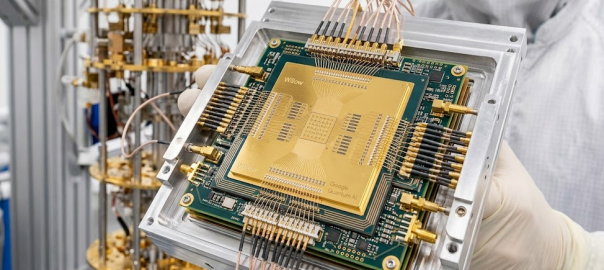
King’s College London Pioneers UK Quantum Research with Access to Google’s 105-Qubit Processor
Sat, May 30 2026 /Mpelembe Media/ — Technical Breakthroughs and Error Correction: Google’s Willow is a 105-qubit processor that represents a major milestone in hardware stability. Its most significant achievement is in quantum error correction—demonstrating that as the system scales and adds more qubits, the error rate exponentially decreases. Leveraging a new algorithm called Quantum Echoes, Willow achieved “verifiable quantum advantage” by modeling complex physical experiments 13,000 times faster than the world’s best classical supercomputers.
Transforming Medicine, AI, and Energy: Researchers are actively transitioning quantum computing from theoretical concepts to practical applications. Google has successfully used the Quantum Echoes algorithm as a “molecular ruler” to map the structure of organic molecules with unprecedented precision, a major step forward for drug discovery and materials science. Furthermore, advanced architectures like Quantum Long Short-Term Memory (QLSTM) are already outperforming classical machine learning in drug screening tasks by efficiently analyzing complex, high-dimensional molecular data. In the energy sector, researchers note that quantum computing will be essential for managing and optimizing the incredibly complex, multi-directional smart grids required to power the global renewable energy transition.
Global Partnerships and Strategic Autonomy: The first UK academic team to gain access to the Willow chip is from King’s College London, who will use it to model quantum analogues of brain neurons and investigate natural processes like photosynthesis. However, this UK-Google partnership highlights a broader geopolitical tension in the global tech race. While the United States currently leads the world in quantum technology—followed closely by China—middle powers face a difficult dilemma. Security analysts note that while the UK gains immediate access to cutting-edge scientific capabilities, it risks ceding long-term strategic autonomy by relying on US-owned infrastructure, which historically leads to domestic intellectual property and commercial value migrating overseas during the scaling phase.
The End of the Unipolar Tech Era: Why Google’s ‘Willow’ and the Belfer Index Signal a Fragile American Lead
In the halls of power, the rhetoric of a “tech war” is often reduced to a binary scoreboard. Yet, beneath the clamor of headlines lies a far more intricate reality of shifting centers of gravity. The inaugural 2025 Critical and Emerging Technologies (CET) Index , developed by the Defense, Emerging Technology, and Strategy (DETS) Program at the Harvard Kennedy School’s Belfer Center , provides the first rigorous data set to map this new topography across 25 nations.This report defines power not merely as military might, but as “the ability of a nation to achieve its national interests through the control of resources, material, and ideas.” In an era of interdependence, technological power has become the ultimate prerequisite for strategic autonomy. While the United States anchors its leadership in a decades-old innovation ecosystem, the data reveals a fragile lead. Here are the five most critical takeaways from the 2025 Index and Google’s recent “Willow” quantum breakthrough.
1. The AI Lead is More Vulnerable Than You Think
The United States currently dominates the AI sector through a trifecta of economic resources, computing power, and world-class algorithms. However, this supremacy is no longer an impenetrable fortress.The 2025 release of Alibaba’s Qwen3 —which has notably toppled DeepSeek’s R1 as the world’s highest-ranked open-source model—demonstrates that China is setting new standards in cost-optimized training. By innovating lean model architectures and efficient pipelines, Chinese firms are effectively bypassing U.S. export controls on high-end hardware.Furthermore, China’s lead in “human capital” is built on the sheer volume of high-impact scientific publications, creating an indigenous research engine that the U.S. cannot simply outspend. If the U.S. cannot maintain its edge in deployment and integration, its foundational lead in innovation may soon be eclipsed by China’s scale.”AI systems will… be used in the pursuit of power.” — U.S. National Security Commission on Artificial Intelligence
2. Biotechnology is China’s “Fast Track” to Supremacy
Of all the sectors analyzed, biotechnology is where the gap between the U.S. and China is narrowest. It represents China’s most immediate opportunity to overtake the United States.This race is a collision of two fundamentally different ideologies: decentralized innovation vs. state-backed manufacturing. The U.S. excels in genetic engineering and vaccine research through private-sector dynamism. However, China has achieved dominance in pharmaceutical production through massive, state-directed investments.By the Numbers: Belfer Index Sector Weights
- Semiconductors: 35%
- Artificial Intelligence: 25%
- Biotechnology: 20%
- Space: 15%
- Quantum: 5%The strategic “bottleneck” is clear: pharmaceutical production, genetic engineering, and vaccine research collectively account for 75% of the total biotechnology score . The U.S. lead is currently at risk of erosion as the country stands to lose talent and funding due to volatile shifts in federal policy and growing clashes with academic institutions.
3. The “Asymmetric Vulnerability” of the U.S. in Orbit
American space power is defined by a striking paradox. Driven by private-sector giants like SpaceX, the U.S. has achieved a massive lead in launch frequency and payload capacity. Yet, the Belfer Index identifies this as an “asymmetric vulnerability.”Because the American military and economy are so deeply reliant on space-based systems for navigation and communications, the U.S. has far more to lose than its rivals. While the U.S. leads, China and Russia are fielding formidable anti-satellite (ASAT) capabilities designed to offset this advantage.Notably, the Index reveals that Russia’s third-place position is increasingly hollow—anchored more in Soviet-era systems and legacy infrastructure than in modern innovation. Meanwhile, newer players like India are closing the gap, proving that the “legacy” advantage of the Space Race era is fading.
4. The 10 Septillion Year Shortcut (The Quantum Leap)
Quantum technology is still in its nascent stages, but the debut of Google’s “Willow” chip has accelerated the timeline for strategic utility. The scale is staggering: Willow solves in five minutes a theoretical problem that would take today’s fastest supercomputers 10 septillion years to calculate.However, the global race remains fragmented. The U.S. employs a “corporate-led” model (Alphabet, IBM), while China utilizes an “opaque, state-led” approach. The disparity in strategic focus is best highlighted by the funding: while semiconductors received a $52 billion injection via the CHIPS Act, quantum remains comparatively underfunded at $ 9.4 billion in total public and private investment.”This technology allows us to ‘light a torch’ for research into nature’s building blocks—mastering atomic interactions to create better solar cells and discover drugs for untreatable diseases.” — Dr. Eleanor Crane, King’s College London and Belfer Center
5. The End of “End-to-End” Control
The semiconductor sector confirms a hard truth: no single nation—not even the U.S. or China—possesses full end-to-end control of the supply chain.The industry is a web of critical chokepoints: the U.S. dominates chip design, Taiwan leads in fabrication, and China controls assembly and specialized materials. Capital alone cannot buy a country out of this interdependence. The Belfer Center suggests the creation of an American “tech fund” to share the initial risk and support a strategic diversification away from Chinese dependencies.Resilience in this sector will not come from isolationism, but from the strength of “alliance architecture”—leveraging the specialized human capital and manufacturing equipment of partners like Japan, South Korea, and the Netherlands.
Conclusion: The Power of Convergence
The 2025 Index underscores that we are entering an era of “technological convergence.” Progress in AI, Quantum, and Semiconductors creates a positive feedback loop; AI accelerates drug discovery in biotech, while quantum research facilitates the design of next-generation chips.In the next decade, “managed interdependence” will define the strategy of every global power. No nation can go it alone, and those who try will find themselves stranded behind the curve of innovation.What do you believe is better suited for this era of convergence: the decentralized, private-sector-led innovation of the U.S. model, or the centralized, state-planned scale of the Chinese model?