Vying for Quantum Supremacy: National Strategies of the US, UK, and China
Fri, May 22 2026 /Mpelembe Media/ — The global race for quantum technology is a high-stakes competition poised to revolutionize major industries, including healthcare, finance, clean energy, and national defense. This “second quantum revolution” relies on principles like superposition and entanglement to solve highly complex optimization problems exponentially faster than classical supercomputers. However, the technology also presents profound national security risks, particularly the potential to eventually break the cryptographic infrastructure that currently secures global communications and financial data.
Nations are deploying distinct strategies to secure leadership in this critical field:
- China employs a highly centralized, state-directed mobilization model. Benefiting from massive public investment, China has achieved undisputed dominance in quantum communications, highlighted by the Micius satellite and extensive terrestrial networks.
- The United States drives innovation through a decentralized, venture-led ecosystem anchored by tech giants, elite universities, and private startups. The U.S. currently holds a commanding lead in quantum computing hardware and algorithms, and has recently utilized CHIPS Act funding to establish domestic quantum foundries to overcome manufacturing bottlenecks.
- The United Kingdom utilizes an application-led approach, successfully bridging the gap between academic research and commercialization through highly specialized National Quantum Research Hubs. This strategy has cultivated a dense deep-tech startup landscape that excels globally in specialized niches like quantum error correction and sensing.
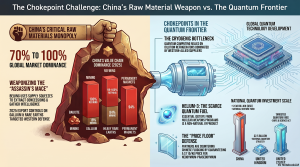
A central challenge defining this technological race is the extreme vulnerability of the physical supply chain. Quantum hardware relies heavily on specialized materials that are subject to severe geopolitical chokepoints. China has increasingly weaponized its dominance over the mining and refining of critical raw materials—such as rare earths, gallium, and germanium—by imposing strict export controls that threaten allied defense and industrial bases. Meanwhile, Western nations dominate the production of other critical components, such as specialized dilution refrigerators and scarce Helium-3 isotopes, both of which are essential for cooling superconducting quantum computers.
To maintain competitiveness and prevent future monopolies, governments are urgently focusing on building resilient, ex-China supply chains, cultivating a specialized quantum workforce, and accelerating commercialization through targeted proof-of-concept partnerships with industry end-users.
The Assassin’s Mace: 5 Counter-Intuitive Truths About the Global Race for Quantum Sovereignty
1. Introduction: The Quiet Deployment of a “Decisive Trump Card”
In the corridors of the Zhongnanhai, the global race for quantum supremacy is not viewed as a mere academic pursuit of error correction or qubit coherence. It is framed through the lens of the shashoujian , or the “Assassin’s Mace.” In Chinese military theory, the Assassin’s Mace is a decisive “trump card” weapon that allows a conceptually weaker power to strike the vulnerabilities of a superior adversary with overwhelming force.While Western policymakers fixate on the “brain” of the quantum revolution—software algorithms and gate fidelities—Beijing has spent decades securing the “muscle”: the physical supply chain and raw materials required to manifest quantum theory into industrial reality. By the mid-2020s, the “raw material weapon” is no longer a theoretical threat; it is a deployed reality. This analysis explores five counter-intuitive truths about how China is using its material dominance to swing the Assassin’s Mace at the knees of Western technological sovereignty.
2. Takeaway #1: The Panopticon of Procurement
Beijing’s export controls on gallium and germanium, intensified throughout 2025, are frequently misinterpreted as simple protectionist measures. In reality, they constitute a sophisticated intelligence harvest. By mandating detailed licensing for these critical inputs, China has effectively turned the West’s procurement offices into a mapping service for its own intelligence agencies.When a Western defense contractor applies for a license to import refined gallium, they are required to disclose the precise identity of end-users, production site locations, and specific industrial applications. This data allows Beijing to move beyond “blanket” supply squeezes. Instead, they can now execute “calibrated” disruptions—targeting specific Western contractors at critical nodes of their production cycle to maximize political friction and industrial delay.”China used export controls to gather strategic information, coerce its trading partners, erode their (defence-)industrial capabilities… it requires detailed information on production sites, products and the identity of industrial end-users, allowing it to map (defence-)industrial networks.” — EUISS Report, May 2026This is the ultimate strategic irony: the West is hand-delivering the blueprint of its defense-industrial vulnerabilities to its primary systemic rival, simply to maintain the flow of basic metallurgy.
3. Takeaway #2: The Infrastructure Flip—Fortress China and the Mass-Production Trap
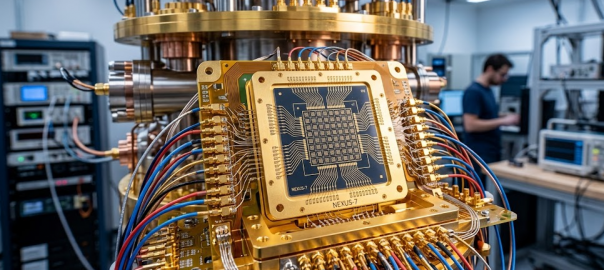
Beijing is aggressively pursuing a “fortress” strategy, pivoting from a dependent importer of specialized tools to a mass-producer of the infrastructure required for the quantum era. Nowhere is this more evident than in the cryogenic systems required for superconducting qubits.While Western leaders like Bluefors and Oxford Instruments face significant lead times, the Anhui Quantum Computing Engineering Research Center has transitioned to a mass-production model. Bluefors, despite expanding its Syracuse, New York facility to a capacity of 20 systems annually and maintaining 50 assembly bays in Europe, still reports lead times of 6 to 9 months. In contrast, Chinese state-supported entities have announced the ability to assemble eight or more systems simultaneously, essentially commoditizing the cooling bottleneck.Indigenous Milestones
- The 80% Threshold: The Origin Wukong third-generation superconducting quantum computer now operates with 80% indigenous hardware, chips, and operating systems.
- Infrastructure Parity: Collaboration between QuantumCTek and the Anhui Center has successfully moved dilution refrigeration from bespoke lab assembly to large-scale mass production.
- Intercontinental Dominance: China has established the world’s longest intercontinental quantum satellite link, spanning 12,900 km between Beijing and Stellenbosch, South Africa.
4. Takeaway #3: Quantum Fuel and the Nuclear Legacy
The most fragile chokepoint in the quantum race is Helium-3, an isotope that serves as the specialized “fuel” for quantum refrigeration. To reach the millikelvin temperatures required for coherence, quantum systems depend on a byproduct that does not exist in meaningful quantities in nature.The irony of the 21st-century technology race is that it remains tethered to the 20th-century nuclear standoff. Helium-3 is primarily harvested from the decay of tritium within nuclear weapons stockpiles. As Western firms attempt to scale to thousands of quantum computers, they face a physical limit imposed by Cold War legacy materials. To mitigate this, the U.S. has entered an agreement with Interlune under the DOE Isotope Program, a high-priority strategic move to secure domestic supply.Further out on the horizon, the quest for “Quantum Fuel” is even driving space strategy. The theoretical potential for lunar extraction of Helium-3 has transitioned from science fiction to a component of long-term geopolitical planning. In the interim, however, the inability to secure Helium-3 remains a discrete risk that could halt Western scaling regardless of how many qubits a company can fabricate.
5. Takeaway #4: The $3.5 Trillion Economic Deterrent
Critical raw materials are no longer an accessory to the global economy; they are its bedrock. Beijing understands that its control over the “mine-to-magnet” pipeline provides a deterrent more potent than conventional military posturing.The Backbone, Not the Accessory The International Energy Agency (IEA) has quantified the “worst-case scenario” of this weapon’s deployment. A total cessation of Chinese exports of rare earths and permanent magnets alone would cost the EU and the United States a combined $3.5 trillion annually.”Critical raw materials are the backbone of the global economy. Maintaining existing defence, communications, energy, healthcare and other vital systems depends on the production of spare parts, which in turn indirectly depends on access to critical materials.”When the cost of a supply chain disruption exceeds the GDP of entire nations, the “raw material weapon” becomes an instrument of absolute coercion. Within months of a total freeze, industries ranging from precision-guided munitions to medical diagnostics would reach a standstill as domestic stockpiles are exhausted.
6. Takeaway #5: The Transatlantic Resilience Gap
There is a widening divergence in how the democratic coalition is responding to this “Sovietisation” of the supply chain—the risk of onshoring everything to defeat a state-capitalist adversary.The U.S. and Japan have moved toward “financial teeth,” using the Japan Organization for Metals and Energy Security (JOGMEC) to establish a guaranteed price floor of $110/kg for Neodymium-Praseodymium (NdPr). This makes diversification financially viable even when Beijing attempts to bankrupt Western competitors through price volatility.In contrast, the European Union’s Critical Raw Materials Act (CRMA) has yielded only modest results as of early 2026. While the EU has introduced the Anti-Coercion Instrument (ACI) to facilitate an “escalate-to-deescalate” retaliatory posture, it still lacks the aggressive state-sponsored financing seen in Washington and Tokyo. The challenge for Brussels is to adopt these command-economy behaviors—state equity and price floors—without destroying the market principles they are intended to protect.
7. Conclusion: Beyond the Chokepoint
Dismantling the Assassin’s Mace requires a fundamental shift in perspective. The West has been distracted by the “conceptual strength” of high qubit counts and theoretical breakthroughs, while Beijing has focused on the “physical leverage” of the value chain.Building resilience is not just about opening a few new mines in Scandinavia or Australia; it is about creating a coalition-wide “indispensability” in the high-value segments of the chain. We must ask ourselves: Has our focus on the software of the future blinded us to the fact that the “Mace” is already being swung at the hardware of the present? Until the democratic coalition can match Beijing’s industrial “teeth” with its own joint price floors and demand-side measures, the Assassin’s Mace will remain the defining feature of the quantum age.