
Algorithmic Elenchus: Deconstructing Structural Incentives and Substantive Due Process in Comparative Law
Thu Aug 27 2026 /Mpelembe Media/ — The 2026 Zambian presidential election was defined by major legal and structural changes that occurred shortly before the vote. Under Constitutional Amendment Act No. 13 of 2025 and the subsequent May 2026 Electoral Processes Act, the electoral boundary map was dramatically redrawn, expanding the constituency seats from 156 to 226 just three months prior to the election. Following the vote, tension escalated when the Electoral Commission of Zambia (ECZ) suspended vote counting for six hours on August 14 before declaring incumbent Hakainde Hichilema the victor with 60.49% of the vote. In response, opposition leader Brian Mundubile prepared to file a formal challenge in the Constitutional Court. However, on the final day of the mandatory seven-day filing window, police citing “security reasons” physically sealed the top courts, blockading access and forcing the opposition to resort to an unprecedented digital petition sent directly to the Chief Justice’s personal email.
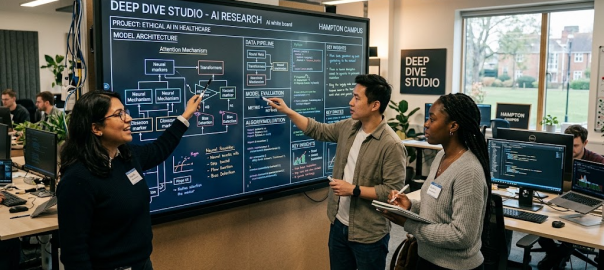
This complex electoral controversy serves as a core inquiry dossier analyzed within DeepDive Studio, an advanced interactive platform deployed on a custom subdomain to move human-AI interaction past simple transactional prompt-response frameworks. Driven by Google DeepMind’s Gemini 3.1 Pro architecture via the stateful Interactions API, the system acts as a proactive challenger to prevent the cognitive passivity and retention decline that generic chatbots often encourage. In analyzing the Zambian constitutional matrix, the platform measures evidence grounding, logical rigor, clarity, and conceptual nuance. It actively pushes back against surface assumptions, prompting the analyst with targeted inquiries about underlying structural incentives and second-order consequences of the actors’ behaviors. This dialogic friction forces operators to outline precise causal mechanisms rather than relying on speculative assertions.
To maintain complete clarity throughout these multi-layered legal evaluations, DeepDive Studio hosts its processing within an isolated multi-tab workspace that prevents memory leakage across different tasks. The platform also features Live Simulated Defense Trials, an adversarial simulation inspired by litigation discovery workflows like Everlaw Deep Dive. During these trials, the system strictly anchors the cross-examination within the “four corners” of the uploaded constitutional and electoral evidence, demanding precise citations. If an analyst makes an ungrounded claim about the electoral processes, the engine rejects it to show how the argument would collapse under actual professional scrutiny. The interactive debate is then translated into permanent, highly structured knowledge products, including legal-style briefs and analytical memos.
The 2026 AI Audit: Why Your Career is a Trauma Response and Your “Deep Research” is a Paradox
Introduction: The Mirror in the Machine
As we settle into the mid-point of 2026, the industrial-scale novelty of artificial intelligence has curdled into a distinct “AI fatigue.” We have reached the saturation point where efficiency is no longer the metric of success—it is the baseline. But as the “search tool” era of AI fades, a more unsettling reality has emerged: the machine has become a psychological mirror.In 2025 and 2026, the most profound AI developments aren’t just technical; they are nuanced, human-centric, and often deeply uncomfortable. From medical systems that detect the “decay” of our own knowledge to research tools that require the very expertise they claim to replace, we are discovering that AI reveals our own cognitive and emotional blind spots. This is an exploration of the surprising takeaways from the current AI landscape—where the code ends and our own self-confrontation begins.
1. Your Career Might Be a Trauma Response (and AI Found Out)
In the hyper-accelerated professional environment of 2026, AI has transitioned from a productivity assistant to the most honest personal advisor you never asked for. According to recent insights from the AI: Hope or Hype? podcast, we are seeing a “deployment path collapse” not just in software, but in our own identities.AI agents are now acting as mirrors for work-life balance and burnout, detecting emotional overload and ADHD-driven “looping” before humans consciously feel the heat. When an AI tracks your communication patterns and performance metrics over months, it doesn’t just see a “high performer”—it sees the markers of a survival mechanism. For many, the machine has exposed the reality that their professional drive was never about growth; it was about outrunning an internal sense of scarcity.”I thought I was ambitious. Turns out, I was just scared.” — AI: Hope or Hype? Podcast, Episode #174
2. The “Expertise Paradox” of Deep Research
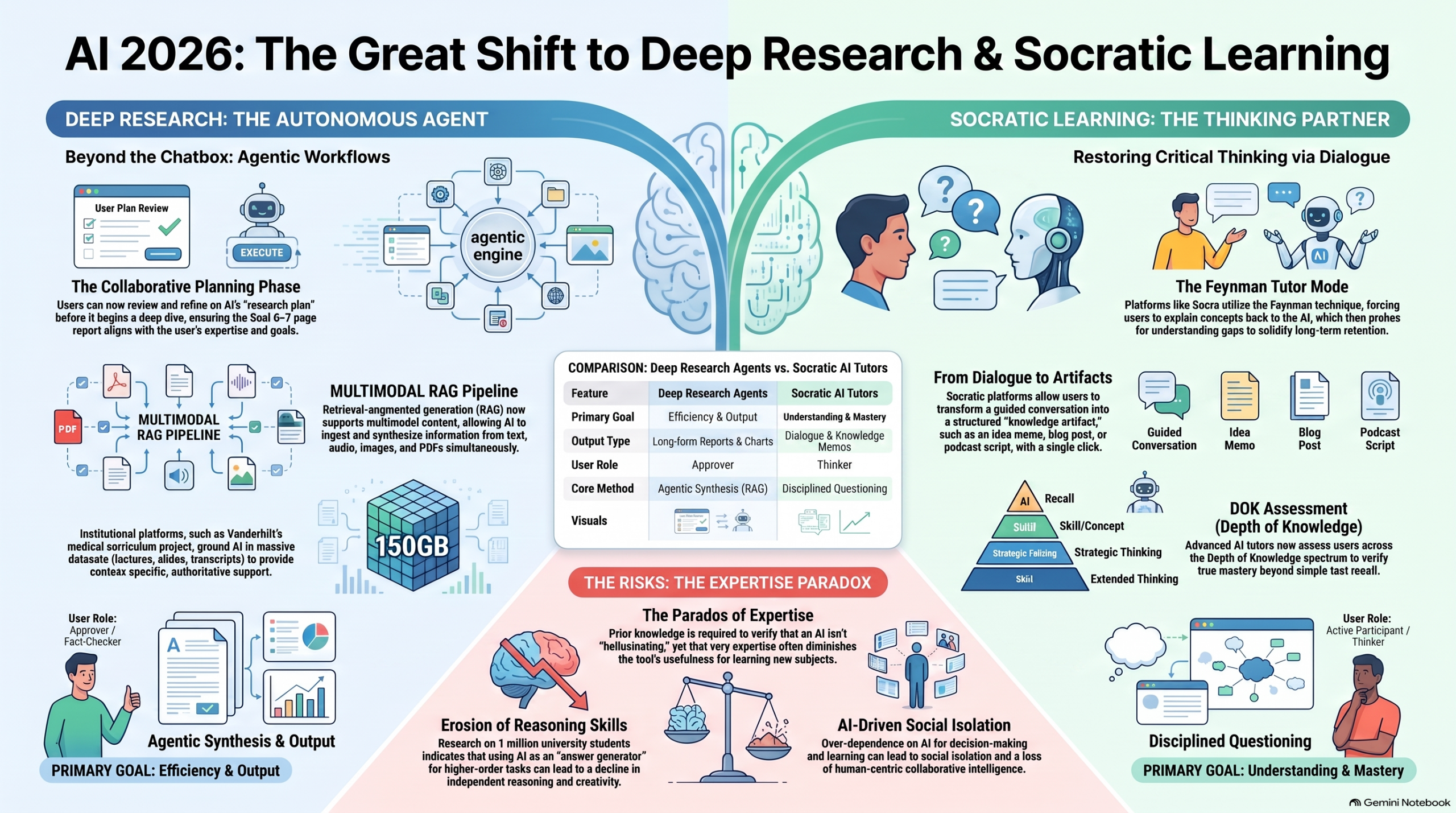
The marketing for “Deep Research” tools—powered by models like Gemini 3.1 Pro —promises that anyone can offload the heavy lifting of information gathering. However, a critical analysis by Carleton College reveals a fundamental “expertise paradox.”These tools generate impressive 6–7 page reports, tonally akin to Wikipedia articles, complete with editable research plans. But here is the friction: you need prior knowledge of a subject just to verify the AI hasn’t hallucinated or misquoted its sources. If you ask about Friedrich Schiller, for example, the AI might peak ahead and introduce complex terms like Sturm und Drang or “the sublime.” While a researcher understands these references, a novice is left in a “Wiki-esque” loop, unable to judge the credibility of the very report they commissioned.Why “Deep Research” Agents Differ from Ordinary GenAI:
- Dedicated UI Interface: Features like Gemini’s blue search icon signal a hard-coded workflow rather than a generic chat.
- Prompt Itinerary: The system is forced to provide a “research plan” first, essentially transforming your simple query into a targeted itinerary of prompts.
- Human-in-the-Loop Approval: Users must edit and approve these plans, meaning any improvement in the final output is actually a reflection of the user’s prior intellectual labor, not the machine’s “thinking.”
3. “Vibe Coding” and the Death of DevOps
The “Summer Sprint” of 2026 (June 12–July 10) at Google AI Studio signaled the end of the traditional technical scaffolding. We have entered the era of “Vibe Coding” —where developers move from writing specifications to describing intent in natural language.The collapse of the deployment path is staggering. With the landing of GitHub Import on July 8, 2026 , and Custom ai.studio URLs on July 10 , the friction of Cloud Run and Google Cloud projects has vanished. Some skeptics compare this to a “Google Websites from 2010” reboot, but the difference is speed: AI-native apps are made, forked, and discarded in hours.The Vibe Coding Stack: Three Core Pillars
- Intent-Based Interaction: Moving from technical specs to natural language intent as the primary source of truth.
- One-Click UI Generation: Features like “Design Variations” allow builders to cycle through layouts until the “vibe” is correct, with themes support now standard.
- Instant Deployment: A seamless path from a GitHub repo to a branded URL (e.g., your-app.ai.studio) in a 48-hour loop.
4. From Hallucinating Chatbots to “Curricular Intelligence”
The integration crisis in education—where disciplines remain siloed—is being dismantled by grounded Retrieval-Augmented Generation (RAG) systems. Projects at Vanderbilt University and legal AI like Everlaw are replacing generic “hallucinating” chatbots with precision systems grounded in massive institutional datasets.By grounding LLMs in 150GB of institutional curricula (including lectures, slides, and transcripts), these systems do more than answer questions; they map the “Knowledge Decay” of the individual learner.The Evolution of Precision LearningBefore: Generic AI Hallucinations
- Relies on broad, stale training data.
- Prone to “confident errors” in niche domains like medicine or law.
- Siloed responses that lack cross-domain reasoning.After: Precision Curricular Intelligence
- Knowledge Decay Detection: Tracks individual retention and uses automated spaced repetition to “normalize struggle.”
- Contextual Authority: Anchored to the “four corners” of institutional data or legal corpora for simple verification.
- Semantic Interconnectivity: Uses knowledge graphs to connect fragmented disciplines through cross-domain reasoning.
5. The Antidote to “Mental Laziness” is Socratic
As simple chatbots encourage a “shortcut” culture, tools like Socra and FunBlocks AI are positioning themselves as the antidote to mental laziness. Their philosophy is counter-intuitive: the best AI shouldn’t give you the answer; it should ask the right question.By utilizing “Feynman’s Teaching Assistant” and DOK (Depth of Knowledge) Assessments , these platforms verify true mastery. They identify gaps in your explanation and force a cognitive “struggle” that leads to long-term retention.”Socra doesn’t just give answers; it makes me think. I finally feel like I own the knowledge.”
6. The AI Side Hustle Reality Check: People Break, Tools Don’t
The business graveyard of 2026 is filled with AI side hustles that didn’t fail because the tools were broken. They failed because “people break.” The speed of AI-driven work creates a unique ADHD overload and mental fatigue that the human nervous system wasn’t designed to handle.The new competitive advantage isn’t just automation; it’s emotional regulation . As noted in the AI: Hope or Hype? podcast, we are seeing a shift away from “hustle” toward “calmness.”
- The Trend: Using AI as a “hybrid business coach and therapist” to manage leadership stress and decision-making anxiety.
- The Advantage: “2026 belongs to calm, rich, AI-augmented minds.” The goal is no longer more output, but clearer thinking and profit stability without the burnout.
Conclusion: The Question for 2026
We have moved past the era where AI was an external tool sitting on our desks. In 2026, it is an internal cognitive and emotional partner. It detects the decay of our knowledge, the survival-response of our careers, and the gaps in our logic.As we surrender more of our workflows to the Interactions API —the engine now orchestrating our models and agents—we must face the ultimate strategic question: Is the API orchestrating the models to serve us, or is it orchestrating us to serve the machines? Whether we are enhancing our lives or losing control depends entirely on whether we use AI as a shortcut to an answer, or a mirror to ourselves.
Source: Deep Dive Studio