
Disappearances, Detentions, and Silenced Courts: Human Rights Observers Sound Alarm Over Zambia’s Post-Vote Deterioration
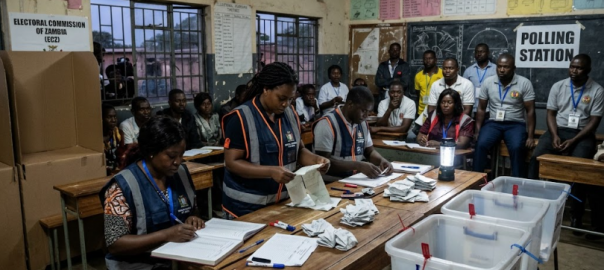
Sun, Nov 01 2026 /Mpelembe Media/ — Following the August 13, 2026 general elections, Zambia experienced an acute escalation of state repression and institutional erosion that reversed earlier commitments to democratic reform. While the Electoral Commission of Zambia (ECZ) officially declared incumbent President Hakainde Hichilema re-elected on August 18 with 60.7 percent of the vote against 38 percent for main opposition challenger Brian Mundubile of the Tonse Alliance (NRPUP), the electoral ecosystem was marred by significant structural controversies. Ahead of the polls, the pre-electoral environment had already contracted through the fast-tracked passage of the 2025 Cyber Security Act and Cyber Crimes Act, selective deployment of the colonial-era 1955 Public Order Act to disrupt opposition rallies, and the abrupt cancellation of the global RightsCon tech summit in Lusaka. International and regional observer missions from SADC, the African Union–COMESA, the EU, and the ICGLR highlighted that procedural fairness was compromised by state-backed intimidation, media curbs, and a temporary halt in vote tabulation.
When aggrieved opposition parties sought to challenge the election outcome under Article 103 of the Zambian Constitution, which mandates a strict seven-day filing window that expired on August 24, 2026, state security forces executed a coordinated, nationwide blockade of judicial premises. Armed police and military units cordoned off the High Court and Constitutional Court in Lusaka, physically barring legal counsel and court officials from lodging presidential election petitions. Described by authorities as an “intelligence-led and preventive measure” and implemented through an internal judiciary closure notice for “security reasons,” the shutdown effectively suspended access to judicial remedies at the precise moment required by the constitution, denying petitioners due process under both domestic law and Article 14 of the International Covenant on Civil and Political Rights (ICCPR).
Simultaneously, state security agencies launched a violent campaign targeting opposition leaders, election monitors, and civil society actors. On August 14, a joint security raid on Mundubile’s private residence in Kabulonga resulted in the fatal shooting of former cabinet minister Mutotwe Kafwaya—an incident the state initially denied before acknowledging he died during an armed security operation. Human Rights Watch verified 14 enforced disappearances, the prolonged arbitrary detention of dozens of individuals, and 61 documented cases of severe physical torture and maltreatment in custody, including waterboarding, beatings with rifle butts, and deprivation of food and medical attention. To block release and halt political remobilization, authorities weaponized non-bailable treason and seditious practices charges against at least 18 figures—including Mundubile, Makebi Zulu, and UNIP President Bishop Trevor Mwamba—often premised solely on digital political speech, such as Facebook Live broadcasts alleging election victory.
The repression extended into administrative retaliation against extraterritorial dissent through Government Gazette Notice No. 1421, issued on September 11, 2026, which revoked the national passports of six prominent critics on unspecified national security grounds. Those targeted included Stellenbosch University historian and political analyst Dr. Sishuwa Sishuwa, former ambassador Emmanuel Mwamba, former lawmakers Binwell Mpundu and Emmanuel Jay Banda, former presidential aide Kaizer Zulu, and blogger Lillian Mutambo. Human rights organizations such as Amnesty International, along with global academic associations including the African Studies Association, condemned the revocations as an unlawful administrative abuse that weaponizes citizenship documentation, creates de facto statelessness, and violates the right to freedom of movement protected by Article 12 of the ICCPR.
How a Democratic Beacon Lost the Plot: 5 Alarm-Bells From Zambia’s Post-2026 Election Crackdown
When President Hakainde Hichilema and the United Party for National Development (UPND) assumed power in August 2021, ending a decade of increasingly authoritarian rule under Edgar Lungu’s Patriotic Front (PF), Zambia was celebrated worldwide as Southern Africa’s premier democratic beacon. Citizens, regional neighbors, and international partners watched a peaceful transfer of power that seemed to prove institutional resilience in African governance. The expectation was clear: systemic legal reform, an expansion of civic space, and an unshakeable adherence to the rule of law.
Yet, in the wake of the general elections held on August 13, 2026, that optimistic narrative has fundamentally collapsed. Rather than consolidating democratic safeguards, the post-election period has exposed a rapid, state-directed descent into autocratic control. What began as subtle pre-electoral legal constriction quickly transformed into state-sponsored digital surveillance, armed physical blockades of courtrooms, arbitrary passport revocations, non-bailable treason charges for digital political speech, and systematic extrajudicial violence.
Understanding how a celebrated democracy unraveled requires examining the interconnected toolkit of modern autocratization—a process where administrative power, judicial obstruction, and physical coercion reinforce one another to preserve executive power at any cost.
1. The Irony of Public Will: Zambians Demand Media Watchdogs, But Receive State Surveillance
The breakdown of Zambian democracy did not occur overnight on polling day; its foundation was laid through a striking disconnect between public governance demands and executive policy. Survey data from the independent research network Afrobarometer reveals that the Zambian public overwhelmingly desires open, transparent governance and a vigilant press:
- 76% of Zambians insist that the media should “constantly investigate and report on government mistakes and corruption.”
- 84% demand complete public access to local government budgets.
- 82% require that government bids and contracts be open to public scrutiny.
Instead of answering this civic mandate, the state enacted the Cyber Security Act and Cyber Crimes Act in April 2025. Framed by authorities as routine modernizations of digital governance, these statutory instruments granted law enforcement sweeping, unmonitored powers of real-time data collection, search-and-seizure, and warrantless communication interception.
“The Cyber Security Act raised the risk of unjustified surveillance, as it allows a law enforcement officer to request providers of electronic services, such as an internet provider, to intercept a person’s communications without a warrant or other safeguards if they suspect a person may cause harm to another person, property damage, or financial loss.” — Human Rights Watch
The practical consequences of this digital dragnet were immediate. Local journalist Mukuka was arrested and held in police custody under the Cyber Crimes Act simply for publishing an audio recording critical of official conduct. In July 2025, the Law Association of Zambia (LAZ) petitioned the High Court to declare provisions of the cyber laws unconstitutional, arguing they directly infringed upon free expression, association, and media freedom. The pervasive chilling effect culminated in May 2026 with the sudden cancellation of the global RightsCon digital rights summit in Lusaka. By establishing unmonitored digital surveillance in 2025, the state built the infrastructure of intimidation necessary to execute its post-2026 election operations.
2. Judicial Lockout: Armed Forces Blocked the Courthouse Doors on the Constitutional Petition Deadline
Once state security apparatuses normalized surveillance and digital control, executive power moved from online monitoring to direct physical interference with the judicial system. Following the Electoral Commission of Zambia’s (ECZ) August 18 declaration naming incumbent Hakainde Hichilema the winner with 60.7% of the vote—versus 38% credited to opposition candidate Brian Mundubile of the Tonse Alliance—the legal mechanism for dispute resolution was formally initiated. Under Article 103 of the Constitution of Zambia , an aggrieved candidate has a strict, mandatory seven-day window following the declaration of results to lodge an election petition with the Constitutional Court. This established August 24, 2026 , as the final statutory filing deadline.
On the morning of August 24, heavily armed personnel from the Zambia Police Service and military units established physical blockades around judicial facilities nationwide. Armored vehicles sealed the entrances to the Lusaka High Court and the Constitutional Court. Armed guards turned away legal counsel, court personnel, and opposition candidate Brian Mundubile under explicit threat of force. Police officials publicly defended the action as an “intelligence-led and preventive measure,” while internal court memorandums revealed that facilities were shuttered “for security reasons.”
“Denying access to the courts at the precise moment of constitutional necessity destroyed the integrity of the judicial dispute resolution process.” — Allan Ngari, Africa Advocacy Director at Human Rights Watch
Deploying armed forces to physically lock the courthouse doors on the precise date of a constitutional deadline effectively neutralized judicial dispute resolution. By preventing opposition candidates from lodging petitions within the non-extendable seven-day window, the executive branch severed the legal mechanism for peaceful recourse, replacing constitutional process with executive mandate.
3. Passports As Weapons: Administrative Power Deployed to Force De Facto Statelessness
When physical blockades inside the country successfully shut down domestic legal challenges, state power expanded beyond national borders to target overseas critics, international diplomats, and academics. On September 11, 2026, the executive branch deployed Government Gazette Notice No. 1421 , issued under Section 8 of the Passports Act , to arbitrarily cancel the national passports of prominent government critics on unspecified “national security” grounds.
This administrative order targeted key political and intellectual figures, including:
- Dr. Sishuwa Sishuwa : Prominent historian, political analyst, and Senior Lecturer at Stellenbosch University.
- Emmanuel Mwamba : Former Zambian Ambassador to Ethiopia and Permanent Representative to the African Union.
- Binwell Mpundu : Former opposition Member of Parliament.
- Emmanuel Jay Banda : Former opposition Member of Parliament.
- Kaizer Zulu : Former Special Assistant to the President.
- Lillian Mutambo : Political blogger and public commentator.
The targeting of an international academic like Dr. Sishuwa created a dangerous precedent for global African studies and international scholarship. Organizations such as the African Studies Association (ASA) and the Editorial Board of the Journal of Southern African Studies (JSAS) issued urgent public statements warning that weaponizing travel documentation sets an extraterritorial chilling effect. It signals to scholars worldwide—Zambian and foreign alike—that conducting fieldwork, publishing critical political analysis, or speaking publicly about state repression can result in transnational retaliation and identity invalidation.
“The arbitrary cancellation of passports by Zambian authorities is a violation of international human rights law. By weaponizing citizenship documents to target dissidents, activists, or political opponents, authorities explicitly breach the right to freedom of movement enshrined in Article 12 of the International Covenant on Civil and Political Rights, ICCPR. … The decision to cancel these passports effectively strips these individuals of their legal and social identity and traps them in a state of de facto statelessness.” — Amnesty International
4. Treason for a Livestream: Weaponizing Non-Bailable Charges to Criminalize Political Speech
Parallel to administrative neutralization abroad, state prosecutors deployed procedural traps at home to ensure that domestic opposition leaders were removed from political life without requiring the immediate presentation of evidence in court. Under Zambian criminal procedure, statutory charges such as treason are explicitly non-bailable. By levying non-bailable indictments, executive authorities bypass standard judicial oversight, creating a legal trap that allows for the indefinite pre-trial detention of political opponents in maximum-security facilities such as Mukobeko or Kabwe.
This mechanism was weaponized directly against opposition figures Brian Mundubile and Makebi Zulu , as well as UNIP President Bishop Trevor Mwamba and campaign strategist Patrick Mwansa . Mundubile and Zulu were arrested and formally charged with treason and seditious practices stemming entirely from an August 14 Facebook Live broadcast. During the livestream, the leaders presented internal campaign polling data and asserted that opposition tallies indicated an electoral victory.
State prosecutors re-interpreted this digital campaign commentary as an illegal attempt to “raise discontent and disaffection among the populace.” By treating standard campaign communications and digital political commentary as acts of insurrection, the state established a precedent where exercising constitutional free speech is prosecuted as high treason.
5. Beyond the Ballot: Disappearances, Systematic Torture, and Extrajudicial Lethal Force
Behind the legal maneuvering and statutory manipulation lay raw physical coercion. Investigations conducted by Human Rights Watch and Amnesty International documented severe physical violations executed by joint security operations involving police, intelligence agencies, and specialized military units operating without visible identification. Detainees were routinely funneled through covert “military command centers” prior to formal police processing to evade habeas corpus oversight.
The documented toll of this post-election physical crackdown includes extrajudicial killings, enforced disappearances, and systematic custodial abuse:
Violation Category,Targeted Individuals / Groups,Documented State Action
Extrajudicial Lethal Force,Mutotwe Kafwaya (Former Minister & Opposition Official),Fatally shot by state security forces during an August 14 armed raid on Brian Mundubile’s Kabulonga residence. Police initially denied involvement until compelled by court petitions.
Enforced Disappearances,14 Documented Cases (including Bishop Trevor Mwamba & Patrick Mwansa),”Apprehended by masked military personnel and held in secret locations, including a designated military command center, for up to four days prior to formal processing.”
Systematic Custodial Torture,”Ezra Topola, Dickson Tembo, Victor Muzyamba, & Patrick Mwansa”,”Subjected to waterboarding, suspension from metal bars, severe rifle-butt beatings, and denial of medical care for severe injuries, including broken bones and facial lacerations.”
Mass Arbitrary Detention,43 Opposition Election Monitors,”Detained on August 14 and held for 21 days without due process, including complete deprivation of food for the first eight days of custody.”
Reclaiming Democratic Integrity
The post-August 2026 election landscape in Zambia demonstrates how rapidly institutional safeguards can be dismantled when digital surveillance, judicial blockades, administrative sanctions, weaponized penal statutes, and physical force operate in tandem.
To break this cycle of repression and restore institutional credibility, election analysts and democracy experts—including veteran observer Washington Katema—have called for an immediate, independent forensic audit of the election results chain. To establish whether the declared outcome reflects the actual public vote, independent international auditing firms (such as KPMG, PwC, Deloitte, or EY) must be granted full access to audit original Gen-20 polling station forms, tracing them through constituency aggregation to the national tally.
As state power moves to preserve the outward appearance of democracy while systematically neutralizing the safeguards that give it meaning, Zambia faces a defining challenge: Can a nation preserve its democratic identity when the formal ritual of voting is maintained, but the core institutions of judicial independence, press freedom, and fundamental human rights are stripped away?