
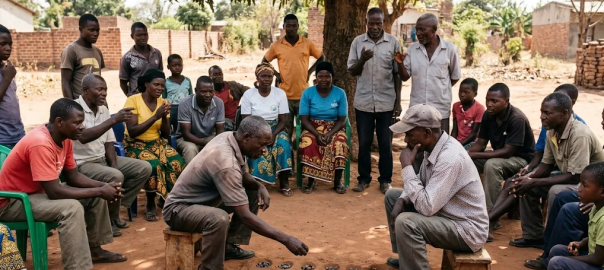
The Four-Row Strategy Game of Skill, Mathematics, and Community Heritage
Sun, Nov 22 2026 /Mpelembe Media/ — Nsolo, also known regionally as Chisolo, Nchombwa, or Nchuwa, is an ancient four-row mancala game played widely across Zambia and Malawi. Historically linked to the nineteenth-century northward migrations of the Ngoni people across the Zambezi and Luangwa basins, the game’s name carries deep socio-ecological roots tied to animal spirits and the intuitive honeyguide bird, reflecting the acute observation, tactical foresight, and calculated risk required during play. Typically played outdoors by scooping pits directly into the soil or utilizing intricately carved wooden boards, matches employ small pebbles, botanical seeds, or indigenous Mongongo nuts as playing counters. The board architecture consists of four parallel rows of pits—commonly configured with ten to twenty holes per row—divided evenly between two opposing players who each command an inner attack line and an outer defensive line. In traditional setups, each hole begins with two counters, except for an intentional opening asymmetry where the rightmost hole of each player’s inner row is left empty, instantly breaking symmetry and initiating tactical engagement.
Gameplay proceeds turn by turn in a strict counter-clockwise direction through continuous relay or lap sowing. A player selects any pit containing two or more counters from their territory and distributes them one by one into consecutive holes; if the final seed lands in an already-occupied pit, the player lifts all accumulated pieces and continues sowing in a cascading multi-lap chain. Strict regulations prevent defensive stalling by prohibiting the movement of isolated single counters as long as multi-stone pits remain available. Captures occur when a player’s final seed lands in an empty pit within their inner row directly opposite occupied opponent holes. A successful capture allows the player to seize all pieces in the opponent’s adjacent inner pit, sweep corresponding counters from the adversary’s outer pit, and even claim an additional bonus pit from across the enemy’s rows, with the ultimate goal of achieving complete elimination or total immobilization of the opponent’s forces.
Beyond its recreational appeal, Nsolo embodies a sophisticated framework of African ethnomathematics, requiring players to compute non-symbolic modulo arithmetic and project complex spatial permutations entirely in their heads. The cognitive benefits—including rapid subitizing, working memory, and strategic forecasting—have prompted educational researchers to incorporate Nsolo dynamics into the Zambia Child Assessment Tool (ZamCAT) and early childhood pedagogical models as a culturally responsive diagnostic of analytical ability. Whether contested in rural village gathering shelters or during lunchtime matches among civil servants in Lusaka, Nsolo serves as both a high-stakes public performance and a living archive of community memory, where elders transmit strategic acumen, proverbs, and cultural traditions across generations.
Opening Strategies and Early Traps
The opening phase of Nsolo is dictated by the game’s initial structural asymmetry: while every pit begins with two counters, the rightmost hole of each player’s inner row starts completely empty. This initial opening shapes early tactical decisions:
- The Outer-Row Mobilization Principle: Expert opening play strongly prioritizes initiating distributions from pits in the outer defensive row rather than the inner attack row. Sowing from the outer row allows seeds to circulate counter-clockwise across a longer arc, building depth in defensive reserves while preventing the premature exposure of front-line stones. In contrast, launching early moves from inner pits often depletes forward defenses and creates unintended empty pits that an alert opponent can exploit as landing targets.
- The Asymmetry Exploitation (First-Strike Capture): The pre-existing empty pit on a player’s inner right flank offers an immediate tactical target. By precisely calculating a multi-lap relay trajectory from an outer hole, an opening player can maneuver their final counter to drop directly into their vacant inner hole opposite an occupied opponent pit, triggering an immediate turn-one or turn-two capture.
- Defending Against “Flying Captures”: A common opening trap involves failing to account for recursive, multi-lap relay sowings (“flying captures”). Because landing in any occupied pit scoops up all accumulated seeds and continues the distribution, a seemingly distant outer cluster can cascade across several laps and strike deep into an opponent’s front row. Players must track multi-lap modulo chains before making a move, verifying that their own inner row does not leave high-value columns vulnerable to an opening raid.
Mid-Game Clearing Tactics and Positional Control
Once pieces disperse and cluster across the board, the game transitions into high-stakes positional warfare centered on column alignment and piece starvation.
1. The Column Breach and the Bonus Capture
The core engine of mid-game tactical destruction is the linked double capture and the subsequent bonus pick:
- Double-Row Elimination: When a sowing sequence terminates in an empty pit on a player’s inner row, it automatically captures the facing inner-row counters of the adversary. If the opponent’s corresponding outer pit in the same vertical column is also occupied, those outer counters are captured simultaneously.
- The Bonus Pit Extraction: Executing a complete column capture (both inner and outer holes) unlocks a bonus capture, allowing the active player to unilaterally seize all counters from any other single hole of their choice anywhere across the opponent’s territory.
- Magazine Disruption (Preemptive Draining): Master players use this bonus pick to systematically dismantle the opponent’s counter-offensive preparations. Instead of picking small, convenient pits, the bonus capture is directed at the adversary’s “build-up pit”—a deep hole where the opponent has been accumulating a massive stack of seeds to launch their own cascading relay. Draining this accumulation removes their primary attacking weapon before it can be unleashed.
2. Defensive Stacking Discipline
Because an opponent who captures an inner pit also claims the outer pit behind it, building massive reserves directly behind occupied inner holes creates extreme liability.
- Maintaining a balanced column depth across your territory is critical. Stacking excessive counters in the outer row without an impenetrable inner front invites the opponent to breach the column, seize both pits, and trigger a catastrophic bonus capture against your remaining ranks.
3. Singleton Strangulation and Immobilization
Nsolo enforces a strict rule regarding single counters: a player is prohibited from moving isolated single stones as long as any pits containing two or more counters remain available on their side of the board. When forced to move singletons, they may only be sown into empty holes.
- Forcing Structural Paralysis: Mid-game maneuvering aims to deliberately isolate the opponent’s forces into disconnected single-stone pits. By targeting pits with two or more seeds and picking off multi-stone clusters, a player restricts the adversary’s legal mobility.
- The Endgame Squeeze: Once an opponent is stripped of multi-seed pits, their tactical momentum collapses. They are reduced to moving single stones into empty adjacent spaces, making them completely unable to sustain relay chains or trigger captures. This leads directly to either total material elimination or victory via total opponent immobilization.
Here is an annotated tactical walk-through and board matrix of a \(4 \times 12\) Nsolo board, tracing how a player engineers a two-lap relay to trigger a full column breach and claim a bonus capture.
1. Board Coordinates and Movement Vector
In a \(4 \times 12\) setup, the board is partitioned horizontally into two territories of 24 pits each. Movement within your territory proceeds in a strict counter-clockwise loop:
- Outer Row (\(P_{\text{out}}\)): Sows left-to-right (Columns \(1 \rightarrow 12\)).
- Inner Row (\(P_{\text{in}}\)): Sows right-to-left (Columns \(12 \rightarrow 1\)).
- Opponent’s Territory: Sits directly opposite, where their inner row faces your inner row.
═══════════════════════════════════════════════════════════════════════════════════════
                             OPPONENT TERRITORY (NORTH)
Outer (Def): [ 2][ 2][ 2][ 2][ 2][ 2][ 2][ 5*][ 2][ 2][ 3][ 2]  (Cols 1 to 12)
Inner (Atk): [ 2][ 2][ 2][ 2][ 2][ 2][ 2][ 1 ][ 2][ 2][ 4][ 0]
───────────────────────────────────────────────────────────────────────────────────────
                               PLAYER TERRITORY (SOUTH)
Inner (Atk): [ 1][ 2][ 2][ 0*][ 2][ 3][ 2][ 2][ 2][ 2][ 2][ 0]  (← Sows Left: 12 → 1)
Outer (Def): [ 2][ 2][ 2][ 2 ][ 2][ 2][ 2][ 4*][ 2][ 2][ 2][ 2]  (→ Sows Right: 1 → 12)
             Col1 Col2 Col3 Col4 Col5 Col6 Col7 Col8 Col9 Col10 Col11 Col12
═══════════════════════════════════════════════════════════════════════════════════════
* Key tactical targets:
  - P_out  : Player's starting attack pit (contains 4 seeds).
  - P_in   : Player's vacant landing hole (0 seeds) opposite opponent Col 4.
  - Opp    : Opponent Col 4 target (Inner = 1 seed, Outer = 5 seeds).
  - Opp   : Opponent's heavy build-up "magazine" (Inner = 4 seeds, Outer = 3 seeds).
2. Stone-by-Stone Execution: The Multi-Lap Relay
Lap 1: Launching from the Outer Line
- Action: Player scoops 4 seeds from \(P_{\text{out}}\) to initiate the counter-clockwise sowing arc.
- Drops 1 seed into \(P_{\text{out}}\) (becomes 3)
- Drops 1 seed into \(P_{\text{out}}\) (becomes 3)
- Drops 1 seed into \(P_{\text{out}}\) (becomes 3)
- Drops final seed into \(P_{\text{out}}\) (was 2 \(\rightarrow\) now 3)
- Relay Trigger: Because the final seed landed in an occupied pit (\(P_{\text{out}}\) now holding 3 seeds), the turn does not terminate. The player immediately lifts all 3 seeds from \(P_{\text{out}}\) and transitions up into the inner row.
Lap 1 Trajectory:
P_out (Lift 4) ──→ P_out ──→ P_out ──→ P_out ──→ P_out (Drop last & Relay!)
                                                                     │
                                                                     ▼ (Turns to Inner Row)
Lap 2: The Inner Front Strike
- Action: Sowing continues right-to-left along the inner row using the 3 scooped seeds:
- Drops 1 seed into \(P_{\text{in}}\) (was 0 \(\rightarrow\) becomes 1)
- Drops 1 seed into \(P_{\text{in}}\) (was 2 \(\rightarrow\) becomes 3)
- Drops final seed into \(P_{\text{in}}\) (was 2 \(\rightarrow\) now holds 3)
- Relay Trigger: Landing in occupied \(P_{\text{in}}\) scoops 3 seeds, continuing the cascade leftward:
- Drops 1 seed into \(P_{\text{in}}\) (becomes 3)
- Drops 1 seed into \(P_{\text{in}}\) (becomes 3)
- Drops 1 seed into \(P_{\text{in}}\) (was 2 \(\rightarrow\) now holds 3)
- Relay Trigger: Landing in occupied \(P_{\text{in}}\) scoops 3 seeds:
- Drops 1 seed into \(P_{\text{in}}\) (was 3 \(\rightarrow\) becomes 4)
- Drops 1 seed into \(P_{\text{in}}\) (was 2 \(\rightarrow\) becomes 3)
- Terminal Drop: Drops final seed into \(P_{\text{in}}\).
- Terminal Condition: \(P_{\text{in}}\) was completely empty (0 seeds) before the drop. Because the final seed lands in an empty pit in the player’s inner row, the relay halts, and the capture check activates immediately.
3. The Harvest: Breach, Sweep, and Bonus Extraction
Because the final counter landed in a previously vacant inner hole (\(P_{\text{in}}\)) directly facing an occupied enemy sector, the capture mechanism executes in three consecutive phases:
                      [Opp Outer Col 4: 5 seeds] ──► CAPTURED! (Double Sweep)
                                ▲
                                │ (Column Alignment)
                                ▼
                      [Opp Inner Col 4: 1 seed ] ──► CAPTURED! (Primary Strike)
════════════════════════════════╪═════════════════════════════════════════════════════
                      [Player Inner Col 4: 1 seed] (Terminal Landing in Empty Pit)
- Primary Capture (Enemy Inner Pit):
- The opposing pit directly across (\(\text{Opp}_{\text{in}}\)) holds 1 seed. It is seized immediately.
- Linked Secondary Capture (Enemy Outer Pit):
- Because the front-line shield at \(\text{Opp}{\text{in}}\) has fallen and the outer pit behind it (**\(\text{Opp}{\text{out}}\)**) contains 5 seeds, the outer pit is breached simultaneously. All 5 seeds are seized.
- The Bonus Pit Extraction:
- Breaching both the inner and outer pits of an opponent’s vertical column awards a bonus capture. The player can unilaterally wipe out any single pit anywhere on the opponent’s board.
- Strategic Selection: Rather than picking a low-value 2-seed hole, the player targets \(\text{Opp}_{\text{in}}\), which holds 4 seeds intended as the opponent’s counter-attacking strike force.
Total Harvest: \(1 \text{ (inner)} + 5 \text{ (outer)} + 4 \text{ (bonus pit)} = \mathbf{10\text{ opponent seeds eliminated in a single turn}}\).
4. Post-Breach Board State
═══════════════════════════════════════════════════════════════════════════════════════
                             OPPONENT TERRITORY (NORTH)
Outer (Def): [ 2][ 2][ 2][ 0!][ 2][ 2][ 2][ 5 ][ 2][ 2][ 3][ 2]
Inner (Atk): [ 2][ 2][ 2][ 0!][ 2][ 2][ 2][ 1 ][ 2][ 2][ 0!][ 0]
───────────────────────────────────────────────────────────────────────────────────────
                               PLAYER TERRITORY (SOUTH)
Inner (Atk): [ 1][ 2][ 2][ 1 ][ 3][ 4][ 3][ 3][ 3][ 1][ 3][ 1]
Outer (Def): [ 2][ 2][ 2][ 2 ][ 2][ 2][ 2][ 0 ][ 3][ 3][ 3][ 0]
             Col1 Col2 Col3 Col4 Col5 Col6 Col7 Col8 Col9 Col10 Col11 Col12
═══════════════════════════════════════════════════════════════════════════════════════
Status: Opponent's Column 4 is completely hollowed out, their Column 11 magazine is
neutralized, and the opponent is forced into defensive, single-seed vulnerability.
Key Ethnomathematical Takeaway
This maneuver illustrates the non-symbolic modulo arithmetic required in competitive Nsolo: \[\text{Landing Pit} = (P_{\text{start}} + S) \pmod{\text{Circuit Perimeter}}\] By mentally chaining three recursive laps (\(f(f(f(x)))\)), the player calculated that an initial 4-seed investment from the outer row would carry across the turning corner, absorb intermediate 2-seed and 3-seed clusters, and terminate on the exact empty pit required to trigger the 10-stone sweep.
Mathematical Framework of Nsolo Movement and Targeting
In competitive Nsolo, calculating whether an opening or mid-game move will terminate in a specific capture pit requires mapping the player’s two rows onto a closed directed cycle of length \(L = 2n\), where \(n\) represents the number of columns per row.
1. The Circuit Coordinate Model
A player’s territory is modeled as a 1D discrete ring \(\mathbb{Z}_{2n}\) indexed from \(0\) to \(2n – 1\) along the counter-clockwise sowing vector:
\[\text{Circuit Index } k \in {0, 1, \dots, 2n – 1}\]
For a standard \(4 \times 12\) board (\(n = 12\), total circuit length \(L = 24\)):
- Outer Row (Defensive Line): Pits \(0\) through \(11\) (sowing left-to-right, Col \(1 \rightarrow 12\)). \[k = c – 1 \quad (\text{where } c \in \text{ is the column number})\]
- Inner Row (Attack Line): Pits \(12\) through \(23\) (sowing right-to-left, Col \(12 \rightarrow 1\)). \[k = 12 + (12 – c) = 24 – c \quad (\text{where } c \in \text{ is the column number})\]
Col Number:    1    2    3    4    5    6    7    8    9   10   11   12
──────────────────────────────────────────────────────────────────────────
Inner Row (k): 23   22   21   20   19   18   17   16   15   14   13   12  (← Sows Left)
Outer Row (k):  0    1    2    3    4    5    6    7    8    9   10   11  (→ Sows Right)
2. Single-Lap Distance and Seed Equations
For any starting pit \(P_{\text{start}}\) and desired target pit \(P_{\text{target}}\), the base forward discrete distance \(\Delta\) is given by:
\[\Delta = (P_{\text{target}} – P_{\text{start}}) \pmod{2n}\]
If no intermediate pits are empty, a single drop with \(S\) seeds will land exactly in \(P_{\text{target}}\) if and only if:
\[S \equiv \Delta \pmod{2n} \quad \implies \quad S = \Delta + m \cdot (2n), \quad m \in {0, 1, 2, \dots}\]
- If \(S = \Delta\), the sowing reaches the target in less than one full lap.
- If \(S = \Delta + 24\), the sowing completes one full lap around the player’s board before landing on the target.
3. Multi-Lap Recursive Sowing Engine (The Relay Operator)
When a drop terminates in an occupied pit, Nsolo does not stop; it scoops the contents and continues. Let \(C_t(k)\) be the number of seeds in pit \(k\) at step \(t\).
State Transition Function
When lifting \(S_t\) seeds from current position \(P_t\):
- Distribution: For each step \(i \in {1, 2, \dots, S_t}\): \[\text{Pit } (P_t + i) \pmod{2n} \leftarrow C_t((P_t + i) \pmod{2n}) + 1\]
- Landing Evaluation: The destination pit is: \[P_{t+1} = (P_t + S_t) \pmod{2n}\]
- Branching Condition: \[\begin{cases} C_{\text{final}}(P_{t+1}) = 1 & \implies \textbf{Terminal State} \ (\text{Turn ends; check capture if } P_{t+1} \ge n) \ C_{\text{final}}(P_{t+1}) > 1 & \implies \textbf{Relay State} \ (S_{t+1} = C_{\text{final}}(P_{t+1}); \text{ repeat from } P_{t+1}) \end{cases}\]
The Capture Invariant
A capture is triggered if and only if the final relay iteration terminates at \(P_{\text{final}}\) such that: \[P_{\text{final}} \in [n, 2n – 1] \quad (\text{Inner Row}) \quad \land \quad C_{\text{initial}}(P_{\text{final}}) = 0\] \[\land \quad \text{Opponent Pit Directly Facing } P_{\text{final}} \text{ is Occupied}\]
4. Direct Single-Lap Targeting Matrix (\(4 \times 12\) Board, \(L = 24\))
This matrix provides the exact number of seeds \(\Delta\) required to reach any specific inner-row attack column (\(c_{\text{in}} \in\)) from any outer-row launch column (\(c_{\text{out}} \in\)) in a single direct lap:
\[\Delta = (24 – c_{\text{in}}) – (c_{\text{out}} – 1) = 25 – (c_{\text{out}} + c_{\text{in}})\]
| Launch Pit (\(c_{\text{out}}\)) | Col 12 (\(k=12\)) | Col 11 (\(k=13\)) | Col 10 (\(k=14\)) | Col 9 (\(k=15\)) | Col 8 (\(k=16\)) | Col 7 (\(k=17\)) | Col 6 (\(k=18\)) | Col 5 (\(k=19\)) | Col 4 (\(k=20\)) | Col 3 (\(k=21\)) | Col 2 (\(k=22\)) | Col 1 (\(k=23\)) |
|---|---|---|---|---|---|---|---|---|---|---|---|---|
| Col 1 (\(k=0\)) | 12 | 13 | 14 | 15 | 16 | 17 | 18 | 19 | 20 | 21 | 22 | 23 |
| Col 2 (\(k=1\)) | 11 | 12 | 13 | 14 | 15 | 16 | 17 | 18 | 19 | 20 | 21 | 22 |
| Col 3 (\(k=2\)) | 10 | 11 | 12 | 13 | 14 | 15 | 16 | 17 | 18 | 19 | 20 | 21 |
| Col 4 (\(k=3\)) | 9 | 10 | 11 | 12 | 13 | 14 | 15 | 16 | 17 | 18 | 19 | 20 |
| Col 5 (\(k=4\)) | 8 | 9 | 10 | 11 | 12 | 13 | 14 | 15 | 16 | 17 | 18 | 19 |
| Col 6 (\(k=5\)) | 7 | 8 | 9 | 10 | 11 | 12 | 13 | 14 | 15 | 16 | 17 | 18 |
| Col 7 (\(k=6\)) | 6 | 7 | 8 | 9 | 10 | 11 | 12 | 13 | 14 | 15 | 16 | 17 |
| Col 8 (\(k=7\)) | 5 | 6 | 7 | 8 | 9 | 10 | 11 | 12 | 13 | 14 | 15 | 16 |
| Col 9 (\(k=8\)) | 4 | 5 | 6 | 7 | 8 | 9 | 10 | 11 | 12 | 13 | 14 | 15 |
| Col 10 (\(k=9\)) | 3 | 4 | 5 | 6 | 7 | 8 | 9 | 10 | 11 | 12 | 13 | 14 |
| Col 11 (\(k=10\)) | 2 | 3 | 4 | 5 | 6 | 7 | 8 | 9 | 10 | 11 | 12 | 13 |
| Col 12 (\(k=11\)) | 1 | 2 | 3 | 4 | 5 | 6 | 7 | 8 | 9 | 10 | 11 | 12 |
5. Multi-Lap Relay Shortcut Theorems
In live play, mental computation across 2 or 3 laps is simplified using three operational shortcuts:
The Initial Opening Shortcut (Targeting the Rightmost Inner Pit)
At the start of the match, the rightmost inner pit (Col 12, \(k=12\)) starts at \(0\) seeds, while all other pits start with \(2\) seeds.
- To execute a direct single-lap strike into Col 12, the outer pit at column \(c\) needs \(\Delta = 13 – c\) seeds.
- The Relay Invariant: Lifting 2 seeds from \(c_{\text{out}} = 10\) (\(k=9\)) drops into \(k=10\) (now holding \(2+1=3\) seeds). Lifting those 3 seeds reaches \(k=13\) (Col 11), continuing until the front flank is breached.
The “Plus-One” Relay Carryover
When calculating intermediate relays, each occupied pit you land in adds its existing contents plus the single incoming seed: \[S_{t+1} = C_{\text{initial}}(P_{t+1}) + 1\] If a sector consists uniformly of 2-seed pits: \[\text{Effective Jump per Relay} = 2 + 1 = 3 \text{ spaces}\] Every intermediate 2-seed hole hit advances your relay forward by 3 pits on the next lap.
Parity Stalling Rule
Because every seed distribution increments consecutive pits by 1, landing in an even-numbered cluster changes parity on the next leg. When seeking to trap an opponent’s piece:
- Odd seed count in target sector: Sowing will invert empty/occupied states.
- Even seed count: Preserves relative occupancy gaps.
Quick-Reference Strategy Card: Common Nsolo Opening Sequences
In standard Nsolo (\(4 \times 10\) to \(4 \times 20\)), every pit begins with two counters, except the rightmost hole in each player’s inner row, which starts completely empty (\(0\) counters). Because play proceeds strictly counter-clockwise through multi-lap relay sowing, the opening move dictates whether you establish a protected defensive shield or immediately fall victim to a cascading “flying capture”.
Board Orientation & Perspective
Both players face the board identically from their respective sides:
- Outer Row (Defensive Line): Sows from left to right.
- Inner Row (Attack Line): Sows from right to left.
- Col 1 (Far Left): Outer start; Col \(n\) (Far Right): Inner start (the initial empty pit: \(0\) counters).
  Opponent Outer Row (Defensive Line)  ← Sows Left
  Opponent Inner Row (Attack Line)     → Sows Right (Far Right Pit = 0)
════════════════════════════════════════════════════════════════════════
  Player Inner Row   (Attack Line)     ← Sows Left  (Far Right Pit = 0)
  Player Outer Row   (Defensive Line)  → Sows Right
Sequence 1: The Outer Flank Sweep (Conservative / Shield Builder)
- Launch Zone: Pits in the left-to-middle outer row (e.g., Columns 2 to 5).
- Initial Distribution: Lifting 2 seeds drops 1 seed each into adjacent outer pits, reinforcing the defensive row without touching the front line.
- Tactical Objective:
- Keeps your entire inner row intact as a defensive wall.
- Prevents creating premature empty inner holes, which an opponent could use as landing zones to execute captures.
- Stacks counters into 3-seed clusters along the outer track, preparing deep reserves for subsequent turns.
- Defensive Counter: If the opponent plays this, avoid launching premature attacks from your front line; mirror by bolstering your own outer perimeter.
Sequence 2: The Right-Wing Asymmetry Probe (Aggressive / Threatening the Flank)
- Launch Zone: Outer-row pit directly adjacent to the turning corner (Column \(n-1\), e.g., Col 11 on a 12-column board).
- The Relay Chain:
- Lifting 2 seeds from Outer Col 11 drops 1 seed into Outer Col 12 (now 3 seeds) and 1 seed into the empty Inner Col 12 (now 1 seed).
- Because the final seed did not land in an empty pit on this lap, the player immediately lifts the 3 seeds from Outer Col 12 and rounds the corner into the inner attack row.
- Tactical Objective:
- Puts immediate tactical pressure on the opponent’s exposed inner left flank.
- Converts your own starting empty pit into an active, occupied defensive outpost.
- Risk & Vulnerability: Landing the final seed in a freshly occupied inner pit can leave a vulnerable singleton if the cascade stalls, making it a high-risk, high-reward gambit.
Sequence 3: The Center-Circuit Staging Move (Positional / Magazine Development)
- Launch Zone: Middle outer-row pits (e.g., Columns 8 to 10 on a 12-column board).
- The Relay Chain:
- Lifting 2 seeds lands on Outer Col 10/11 (becomes 3 seeds).
- The relay scoops up 3 seeds, crossing the right-hand corner and advancing into Inner Col 12 and Col 11.
- The relay continues into the inner row, consolidating multiple pits into 3-seed and 4-seed strike magazines.
- Tactical Objective:
- Concentrates multiple counters into the center of the attack line.
- Threatens multi-column breaches across the opponent’s middle rows on turn two.
- Risk & Vulnerability: Requires precise mental calculation; misjudging the relay chain can accidentally land in a vacant inner hole that does not align with opponent counters, wasting the turn without a capture.
Quick Comparison Matrix
| Sequence | Launch Pit | Risk Level | Primary Strength | Key Vulnerability |
|---|---|---|---|---|
| 1. Outer Flank Sweep | Outer Cols 2–5 | Low | Maintains solid inner-row shield; builds outer reserves. | Yields temporary board initiative to the opponent. |
| 2. Right-Wing Probe | Outer Col \(n-1\) | High | Occupies starting empty pit; threatens early flank capture. | Can stall into an exposed single seed on the front line. |
| 3. Center-Circuit Staging | Outer Cols 8–10 | Medium | Builds heavy strike magazines in the inner row. | Prone to miscalculation landing outside capture alignment. |
Three Inviolable Opening Rules
- Never open from the inner row: Moving an inner-row pit on move one leaves a vacant hole on your front line, gifting your opponent an immediate target to land on and trigger a double capture.
- Beware the “Flying Capture”: Before committing to a move, mentally compute whether your opponent can reach your inner holes on their following turn via a multi-lap relay.
- Respect the Singleton Restriction: Remember that any pit reduced to 1 seed cannot be moved as long as pits with 2 or more seeds remain on your side. Avoid scattering seeds so thinly that you paralyze your own legal moves.
Defensive Counter-Measures: Neutralizing the Flank Probe
When an aggressive opponent opens with a Right-Wing Flank Probe (launching from their outer row near the corner to round into the inner attack line and challenge your left flank), they are gambling on early disruption. While aggressive, this probe often overextends their forces, leaving shallow pits and predictable landing zones that can be systematically countered.
1. The Threat Architecture of the Flank Probe
In a typical flank probe on a \(4 \times n\) board:
- The Attack Arc: The opponent scoops counters from their outer right flank (Columns \(n-1\) or \(n\)) to round the corner into their inner row.
- Their Objective: Land their final counter in a vacant inner-row hole directly facing your front line to trigger an immediate double capture, or establish an advanced 3-to-4 seed “magazine” poised to breach your left flank on turn two.
- Their Vulnerability: Initiating a long arc from the flank depletes their rear corner defenses, creates temporary singleton pits (1 seed) that cannot legally move on subsequent turns, and leaves their newly occupied front-line holes exposed before their defensive shield is fully set.
2. Core Counter-Strategies
Depending on whether the opponent’s opening move achieved an immediate capture or stalled into an aggressive forward staging post, deploy one of three tactical responses:
A. The Column Evacuation (Starvation Counter)
- When to use: The opponent’s probe lands in an inner-row staging pit and threatens a devastating double capture on their very next turn against your front-line pieces on Columns 1 or 2.
- Execution:
- Calculate a move originating from your threatened inner-row pit (e.g., Inner Col 1 or 2).
- Sow those counters backward along your inner track (sowing counter-clockwise toward higher-indexed columns).
- Tactical Result: You empty the exact pit the opponent calculated to capture. In Nsolo, capturing is strictly predicated on landing opposite an occupied pit. By evacuating your front-line target, you leave an empty hole: even if the opponent reaches that column, their sequence either terminates harmlessly or scoops past the intended strike zone without triggering a capture.
B. The Flank Counter-Breach (Exploiting Overextension)
- When to use: The opponent’s probe failed to capture and stalled in their inner row, leaving their newly reinforced inner hole protected by a shallow or depleted outer hole behind it.
- Execution:
- Identify your outer-row pit whose counter-clockwise trajectory rounds your own right corner and terminates directly opposite their forward probe.
- Launch a calculated multi-lap relay to terminate in your corresponding inner pit.
- Tactical Result: Because their flank probe emptied their own outer row to supply the forward attack, their rear defense is either completely bare or reduced to a singleton. Striking their forward pit allows you to capture their primary attacking force immediately, stripping away their initiative.
C. The Opposite-Flank Counter-Strike (Asymmetrical Pressure)
- When to use: The opponent heavily commits pieces to contest one side of the board (e.g., your left flank), leaving the opposing wing (your right flank) untouched.
- Execution:
- Refuse to engage in a localized war of attrition on their preferred flank.
- Mobilize your middle or right outer-row pits (Columns 8 to 11) to reinforce your own right inner flank.
- Use the natural opening asymmetry (the initial \(0\)-seed hole on your inner right) to construct your own forward strike magazine.
- Tactical Result: This splits the board. The opponent is forced to either abandon their offensive probe to defend their neglected flank or commit to a mutual race where the player with better modulo calculation wins the bonus capture.
3. Defensive Rules of Thumb Against Early Aggression
- Never panic-sow singletons: An aggressive opening by an opponent is designed to bait you into premature defensive moves that break up your multi-seed clusters. Remember that single seeds cannot be moved while multi-seed pits exist. Keep your pieces clustered in 2s and 3s so you retain maximum movement flexibility.
- Monitor the outer-row shield: As long as your inner pit remains occupied, your outer pit behind it is completely immune to capture. If an opponent threatens a column, simply reinforcing the inner pit with an additional seed preserves the shield.
- Punish stalling moves: If the opponent’s probe ends in an inner-row pit containing only 1 seed, that pit is legally immobilized. Treat it as dead material and direct your calculations elsewhere on the board.5 Counter-Intuitive Lessons on Learning, Play, and Human Intelligence from African Traditions
1. Introduction: Unlearning Our Universal Assumptions
Modern formal education systems and dominant psychological frameworks frequently treat their own concepts of time, intelligence, and cognitive development as universal truths. From standardized testing regimens to rigid classroom schedules, Western pedagogical paradigms tend to assume that their metric of progress is the default baseline for all of humanity.
However, examining traditional practices—specifically within Zambian and broader African contexts—flips these foundational assumptions on their head. Far from being informal or unscientific, indigenous traditions contain highly sophisticated systems for processing information, structuring play, and understanding human growth. Through a lens of epistemological diversity, we discover that human cognitive development thrives in frameworks that the Western academy has historically overlooked or misunderstood.
This post distills five impactful, counter-intuitive takeaways about human cognitive development, play, and culture that challenge mainstream educational assumptions and reveal a deeper, more holistic vision of human potential.
2. Takeaway 1: Utility Beats Abstraction (Why Language Shapes Thought Differently)
In Western academic norms, abstract categorization is frequently mistaken for superior intelligence. Detached taxonomic classification—sorting objects by non-functional geometric or conceptual labels—is treated as a “higher-order” cognitive skill, while context-dependent or functional thinking is mischaracterized as an inferior stage of mental growth. This bias overlooks the extraordinary cognitive efficiency and practical sophistication of functional information processing.
Research conducted by communications scholar Andreas Fuglesang provides a compelling demonstration of this cultural disconnect through an interaction with a Zambian woman named Bana Enifa. When shown a pawpaw and a mango and asked how they were alike, Bana Enifa did not classify them under an abstract category like “fruit.” Instead, she identified their functional utility and immediate visual attributes, answering: “I can eat paw paw! I can eat mango!” or noting, “They are round.” To her, the meaningful information lay in actionable use and direct observation here and now, rather than in an abstract classification system for which she had no practical need.
Linguistic structures reinforce this focus on context and utility. In languages like Bemba, abstract geometric adjectives such as “square” or “triangular” do not exist as isolated lexical categories. Instead, vocabulary is tied directly to concrete physical forms. A term indicating “circularity” is applied to concrete rounded objects like a pot, a pan, or a frog. Similarly, a term indicating “triangularity” is applied to concrete tapered forms like an arrowhead or a bow.
Rather than reflecting a cognitive deficit, this linguistic relativity demonstrates a highly functional model of information processing. It prioritizes actionable relationships within an environment over arbitrary abstractions. Western academic frameworks mistake their own habit of conceptual detachment for universal logic, failing to recognize that practical utility is a fully realized, highly efficient intellectual system.
“Why do you Mzungu not try to understand the minds of Africans more than their ability to work? You people do not understand your words do not belong to our minds.” — Mukahamubwatu, Zambia
3. Takeaway 2: Complex Math and Strategy Are Built Into Traditional Games
Early Childhood Education (ECE) sectors across developing regions—such as those monitored by Zambia’s Ministry of Education, Science, Vocational Training and Early Education (MESVTEE)—frequently face severe resource constraints, including shortages of commercial play equipment and age-appropriate textbooks. Yet, rich pedagogical tools already exist within local heritage. Indigenous children’s games and traditional board games act as non-digital, organic engines of ethnomathematics, spatial logic, and strategic planning.
- Nsolo : Played widely across Zambia and Malawi (and known regionally as Chisolo , Cisolo , Nchombwa , or Njombwa ), this four-row mancala variant is a masterclass in ethnomathematics and combinatorial calculation. Played on expansive boards requiring up to 284 counters (small stones or seeds), Nsolo features continuous counter-clockwise relay sowing across a player’s assigned inner and outer rows. When a final counter lands in an occupied hole, the player scoops up all accumulated counters—including the newly dropped piece—and continues sowing across multiple laps. Players must compute multi-turn trajectories, execute tactical captures of enemy counters, and manage fluctuating resource reserves. It provides mathematical and strategic rigor that easily rivals modern formal curricula.
- Chidunu : A tactical hide-and-seek variant built around a centrally guarded ball. While a designated seeker guards the ball, players hiding in the open bush must calculate the precise timing required to sprint from cover and kick the ball to redeem captured peers before the seeker can reach the ball and count to ten. The game requires real-time spatial calculation, risk assessment, gross motor speed, and social-emotional self-regulation from the seeker, who must exercise resilience during sudden player redemptions.
- Ego / Kapendo / Espada : Hopscotch variants where children use sticks or chalk to construct court layouts on raw ground, arranging complex geometric configurations of squares, rectangles, triangles, and semi-circles. Navigating these courts while hopping on one foot and manipulating markers fosters sequential numerical planning, visual-spatial awareness, gross motor coordination, and physical balance.
These indigenous games demonstrate that rich strategic reasoning and mathematical competence do not require expensive commercial technology; they thrive within low-cost, community-driven play heritage.
4. Takeaway 3: Standardized Tests Measure Cultural Background, Not Inherent Potential
Cross-cultural developmental psychology has long wrestled with the misapplication of Western-designed assessment tools. When standardized instruments are exported without thorough contextual grounding, high scores frequently reflect a child’s familiarity with specific Western cultural artifacts and privileged home environments rather than higher innate intellectual capacity.
This diagnostic limitation was highlighted during the design and validation of the Child Assessment Tool for Zambia (CDAZ), targeted at young children aged 0–5 years. As developmental researchers including Robert Serpell have observed, Western test items often rely on assumptions about materials, tasks, and communicative norms that are specific to Western middle-class households. A child unaccustomed to specific toy formats or formal testing dynamics may score poorly despite possessing exceptional cognitive competence within their everyday environment.
To measure human potential accurately, assessment instruments must achieve deep linguistic and contextual equivalence. Furthermore, early childhood research in Zambia, championed by scholars like Beatrice Matafwali, reveals that developmental and educational inequalities first manifest in early childhood—well before primary school entry. Policy interventions cannot afford to wait for formal schooling; inclusive early childhood framework design must begin at the very start of a child’s life.
“The early years are crucial for inclusion because this is the period when the foundation for lifetime learning and the development of core values and attitudes is laid… It is simply too late to start talking about inclusion when children are already in primary school.” — Beatrice Matafwali
5. Takeaway 4: “Event-Time” vs. “Clock-Time” (Measuring What Actually Matters)
Human societies structure their understanding of reality through fundamental perceptions of time and space. Industrialized Western cultures operate on a “monochronic” or “clock-time” framework, where time is commodified, segmented into abstract units, and evaluated as something to be saved, spent, or wasted. In contrast, traditional rural African communities historically operate on an “event-time” model, where temporal and spatial measurements are anchored in social presence and human activity.
Under event-time, temporal markers derive their meaning from significant natural or community occurrences. A child’s birth is not recorded as an abstract calendar date, but remembered as happening “two rainy seasons after the great drought.” A historical transition is referenced as occurring “three moons after the death of the village headman.”
Spatial measurement is similarly rooted in embodied human action rather than standardized metrics. As documented by Andreas Fuglesang, when asking a villager named Godson Handoma about the size of his family house, Godson explained it was “15 paces”—a distance standardized not by a mechanical ruler, but by the physical stride of the village headman, Mr. Viyambo, who personally performed the pacing.
This relational temporal orientation transforms our understanding of the “psychology of sitting” in village life. To an outsider bound to monochronic clock-time, elders or community members sitting together under a tree might appear unproductive. Within an event-time framework, however, sitting is an essential social practice. It is not an idle waste of time, but the intentional act of having time together —a vital investment in community harmony, shared memory, and relational presence.
6. Takeaway 5: Nature as a Subject, Not a Symbol (Lessons from African Storytelling & Literature)
In Western anthropocentric traditions, the natural world is frequently reduced to a passive backdrop, an economic resource, or a convenient set of allegorical symbols for human affairs. In contrast, traditional African oral lore, indigenous knowledge systems, and modern regional literature frequently adopt a relational, ecocentric ontology. Nature is recognized as an active subject endowed with agency and intrinsic value.
- Zulu Environmental Stewardship : Traditional Zulu customs teach young boys that when they discover a brooding bird in the wild, they must treat it as their own personal “property” to safeguard. Harassing brooding birds is strictly forbidden because mother birds are known to be sensitive to human scent and may abandon their nests if disrupted. Boys learn to keep the location secret in their hearts, learning empathy, restraint, and an understanding of non-human vulnerability.
- KhoeSan “Organism-Persons” : In KhoeSan hunter-gatherer traditions, birds and animals are not viewed as ontologically separate biological objects, but as “organism-persons.” Birds act as heralds within the ecosystem—warning human companions of hidden danger (such as lions or puff adders), predicting weather changes, or signaling news of distant relatives.
- Subjectivity in Regional Literature : In his Mikuyu prison poetry, Malawian poet Jack Mapanje portrays defenceless birds—such as wagtails, sparrows, and swallows—not merely as literary metaphors for political freedom, but as literal, vulnerable subjects enduring physical suffering alongside human detainees under a despotic regime.
Similarly, South African poet Chris Mann, in his collection Lifelines (analyzed by literary scholar Pat Louw), deliberateIy inverts traditional human-animal metaphors. In poems detailing encounters with a falcon (“Get out of my niche!”) or an Eagle Owl hovering like a dark angel, Mann places the human as the object of the bird’s subjectivity. By using human terms to describe the bird’s sovereign presence, Mann forces the reader to confront nature’s independent physical domain and recognize non-human beings as distinct subjects rather than mere symbols.
7. Conclusion: Reclaiming Holistic Foundations for the Future
Re-evaluating traditional parenting practices, indigenous play-based learning, relational temporality, and contextually grounded assessment frameworks provides a richer foundation for early childhood development and social well-being. By honoring the intellectual depth embedded in local games like Nsolo , functional linguistic category systems, event-time social cohesion, and ecological stewardship, modern education can move past narrow, standardized assumptions to unlock genuine human potential.
If mainstream educational systems continue to mistake Western cultural familiarity for universal intelligence, what critical forms of cognitive strength, strategic capability, and community wisdom will continue to be ignored?