
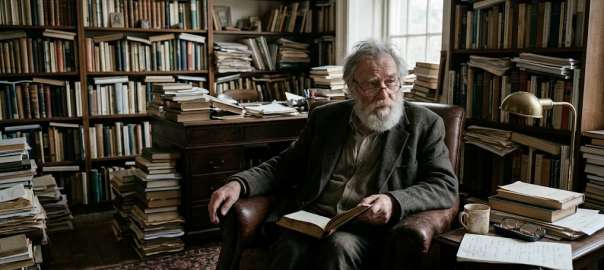
The Anatomy of Maturity: Rejecting Mass Movements for Personal Responsibility
Fri, Nov 20 2026 /Mpelembe Media/ — Nicolás Gómez Dávila’s philosophy redefines human maturity by urging an abandonment of the illusion of political salvation. While modern culture encourages individuals to seek redemption and existential meaning through state power, legislative reforms, and political activism, Gómez Dávila diagnoses modern democracy and Enlightenment progress as an anthropotheistic religion in which man attempts to deify himself. He observes that expecting societal structures to cure personal unhappiness or abolish inherent suffering misjudges what politics can achieve. Often, intense political obsession serves merely as a convenient evasion of self-examination, allowing individuals to project internal defects onto ideological opponents rather than confronting their own lives.
True maturation, according to Gómez Dávila, begins with the quiet recognition of human limitations and the pursuit of internal discipline. Because real growth occurs inward—as expressed in his aphorism that “the soul grows inwards”—genuine wisdom demands the daily reconquest of lucidity against the noise of mass media, ideological dogmas, and collective hysteria. Instead of mistaking liberty for an absolute end or treating values as subjective whims, the mature individual anchors freedom to virtue, beauty, and an objective moral hierarchy grounded in the transcendent. Embodying what he termed the “authentic reactionary,” Gómez Dávila advocates neither for the futile restoration of a dead past nor for partisan mobilization, but for independent judgment, contemplative solitude, and personal moral responsibility.
The Deification of Modern Man: Nicolás Gómez Dávila’s Theological Critique of Anthropotheistic Democracy
In modern political theory, democracy is conventionally analyzed as an institutional procedure: a constitutional design governing representative elections, the administrative balance of power, and the codification of civil liberties. For the Colombian thinker and aphorist Nicolás Gómez Dávila (1913–1994), however, interpreting democracy primarily through procedural or socioeconomic categories constitutes a profound philosophical error. Throughout his writings—most systematically in the sixth essay of Textos I (the renowned centón reaccionario ) and across the thousands of concise marginal scholia published in Escolios a un texto implícito —Gómez Dávila insisted that modern democracy is fundamentally a religion. Specifically, it represents an anthropotheistic creed whose core dogma is the self-divinization of humanity and the systematic substitution of divine transcendence with radical human immanence.
Engaging with a tradition of political theology that includes Juan Donoso Cortés, Carl Schmitt, and Eric Voegelin, Gómez Dávila argued that modern political systems have not overcome religion. Instead, the modern secular state has secularized traditional Christian metaphysics, converting the theological attributes of God into the political prerogatives of collective man.
1. The Inescapability of Political Theology
A foundational axiom of Gómez Dávila’s political philosophy is that all political doctrines implicitly presuppose an underlying theology. Modern secular thought operates on the premise that political institutions can maintain absolute metaphysical neutrality by relegating spiritual convictions to private conscience. Gómez Dávila rejected this claim as an ideological fiction. Every political philosophy necessarily adopts a definitive stance on the relationship between humanity and the transcendent order, meaning that an absolute state or a secular democracy is inevitably organized around an implicit conception of God—whether that conception is deist, pantheistic, agnostic, or militant atheist.
Rather than inaugurating an era free from sacred dogma, the modern secular state executes what scholars of Gómez Dávila describe as a “sacred transfer.” The emotional burdens, existential expectations, and salvific hopes previously oriented toward God are relocated into civic and political institutions. Gómez Dávila noted that the sociology of democratic revolutions continually resurrects categories native to the history of religions: the inspired prophet, the sacred mission, the dogmatic creed, and the persecution of heretics. The modern citizen who looks to the state for moral absolution, happiness, and existential purpose has not outgrown religion; he has merely embraced an immanent political religion that elevates worldly authority to divine status.
2. The Gnostic Genealogy: From Sacred Transcendence to the Regnum Hominis
To understand the metaphysical roots of modern anthropotheism, Gómez Dávila traced its lineage back to ancient Gnosticism and its secular transformation through the Enlightenment ( Aufklärung ). In classical Christian doctrine, creation possesses an intrinsic teleology, and human redemption is an unmerited gift of divine grace received through faith ( pistis ). By contrast, ancient Gnosticism posited that salvation is achieved through esoteric knowledge ( gnosis )—an inward realization through which the human spirit recognizes its own divine spark and seeks liberation from the material cosmos.
Gómez Dávila argued that the modern Enlightenment constitutes the direct, secularized descendant of this ancient heresy, observing that the Aufklärung is the circumspect translation of gnosis. While ancient Gnosticism sought to escape the material world in the name of an extreme transcendence, modern Gnosticism atheizes reality in the name of radical immanence. By rejecting metaphysical realism and stripping nature of its teleological orientation—treating the physical universe as mere extended matter ( res extensa ) subject to mechanical exploitation—Enlightenment rationalism positioned human consciousness as the sole measure and architect of reality:
“Regnum hominis, with whose preaching Bacon inaugurates the modern world, is not a parody of regnum Dei, but its gnostic version.”
In this transition from the Kingdom of God ( regnum Dei ) to the Kingdom of Man ( regnum hominis ), the traditional Christian drama of the Fall and Redemption is reinterpreted in secular terms. The restoration of paradise is no longer expected from divine reconciliation, but from the union of empirical science and political engineering. Humanity takes upon itself the messianic burden of eradicating suffering, ignorance, and physical limitation, turning political action into an instrument of cosmic self-redemption.
3. The Anatomy of Anthropotheism: Democracy as the Religion of Man
When modern democracy is viewed through Gómez Dávila’s critical framework, its defining doctrines reveal themselves as theological dogmas within an anthropotheistic cult. In the sixth essay of Textos I , Gómez Dávila analyzed what he termed the theogony, theology, and theophany of the democratic deity. Unlike classical theisms that begin with an eternal, self-subsisting Creator, democracy is an “anthropotheism of the future”—an ideological project dedicated to manufacturing a god out of the collective essence of mankind.
To maintain the credibility of this collective deity, democratic modernity relies upon four structural pillars:
The Four Pillars of the Anthropotheistic Creed
- Pathetic Atheism
- Modern democracy requires the denial of God not as a dispassionate scientific deduction, but as an indispensable metaphysical prerequisite. If a transcendent God exists, human will is immediately constrained by a higher metaphysical order, exposing human sovereignty as finite, dependent, and flawed. In order for man to treat himself as god, the throne of the universe must be declared vacant. As Gómez Dávila wrote in Textos I :
“If God existed, man could not feel his presumed divinity. The transcendent God nullifies our useless rebellion. Democratic atheism is theology for an immanent god.”
- The Ideology of Progress
-
- Having severed its horizons from eternity, democratic civilization must locate salvation within chronological history. Progress functions as a secularized providence. The democratic man places faith in historical evolution, expecting that scientific, economic, and institutional advances will ultimately save him from misery, boredom, moral failing, and death. Progress operates as the modern narcotic that conceals human contingency.
- Subjective Value Theory
-
- In traditional metaphysics, values such as truth, beauty, and goodness exist objectively in reality and reflect a divine hierarchy. Democratic anthropotheism inverts this relationship by adopting radical axiological subjectivism. Values are no longer recognized or contemplated; they are arbitrarily invented by human decree. The subjective desires of the individual are elevated to absolute rights, and justice is reduced to the changing consensus of majority vote.
- The Cult of Technique
- If divine creation was spoken into existence through the eternal Logos, technological mastery represents the physical speech of self-divinizing humanity. Gómez Dávila designated modern technology as “the verb of the man-god.” Through industrial technique and scientific manipulation, modern man seeks to overcome biological constraints and subjugate nature, attempting to achieve functional omnipotence within the material sphere.
4. Popular Sovereignty and the Corruption of Liberty
The theological elevation of humanity transforms the fundamental concepts of political sovereignty and human freedom. In classical and Christian thought, political authority is conditioned and limited: rulers are subordinate to natural moral law, and power is justified only by its pursuit of transcendent justice and the common good. Modern democracy radically relocates this authority by investing absolute sovereignty in “the people.”
Gómez Dávila observed that democratic theory replicates the theological structure described by Alexis de Tocqueville: the people rule over political life precisely as God reigns over the cosmos, standing as the supreme cause and final end from which all laws originate and to which all power returns. When authority derives its legitimacy entirely from its democratic origin rather than from its conformity with moral truth, it becomes inherently limitless. As Gómez Dávila noted, nothing is forbidden to power if its origin grants it legitimacy. Under this doctrine, the state is freed from objective ethical boundaries. Any traditional moral reservation, aesthetic principle, or spiritual objection that impedes the implementation of collective will or economic expansion is dismissed as an illegitimate obstacle to the sovereign people.
Consequently, modern legislation ceases to be the juridical articulation of organic custom and natural justice; it becomes an instrument for imposing ideological designs. Gómez Dávila warned that reforming society through statutory engineering is the discrete preamble to every tyranny. Because the collective sovereign recognizes no law higher than its own will, democratic regimes can enact the most pervasive encroachments upon personal liberty while claiming to govern in the name of the people.
5. Metaphysical Divergence: Anthropotheism versus Reactionary Realism
To grasp the total scope of Gómez Dávila’s critique, it is necessary to contrast the assumptions of modern democratic anthropotheism against the classical and reactionary realism from which his philosophical work emerged. The conflict between these two worldviews is not a dispute over technical policies, but an irreconcilable divide over the nature of being, freedom, and authority.
The following matrix synthesizes the structural contrasts between the modern anthropotheistic creed and Gómez Dávila’s reactionary political theology across seven foundational categories:
Philosophical Dimension,Modern Democratic Anthropotheism,Gómez Dávila’s Reactionary Realism
Metaphysical Foundation,Radical immanence; human self-divinization; denial of a transcendent ontological order.,Metaphysical realism; objective cosmic hierarchy; ontological dependence of the creature upon God.
Locus of Sovereignty,Popular will and electoral consensus; absolute self-determination of the human species.,”Divine sovereignty; natural moral law; human authority strictly conditioned, bounded, and fallible.”
Epistemological Matrix,Gnostic rationalism and scientism; human reason as the sovereign creator of truth and norms.,Contemplative intelligence ( inteligencia ); recognition of eternal truths and intuitive perception of values.
Conception of Liberty,Freedom conceived as an absolute end; unconstrained autonomy to enact subjective desire.,”Conditioned liberty; freedom as a disciplined, ethical means toward virtue, excellence, and contemplation.”
Soteriological Mechanism,”Secular progress, state administrative engineering, and industrial technique.”,Divine grace; internal moral transformation; conscious acknowledgment of original sin and finitude.
Institutional Structure,Expansive administrative state apparatus dissolving intermediate and organic social bodies.,”Organic, pluricentric societal hierarchy; defense of local customs, families, and autonomous associations.”
View of Human Nature,Inherently good or indefinitely plastic; capable of earthly perfection through systemic reform.,Structurally flawed and fallen; permanently bounded by physical vulnerability and spiritual limitations.
This metaphysical divergence reveals how modern democracy corrupts the concept of freedom itself. In a secularized order devoid of teleological orientation, freedom is stripped of its moral purpose. It is no longer understood as the capacity to choose the good, but as the entitlement to dismantle any constraint that impedes sovereign human appetite. Gómez Dávila captured this degeneration in a striking formulation:
“Freedom in the hands of the democrat is nothing more than a pick to break until the last lock.”
When freedom is unanchored from transcendent virtue, it inevitably culminates in the sociological enslavement of thought under mass media, cultural conformity, and bureaucratic regulation.
6. Skepticism and Transcendence: The Reactionary Antidote
In confronting the spiritual crisis of modern anthropotheism, Gómez Dávila steadfastly refused the temptation of political activism. The authentic reactionary recognizes that history is irreversible and that organized attempts to restore past political forms typically succumb to the same ideological dogmatism they seek to fight. The authentic reactionary does not mobilize mass movements; instead, he adopts a posture of intellectual and spiritual resistance from within contemplative solitude.
This defense relies upon the complementary pairing of philosophical skepticism and religious faith. For Gómez Dávila, skepticism does not lead to cynicism or despair; rather, it functions as a therapeutic discipline that purges the mind of utopian delusions:
“Against gnostic pride, only skepticism and faith could immunize. He who does not believe in God can have the decency not to believe in himself.”
By exposing the recurring failure of all social engineering and highlighting the comic disproportion between man’s divine pretensions and his persistent frailties, skepticism strips the modern world of its ideological idols. Once political messianism is dismantled, the individual is released from the compulsion to seek redemption through the state.
True maturity, in Gómez Dávila’s vision, requires accepting human creatureliness. By recognizing that humanity is not god and that human problems admit no absolute worldly solution, the individual can abandon collective hysteria and redirect his energies toward interior growth. In the quiet cultivation of books, intimate friendship, aesthetic discernment, and prayer, the mature spirit preserves eternal values amidst the decline of civilization, finding in transcendent dependence the only lasting foundation for authentic human dignity.
The Reclusive Hermit Who Saw Through Modernity: 5 Counter-Intuitive Lessons from Nicolás Gómez Dávila
Introduction: The Modern Trap of Constant Outrage
Living in the contemporary world often feels like an exhausting endurance test. We are inundated by an endless stream of political noise, hyper-connected digital distractions, and an intense cultural pressure to find personal salvation in external ideologies or state institutions. Modern public life demands our constant engagement, framing every societal conflict as an urgent, apocalyptic crusade where total moral allegiance is the mandatory price of admission.
Yet mid-20th-century Colombia produced a thinker who quietly stepped away from this frantic arena to practice an unyielding intellectual sovereignty. Nicolás Gómez Dávila—affectionately known to his circle as “Don Colacho”—spent most of his adult life in Bogotá assembling a private library that eventually grew to roughly 30,000 volumes. Though he was a distinguished member of the Colombian elite who helped found the University of the Andes in 1948, he deliberately chose a life of private contemplation over public prominence.
Gómez Dávila consistently turned down opportunities to enter statecraft, declining an offer to serve as an advisor to President Alberto Lleras in 1958 and refusing the post of ambassador to the Court of St. James in London in 1974. From the secluded sanctuary of his study, he produced thousands of sharp aphorisms ( escolios ) that challenge the core metaphysical premises of post-Enlightenment civilization. Drawing upon a rich lineage that connects Montaigne, Burckhardt, Neoplatonism, and the Perennial Philosophy, Don Colacho offers a timeless antidote to our age of relentless outrage.
Takeaway 1: True Maturity Begins When You Stop Expecting Politics to Fix Your Life
Gómez Dávila puts forward a counter-intuitive definition of human adulthood: genuine maturity consists not in selecting the “correct” political program, but in abandoning the illusion that political statecraft can resolve internal human suffering or spiritual emptiness. Modern secularization removed God from the horizon only to deify human autonomy. Gómez Dávila diagnosed this modern creed as “anthropotheism”—the projection of divine attributes (omnipotence, sovereignty, redemptive power, and absolute liberty) onto state systems and political movements.
When political institutions are burdened with divine expectations, public life degenerates into fanatical messianism. Relinquishing this political messianism is a profoundly liberating act. By acknowledging the strict metaphysical limits of political action, an individual ceases to project personal moral flaws onto external ideological enemies, redirecting attention away from public theater and toward interior discipline, moral self-examination, and genuine spiritual growth.
“Man matures when he stops believing that politics solves his problems.”
Takeaway 2: The “Authentic Reactionary” Is Not Nostalgic for a Dead Past
Popular discourse often confuses the reactionary with a sentimental conservative yearning to turn back the clock to a bygone era. Gómez Dávila thoroughly dismantles this error. The “authentic reactionary” recognizes that canceled historical forms cannot be reconstructed and that modern mass activism is structurally driven by hubris. As the critic Ernst Volkening famously observed of Gómez Dávila’s framework, the authentic reactionary is “l’homme non-engagé par excellence” —the uncommitted man who refuses to be recruited by contemporary ideological crusades.
Rejecting the linear view of history as an inevitable march of progress, the authentic reactionary adopts a cyclical perspective: “The ‘wheel of fortune’ is a better analogy for history than the ‘evolution of humanity.'” Rather than wasting energy on political activism or romantic nostalgia, the reactionary operates as a sovereign thinker who seeks eternally valid, transcendent truths—what Gómez Dávila termed “causes that do not turn up on the notice board of history.”
- The Progressive Utopian : Views history as a linear movement of human liberty and secular redemption. Treats historical facts as dociles, pliable material to be refashioned by sovereign human will.
- The Sentimental Conservative : Entertains illusions about restoring dead political institutions, attempting to preserve societal structures even when they no longer retain anything worthy of conservation.
- The Authentic Reactionary : Accepts that past historical forms cannot be restored, rejects mass political mobilization, and acts as a sovereign mind seeking timeless, objective truths beyond the fleeting fashions of history.
“The reactionary is not a nostalgic dreamer of a canceled past, but rather a hunter of sacred shades upon the eternal hills.”
Takeaway 3: “Inuseful” Leisure and Dead Languages Are Therapy for the Soul
In contrast to modern utilitarianism—where study is valued solely for economic production, technical specialization, or academic credentialing—Gómez Dávila defended the spiritual practice of “inuseful” leisure ( ocio ) and classical studies. After a severe childhood bout of pneumonia in Paris left him bedridden for nearly two years, private tutors taught him fluent Latin and Greek. This sparked a lifelong habit of reading ancient texts until dawn, using his morning reading of Homer as the ultimate viaticum to endure the daily vulgarity of the modern world.
Don Colacho insisted that true classical education acts as an indispensable foundation for the mind, remarking that “Without Latin or Greek it is possible to educate the gestures of intelligence, but not intelligence itself.” Non-commercial, disinterested reading functions as a sanctuary ( bibliotherapy ). Engaging with classical literature in original languages acts as a cultural disinfectant; it presents the timeless commonplaces of human wisdom with serene calmness, protecting the soul from being brutalized by fleeting modern fashions.
“Reading only in Latin and Greek is the only thing that disinfects the soul a bit.”
Takeaway 4: Capitalism and Communism Are Twin Siblings of the Same Materialist Faith
Gómez Dávila offered a radical critique of modern economic systems, arguing that despite their overt geopolitical rivalry, Capitalism and Communism are historical twin hybrids born from the same anthropotheistic premise. Both systems reject human metaphysical dependence on the transcendent, seeking a world where man acts as the sole master of his own destiny through technocratic power and economic mastery.
Both ideologies reduce the human person to a sociological abstraction and an economic animal, evaluating human fulfillment by the same utilitarian rulebook. As Gómez Dávila observed of their specific mechanisms: “Artificially fomenting greed, in order to become rich by satisfying it, is the unforgivable sin of capitalism,” while “A man is called a Communist if he fights for the state to assure him a bourgeois existence.”
- Shared Premises of Capitalism and Communism:
- Anthropotheistic Autonomy : Both discard transcendent metaphysical limits, treating human self-determination as absolute.
- Materialist Reductionism : Both evaluate societal success through economic growth and material consumption rather than spiritual elevation.
- Technocratic Mastery : Both rely on technical-scientific progress and industrialization to dominate nature and satisfy artificially fomented desires.
“To avoid a virile confrontation with nothingness, men raise shrines to honor progress.”
Takeaway 5: “Writing Short” Is an Act of Intellectual Honesty and Resistance
Gómez Dávila chose the aphorism or gloss ( escolio ) as his primary literary vehicle, rejecting the vast, systematic treatises of modern philosophy. This choice was an epistemological and ontological stance rather than a mere stylistic preference. Modern linear systems falsely project a seamless logical harmony onto a fragmented world. Don Colacho described his own work as a “concentric book” rather than a linear one, framing his short fragments as marginal glosses on the implicit text of the world.
Writing in short fragments serves as an active rebellion against modern intellectual posture. Aphorisms do not attempt to lecture, manipulate, or sell a comprehensive political program to the masses. Instead, Gómez Dávila viewed reactionary teaching as a “dialogue between friends” and “the calling of a sleeping freedom to an awakened freedom,” using concise fragments to invite quiet reflection without forcing reality into an artificial logical matrix.
“The discourse tends to hide the ruptures of being; the fragment is the expression of honest thought.”
Conclusion: Fashioning Silent Loyalties in an Age of Noise
The enduring legacy of Nicolás Gómez Dávila does not offer a rallying cry for public political crusades or institutional revolution. In a world consumed by hyper-fixation on state power and mass digital distraction, his life and writing point to an internal reconquest of personal discipline, intellectual lucidity, and contemplative quiet within immediate reality.
His work reminds us that when public life devolves into vulgarity and ideological fanaticism, the individual is not obligated to join the noise. As Don Colacho explicitly wrote, “When nothing in society deserves respect, we should fashion for ourselves in solitude new silent loyalties.” By stepping back from the demand for political salvation, we preserve the dignity of the human soul.
In a culture that demands your constant outrage as the price of admission to public life, do you have the courage to step back, reject political messianism, and fashion in solitude your own silent loyalties?