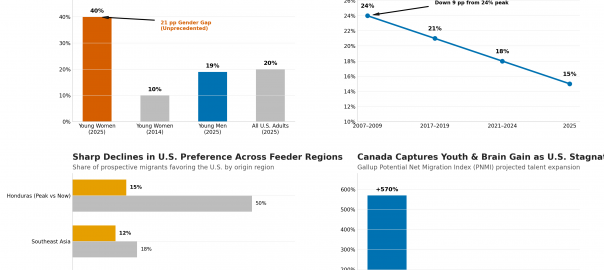
America’s Gendered Exit: Why 40% of Young Women Want to Leave the U.S.
Sat Oct. 16, 2026 /Mpelembe Media/ — Global migration aspirations have entered a period of structural recalibration, as the proportion of adults worldwide desiring to relocate permanently dipped to 15% in 2025 after sustaining a record peak of 16% between 2021 and 2024. Although the United States remains the single most desired destination globally, its attraction has fallen to a nearly two-decade low of 15% in 2025, down from 24% in the 2007–2009 period. This cooling demand is particularly striking in traditional feeder corridors such as Latin America and the Caribbean (dropping from 33% to 28%) and Southeast Asia (falling from 18% to 12%), with Honduras recording a dramatic 35-percentage-point collapse in U.S. preference. Instead of defaulting to North America, potential migrants are turning toward multipolar regional networks—favoring Japan in Southeast Asia, Germany in the Middle East, and Spain in Europe—while Canada solidly maintains its position as the second most preferred global destination at 9% (representing ~85 million adults). Continue reading