Tag Archives: El Salvador

01Nov/26

The Illusion of Democracy: Constitutional Manipulation and the Modern Dictator

How Modern Dictators Hold Absolute Power

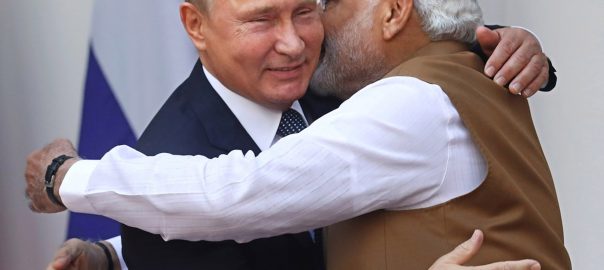
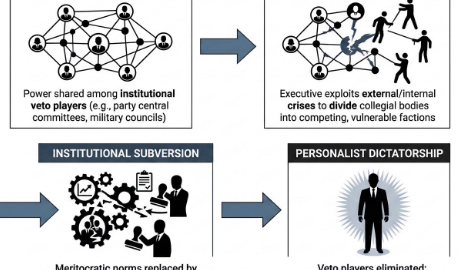
Sun, Nov 01 2026 /Mpelembe Media/ —A dictatorship is a system of governance where a single individual or political party wields absolute power, typically emerging during periods of severe social unrest or economic instability. Within these regimes, personal autonomy, political choice, and human rights are heavily suppressed, and democratic institutions as well as opposition parties are dismantled. Rulers maintain authority through coercion, intimidation, unlawful imprisonment, violence, and state apparatuses such as secret police or indefinite detentions. Furthermore, autocrats frequently manipulate legal frameworks to preserve control; for instance, constitutional amendments in Russia altered presidential term limits to allow Vladimir Putin to remain in power through 2036. While autocracies concentrate unchecked authority strictly within an individual—a category that historically encompassed benevolent rulers—dictatorships can disperse authority across a governing party or ruling circle and inherently feature severe abuses of power. Continue reading →
17Oct/26

Why America Is Losing Global Talent

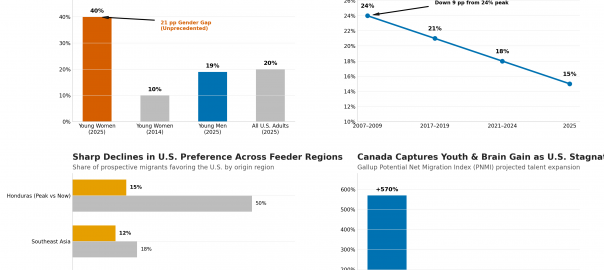
America’s Gendered Exit: Why 40% of Young Women Want to Leave the U.S.

Sat Oct. 16, 2026 /Mpelembe Media/ — Global migration aspirations have entered a period of structural recalibration, as the proportion of adults worldwide desiring to relocate permanently dipped to 15% in 2025 after sustaining a record peak of 16% between 2021 and 2024. Although the United States remains the single most desired destination globally, its attraction has fallen to a nearly two-decade low of 15% in 2025, down from 24% in the 2007–2009 period. This cooling demand is particularly striking in traditional feeder corridors such as Latin America and the Caribbean (dropping from 33% to 28%) and Southeast Asia (falling from 18% to 12%), with Honduras recording a dramatic 35-percentage-point collapse in U.S. preference. Instead of defaulting to North America, potential migrants are turning toward multipolar regional networks—favoring Japan in Southeast Asia, Germany in the Middle East, and Spain in Europe—while Canada solidly maintains its position as the second most preferred global destination at 9% (representing ~85 million adults). Continue reading →

15Apr/23

Why democratic countries around the world are not prepared to support Ukraine – and some are shifting closer to Russia

Jose Caballero, International Institute for Management Development (IMD)

After over a year of the Ukraine war, efforts at building a global consensus against Russia seem to have stalled, with many countries opting for neutrality.

The number of countries condemning Russia has declined, according to some sources. Botswana has edged towards Russia from its original pro-Ukraine stance, South Africa is moving from neutral to Russia-leaning and Colombia from condemning Russia to a neutral stance. At the same time, a large number of countries have been reluctant to support Ukraine.

Continue reading →

17Oct/22

Surveillance tech is weaponry

By Rand Hammoud, Surveillance Campaigner, Access Now

Surveillance technology is weaponry – it targets, tracks, invades, and decimates – and its unbridled use is a far-reaching, destructive violation of human rights. It is an assault rifle in the sustained global offensive on civic space, and we need a global moratorium on its export, sale, transfer, servicing, and use. Continue reading →

08Sep/22

Digital nomads have rejected the office and now want to replace the nation state. But there is a darker side to this quest for global freedom

Dave Cook, UCL

A ‘network state’ is ideologically aligned but geographically decentralised. The people are spread around the world in clusters of varying size, but their hearts are in one place.

In June 2022 Balaji Srinivasan, former chief technology officer of the Coinbase cryptocurrency exchange, published an ebook entitled The Network State: How To Start a New Country. It is the latest in a flurry of utopian visions by self-styled digital visionaries, crypto believers and web 3.0 evangelists who are lining up to declare the death of the traditional concept of countries and nationhood.

Continue reading →