
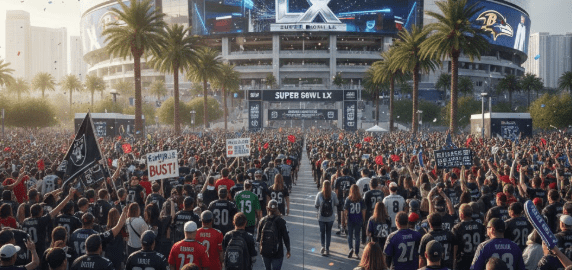
Happy Superbowl Sunday to all who celebrate! Where commercials occasionally interrupted by the World Championship of Football. If you’re reading this from abroad, and if you don’t like the “Football World Championship” phrasing then you are cordially invited to assemble a team of your own to challenge the claim. Super Bowl LX features the Seattle Seahawks versus the New England Patriots at Levi’s Stadium. Bad Bunny headlines the halftime show, with Green Day and Charlie Puth performing pregame. Fans can stream on Peacock or NBC while navigating high ticket prices and mild weather.
The Rematch No One Predicted
On February 8, 2026, the NFL returns to the high-tech epicenter of the world: Levi’s Stadium in Santa Clara. While the “rematch” between the Seattle Seahawks and New England Patriots evokes memories of their 2015 classic, the 2026 reality is a different beast entirely. The traditional tailgate has been replaced by high-stakes investment summits over artisanal espresso, set against a backdrop of Silicon Valley’s “Golden Hour” glow and shimmering digital screens.This pairing is mathematically staggering, representing the most unlikely Super Bowl matchup in at least 50 years based on preseason odds. Seattle entered the season as a 60–1 longshot, while New England sat even further back at a nearly impossible 80–1. Now, a revitalized Sam Darnold faces off against 23-year-old Drake Maye, who has the chance to become the youngest starting quarterback to ever hoist the Lombardi Trophy.
The Death of the “Script”: How a Rainbow Logo Trolled the Internet
For years, the “Logo Color Theory” convinced fans the NFL was scripted, with logo hues allegedly predicting the finalists. The NFL effectively dismantled this conspiracy by releasing a “shattered prism” CMYK gradient logo for Super Bowl LX. The design incorporates magenta, purple, royal blue, cyan, golden yellow, and International Orange, ensuring that every fanbase—from the Ravens (purple) to the Dolphins (teal) and Bills (blue)—could see their team in the spectrum.The logo is a brilliant piece of brand-level trolling that mirrors the “everyone versus everyone” parity of the current season. By including the entire visible spectrum, the league signaled that the era of predictable outcomes is officially dead. This neutral palette is anchored by local tributes, featuring the silhouette of the Golden Gate Bridge and the teal of Coastal Redwoods.”The NFL really said ‘Everyone vs. Everyone’,” noted one Reddit user, capturing the digital consensus that the league has successfully trolled the predictors.
Bad Bunny’s World: The Math of a Global Halftime Show
Selecting Bad Bunny to headline the halftime show is a masterstroke of demographic engineering rather than just a musical choice. At 31, he is a bridge to the league’s most critical growth sector: the 70 million-strong U.S. Latino population. While the league currently claims 39 million Latino fans, executives admit that future expansion is “mathematically impossible” without total engagement of this community.As the first Spanish-language artist to win Album of the Year, Bad Bunny represents the shift toward a globalized NFL. His presence in Santa Clara is a calculated move to ensure the league remains culturally relevant in a shifting American landscape. It is a strategic play where the math of the boardroom meets the rhythm of the stage.”It’s Bad Bunny’s world, and we’re all just living in it.”
“Legendary February”: The Great Network Synergy
NBC is currently executing a media marathon branded as “Legendary February,” a strategy that bundles the Super Bowl with the Winter Olympics and the NBA All-Star Game. The logistical scale is unprecedented; on game day, fans can watch live Winter Olympics from Milan-Cortina at 7 AM, followed immediately by Super Bowl coverage at 1 PM. This synergy has allowed NBC to command record-breaking advertising rates for the privilege of 30 seconds of airtime.A base-level commercial spot now starts at a staggering $7 million. Advertisers are paying for a “Legendary” cultural dominance that spans the entire month of February. In the heart of Silicon Valley, this synergy between tech, sports, and global broadcasting has turned a single game into a month-long corporate takeover of the American living room.
Ballers Meets Billions: The Silicon Valley Sticker Shock
The location of Super Bowl LX has transformed the championship into the ultimate networking event for the tech elite. The corporate density in Santa Clara has created a “sticker shock” that alienates the average fan, with the cheapest resale ticket priced at $4,237. Average seating is hovering near $6,687, making this unlikely matchup of underdogs the most expensive ticket in sports history.Venky Ganesan of Menlo Ventures described the event as the “perfect juxtaposition of ‘Ballers’ meets ‘Billions’ meets ‘Silicon Valley’.” The stadium will be a literal boardroom of the world’s most powerful firms, where investment rounds are likely closed between touchdowns.
Tim Cook: CEO of Apple (Half-time sponsor).
Neal Mohan: CEO of YouTube (Broadcaster of Sunday Ticket).
Eddy Cue: Senior VP of Services at Apple.
Alan Waxman: CEO of Sixth Street (owns 3% of the New England Patriots).
A New Era of Neutrality
Super Bowl LX marks the definitive transition from a “scripted” NFL into a “rainbow spectrum” era where the unexpected is the only constant. The visual contrast on the field is stark: the Patriots will wear all-white monochromatic uniforms, while the Seahawks will don all-navy. This minimalist aesthetic on the turf stands in sharp relief against the multi-colored corporate branding saturating the stadium.As East Bay’s own Green Day leads the 60th-anniversary opening ceremony, ushering generations of Super Bowl MVPs onto the field, the league’s history comes full circle. However, a deeper question remains as the flyover roars above Levi’s Stadium. Is the Super Bowl still a “people’s championship,” or has it officially evolved into a $4,000-a-seat Silicon Valley networking event?