From Secret Oaths to Public Trust: A Historical Review of Masonic Influence and British Justice
Feb 18, 2026 /Mpelembe media/ — On February 17, 2026, the High Court dismissed a legal challenge brought by the United Grand Lodge of England (UGLE) and other Masonic bodies against the Metropolitan Police Service. The court upheld the force’s new policy requiring all officers and staff to declare membership in “hierarchical” and “confidential” organizations, specifically Freemasonry
The Perception Gap: Understanding the “So What?” for Modern Justice
In the study of constitutional law and policing, the central tension lies between two competing imperatives: the individual’s right to private association (protected under Articles 8 and 11 of the ECHR) and the public’s right to impartial service . For decades, the British justice system was haunted by a “Perception Gap”—the chasm between a lack of empirical evidence of Masonic malfeasance and a persistent, corrosive public suspicion of “secret networks” within the law.The genesis of the transparency mandate is found in the need to combat “Institutional Corruption.” In this scholarly context, corruption is defined not merely as the solicitation of bribes, but as a systemic failure where an institution prioritizes its internal reputation and the protection of its members over the public interest.Primary Stakeholders in the Disclosure Debate
- The Home Affairs Committee: A parliamentary body tasked with investigating whether secret societies undermined the criminal justice system. Its primary objective was the restoration of institutional legitimacy.
- The United Grand Lodge of England (UGLE): The governing body for Freemasons, which sought to defend members’ privacy against what it characterized as “institutional signals of suspicion” and discriminatory “blacklisting.”
- The Metropolitan Police Service (MPS): The UK’s largest force, which transitioned from a culture of voluntary disclosure to a mandatory “Condition of Service” to mitigate the risk of perceived bias.Scholar’s Note: The learner must recognize that “public trust” is not a nebulous sentiment but a functional legal metric. In modern administrative law, this metric can override traditional privacy rights when the integrity of the state’s coercive powers is at stake.This conceptual struggle was not born in a vacuum; it was forged by the specific, catastrophic institutional failures of the late 20th century.
The Catalysts of Crisis: The West Midlands Serious Crime Squad and Birmingham Pub Bombings
The demand for transparency emerged from the systemic malpractice of units that appeared to operate as law unto themselves.The West Midlands Serious Crime Squad (WMSCS) Between 1974 and 1989, the WMSCS became the focal point of British police corruption. Systematic fabrication of confessions led to the quashing of over 30 convictions. A notable data point is the case of Derek Treadaway , who was awarded £50,000 in damages after a court found it “highly probable” that officers had used a plastic bag to suffocate him into confessing.The Birmingham Pub Bombings Investigation The 1974 bombing, which claimed 21 lives, led to a miscarriage of justice so profound it shook the foundations of the judiciary.”If the defendants were telling the truth, the police had been involved in a conspiracy unprecedented in the annals of criminal history .” — Mr. Justice BridgeInvestigating the “Hidden Hand” Because these scandals involved tightly-knit groups of officers protecting one another, investigators scrutinized Freemasonry as a potential contributory factor. The Home Affairs Committee’s attempt to quantify this link revealed significant friction with the Grand Lodge.The 5-Attempt Confirmation Process (WMSCS Inquiry)| Attempt | Status of Data Provided by Grand Lodge || —— | —— || 1st | Suggested 8 were “probably” Masons and 6 “possibly.” || 2nd | Refined the estimate to 14 “definite” Masons. || 3rd | Claimed only 10 Masons were in the squad during the relevant period. || 4th | Reduced the figure to 5 Masons and 1 “possible.” || 5th | Following a formal Parliamentary Order , 7 names were confirmed. An 8th officer was only confirmed after the Committee Chairman pointed out the officer’s own television confession. |
The persistent obfuscation regarding the WMSCS convinced Parliament that the “honor system” of voluntary disclosure was fundamentally incompatible with public accountability.
The Parliamentary Pivot: The Home Affairs Committee Inquiries (1997–1999)
The late 1990s marked a shift from investigating specific scandals to establishing a new “Transparency Standard.”Principal Recommendation (1997): “Police officers, magistrates, judges and Crown Prosecutors should be required to register membership of any secret society and that the record should be available publicly.”The Conflict: Parliamentary Demands vs. Masonic Privacy| Parliamentary Demands for Transparency | Masonic Arguments for Privacy || —— | —— || Compulsion: Registers are necessary to excise “unjustified paranoia” and restore legitimacy. | Voluntary: Openness should be a personal choice; mandatory lists constitute a “blacklist.” || Doctrine of Public Legitimacy: Public servants must be seen to be impartial; privacy is secondary to trust. | Human Rights (Art. 8/11): Mandatory disclosure is an “institutional signal of suspicion” based on tropes. || Contextual Evidence: Cases like the Stalker-Sampson inquiry and the Daniel Morgan murder suggest secret networks damage integrity. | Conspiracy Theories: The push for registers is fueled by “longstanding conspiracy theories” rather than empirical fact. |
While direct causality was difficult to prove in the Stalker-Sampson “shoot-to-kill” inquiry , the perception of Masonic interference was so pervasive that the law began to treat “perception” as a tangible threat to the rule of law.
Quantifying the Brotherhood: Data and Disclosure Trends
The voluntary registers established in 1998 revealed a high degree of institutional resistance, particularly within the prosecution services.
- Professional Judiciary: 263 confirmed Masons out of 5,290 (approx. 5%).
- Lay Magistracy: 1,465 confirmed Masons out of 29,054 (approx. 5%).
- The CPS Resistance: The Crown Prosecution Service exhibited the most significant defiance; 41% of staff refused to return the forms . The Home Affairs Committee noted that the proportion of Masons could theoretically have been as high as 48% due to this non-cooperation.Operation Tiberius (2002) Concerns did not abate with the turn of the century. The 2002 leaked report, Operation Tiberius , alleged that organized crime syndicates were actively using Masonic contacts to “recruit corrupt officers” within Scotland Yard, concluding that these secret networks were among the most difficult corruption risks to combat.Defining “Perceived Bias” The data highlighted a critical legal distinction:
- Actual Bias: Improper behavior to benefit a “Brother.”
- Perceived Bias: A public suspicion or “institutional signal of suspicion” that impropriety might be occurring.The Scholar must understand that the law prioritizes “perceived bias” because the belief that the “game is rigged” leads to the withdrawal of public consent, which is the foundational requirement for policing.
The Modern Standard: The 2026 Metropolitan Police Disclosure Mandate
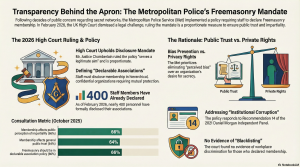
The modern resolution of this struggle was catalyzed by the 2021 Daniel Morgan Independent Panel , chaired by Baroness Nuala O’Loan. The panel’s finding of “institutional corruption” led to Recommendation 14 , which called for the mandatory registration of Masonic membership. This became the cornerstone of the Met’s Operation Drayfurn .The 2025/2026 Policy In December 2025, the Met moved Freemasonry into its “Declarable Associations” policy. An organization is now declarable if it meets three criteria:
- Hierarchical (internal chain of command).
- Confidential (membership is not public).
- Mutual Support (members are required to support and protect each other).The High Court Ruling (EWHC 330) Mr. Justice Chamberlain’s 17-page ruling dismissed the legal challenge brought by the UGLE and two anonymous officers (FSK and IPS).The 3 Legal Pillars of the Decision:
- Legitimate Aim: The policy is essential for “maintaining and enhancing public trust.”
- Proportionality: The disclosure of legal associations is a “proportionate price” for holding public office.
- Non-discrimination: The policy targets organizational structures (hierarchy/secrecy) rather than the philosophical beliefs of Masons.October 2025 Consultation Metrics | Metric | Agreement Rate | | :— | :— | | Membership affects perception of impartiality | 66% | | Membership affects public trust | 64% | | Freemasonry should be included in the policy | 66% |The court explicitly rejected the Metropolitan Police Federation’s “Slippery Slope” argument—which questioned if golf clubs or Scouts would be next—by focusing on the unique “Functions of a Constable.” Police officers hold a unique status in the state; therefore, the Doctrine of Public Legitimacy overrides the standard privacy expectations of a private citizen.
The Evolutionary Journey of Transparency
The arc from the 1970s to 2026 represents a total transformation of the British legal standard. We have moved from a culture of “obsessive secrecy” and “honor-based” disclosure to a modern regime where transparency is a non-negotiable Condition of Service .The historical record demonstrates that while individual Masons may act with integrity, the structural opacity of a “society with secrets” is fundamentally incompatible with the accountability required of those who wield the power of the state.The Modern Requirement: Public servants must not only behave with integrity but must be seen to do so.
Scholar’s Reflective Prompt: Having analyzed the shift from the voluntary registers of the 1990s to the 2026 mandate, consider: Is a “Perception-Driven” legal standard a necessary safeguard for institutional legitimacy, or does it represent a dangerous erosion of the individual’s right to private association in the face of “unjustified paranoia”?