
From Autopilot to Co-Pilot: Why Multi-Agent Orchestration is the New Standard for Clinical Excellence
Feb 17, 2026 /Mpelembe media/ — CuraFlow AI is an advanced healthcare orchestration platform designed to assist clinical professionals through multi-agent AI workflows. Powered by the Google Gemini API, the system automates a sequential clinical process involving specialized agents.
The Clinical Bottleneck: An Introduction
The modern clinical landscape is fractured by a high-stakes paradox: an abundance of patient data paired with an exhausting deficit of time. Clinicians today face a cognitive tax that threatens both professional longevity and patient safety, as administrative synthesis often eclipses actual care. CuraFlow AI represents a paradigm shift from simple, reactive automation to proactive healthcare orchestration. By leveraging sophisticated multi-agent workflows, this platform moves beyond the limitations of isolated chatbots to create a seamless, evidence-based environment. It is designed to decouple administrative synthesis from clinical intuition, allowing providers to reclaim their cognitive bandwidth and focus on high-value decision-making. In this new architecture, the technology doesn’t just answer questions; it organizes the entire clinical path, ensuring that the heavy lifting of data integration is handled with precision before the practitioner even enters the room.
Takeaway 1: The Rise of the AI “Clinical Team”
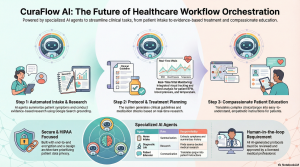
In a medical context, generalization is often the enemy of precision. CuraFlow AI addresses this by utilizing “Multi-Agent Orchestration,” a system where distinct AI entities are assigned highly specific roles. This approach recognizes that clinical excellence requires the same division of labor found in a real-world medical team.Rather than one AI attempting to handle every aspect of care, the platform employs a sequential workflow of specialized agents. The Nurse Intake agent focuses on extracting and summarizing patient history; the Diagnostic Lab handles research; the Clinical Protocol agent checks medication and guidelines; and the Patient Educator manages communication. This specialization allows for a higher fidelity of output, as each agent is optimized for a narrow, critical task.”Sequential workflow involving specialized AI agents for different clinical tasks.”
Takeaway 2: Ending Hallucinations with “Clinical Grounding”
The greatest friction point for AI adoption in the clinic is the risk of “hallucinations”—instances where models generate factually incorrect information. CuraFlow AI, powered by the Google Gemini engine, addresses this through integrated clinical grounding. Specifically, the Diagnostic Lab agent utilizes Gemini’s native integration with Google Search to anchor its findings in real-time, peer-reviewed medical literature.This feature creates a robust “computational audit trail,” transforming the AI from a generative black box into a transparent research partner. For a healthcare strategist, this transparency is essential; it provides the verifiable evidence-base and citations necessary to mitigate liability concerns and build professional confidence in AI-assisted research.
Takeaway 3: Translating Jargon into Compassion
Technical accuracy is meaningless if it is lost in translation during patient discharge. The Patient Educator agent represents the “empathetic core” of the CuraFlow architecture, bridging the chasm between complex clinical findings and patient understanding.Its mandate is to distill dense clinical jargon into compassionate, easy-to-understand instructions. Successful outcomes are deeply tied to patient health literacy; by ensuring that a care plan is communicated in plain, supportive language, the platform improves adherence and reduces patient anxiety. This demonstrates that high-tech orchestration must ultimately serve the high-touch reality of the human experience.”Translates clinical jargon into compassionate patient instructions.”
Takeaway 4: The “Human-in-the-Loop” Safety Standard
Innovation must never outpace integrity. CuraFlow AI is engineered as a clinical assistant, reinforcing rather than replacing human expertise. The platform’s architecture respects rigorous data privacy standards, incorporating HIPAA-focused UI design and end-to-end data encryption to protect sensitive patient information.The “human-in-the-loop” model is a non-negotiable safety standard within the system. By requiring expert validation for every generated protocol, the platform ensures that the ultimate responsibility for patient care remains with the licensed expert. This creates a secure environment where AI handles the data-heavy synthesis while the clinician maintains final oversight.”All AI-generated protocols must be reviewed by a licensed medical professional.”
Takeaway 5: Real-Time Vitals and AI Convergence
Efficiency in the modern ward requires a unified view of the patient’s physiological status. CuraFlow AI integrates technical monitoring—tracking vitals such as BPM, blood pressure, and temperature—directly into the orchestration workflow. Using Recharts for sophisticated visual trend analysis, the platform provides a cohesive dashboard for real-time monitoring.This convergence allows for a more responsive clinical environment. The AI agents do not merely look at static notes; they operate alongside real-time data trends, allowing the Clinical Protocol agent to suggest interventions based on evolving patient vitals. This holistic view enables faster recognition of clinical deterioration and more informed decision-making at the point of care.
The Future of Orchestrated Care: Conclusion
The transition from simple automation to full-scale healthcare orchestration marks the next frontier of clinical excellence. Platforms like CuraFlow AI demonstrate that the true value of artificial intelligence lies in its ability to organize complexity, returning the focus of the physician to the bedside rather than the screen. By organizing complex tasks into specialized, evidence-based workflows, we can restore the human element of medicine. As orchestration moves from prototype to the bedside, will we measure AI’s success by the accuracy of its protocols, or by the minutes of eye contact it restores between doctor and patient?
Source: CuraFlow AI