
Africa’s Billion-Rand Botanical Blueprint: Bridging Ancient Ethnobotany and the Industrial Hemp Revolution
Feb 17, 2026 /Mpelembe media/ — The African cannabis landscape is undergoing a historic structural transformation, shifting from a century of colonial-era prohibition toward a sophisticated, multi-tiered regulatory environment driven by economic necessity and industrial innovation. As of 2025/2026, the continent is positioning itself as a critical supplier to the global legal market—projected to reach $50 billion by 2027—while grappling with significant internal challenges regarding social equity and regulatory coherence.
The Hook: A Convergence of Eras
As the global green economy pivots toward high-tech solutions to combat climate change, a profound and unexpected bridge is forming between the digital future and the ancestral past. While contemporary industrial giants scramble for the next breakthrough in sustainable materials and renewable energy, the most viable answers may reside in a botanical history that spans over fifty millennia. The “Traditional Medicine and Industrial Hemp Project 2024” represents more than a commercial venture; it is a sophisticated synthesis of these two disparate worlds, positioning African indigenous knowledge not as a historical relic, but as a primary driver of modern industrial innovation.By integrating the deep-rooted, time-tested practices of traditional medicine with the versatile, carbon-sequestering potential of industrial hemp, this project establishes a new paradigm for ethnobotanical innovation. It is an intelligent, forward-thinking strategy that recognizes the sophisticated nature of traditional healing systems and leverages them to meet the demands of a multi-billion dollar global market. This convergence of eras suggests that the path to a sustainable, regenerative future is paved with the wisdom of the past, re-engineered through the lens of modern strategic planning.
The R2.9 Billion Market Hiding in Plain Sight
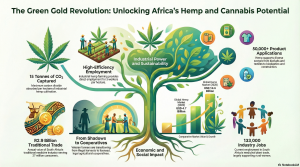
Traditional medicine in South Africa is not a marginal legacy practice; it is a vibrant, massive economic engine operating in parallel with modern pharmaceuticals. Current valuations place the trade at R2.9 billion annually, reflecting its deep integration into the socio-economic fabric of the nation.The annual valuation of the traditional medicine trade represents approximately 5.6% of the National Health budget.With 27 million consumers and a workforce of at least 133,000 people—primarily rural women—the industry is a vital pillar of rural livelihoods. However, an analyst’s view reveals a significant “market leakage” problem. While Africa contributes roughly 8% of the 1,100 medicinal plants commercialized globally, the vast majority are exported as raw materials. This extractive model forces the continent to buy back value-added products, such as teas, tinctures, and capsules, from international markets. The 2024 project seeks to plug this leak by establishing localized agro-processing facilities through Ntabeni Indigenous Knowledge Systems (NIKS).
Hemp: The 50,000-Year-Old New Frontier
While industrial hemp is often heralded as a modern “super-crop,” its utility is ancient, having been among the first plants spun into usable fiber 50,000 years ago. Today, the global market is experiencing a massive resurgence—estimated at USD 5.49 billion in 2023—driven by regulatory shifts that finally distinguish industrial hemp (low THC) from marijuana.Its return is a critical necessity for climate change mitigation. Industrial hemp is one of the world’s most efficient CO2-to-biomass converters, sequestering between 8 to 15 tonnes of CO2 per hectare. This ecological power is matched by its versatility, with over 50,000 possible applications. Key industrial and medicinal uses include:
Hypoallergenic Textiles: Naturally safe for sensitive skin, requiring no chemical alteration during manufacture.
Pharmaceutical Feedstock: Ancient remedies for fevers and pain are now being refined to treat inflammatory arthritis and chronic joint pain.
Hempcrete: A high-performance, sustainable building material derived from the plant’s core.
From Ancient Roots to Car Batteries: The Biofuel and Offtake Reality
The project’s most disruptive potential lies in its energy applications. Through a process of pyrolysis, hemp biomass is converted into renewable energy. This creates a fascinating technical irony: a traditional botanical source provides the feedstock for Sustainable Aviation Fuel (SAF) and BioMethanol for marine oil. Furthermore, the pyrolysis process yields a by-product that can be valorized for car battery production, positioning hemp at the heart of the electric vehicle transition.The business case is already validated. PHIWE , the project’s dedicated subsidiary for seed procurement and cultivation, has been offered an international offtake agreement for an initial 1,000 tons of hemp fiber valid from 2024 to 2028. To support this, PHIWE is procuring specialized seed varieties from Australia, France, and Spain, tailored for specific end-uses like biofuels and textiles.| Feedstock & Logistics | End-Use Markets || —— | —— || Agronomics & Volume Demands | Petrochemical & Oil Industry || Storage & Quality-Controlled Logistics | Aviation (SAF) & Shipping (BioMethanol) || Agro-processing Waste/Biomass | Carbon Credit Markets || Seed Bank Development (PHIWE) | Car Battery Production (By-products) |
Ethical Innovation: Protecting Indigenous Knowledge
A core mission of NIKS is to dismantle the extractive “raw material export” model. However, the path has not been without struggle; in 2020, NIKS was forced to discontinue manufacturing due to a lack of funds. The 2024 relaunch represents a resilient comeback, focusing on “African botanical science” that combines cannabis research with traditional African flora.The project acts as a catalytic employment engine, creating 3 direct jobs per hectare of hemp. Sustainability is further bolstered by integrating crop rotation with superfoods , which enhances soil fertility and improves community nutrition while diversifying revenue streams.”Often, when medicinal plants get commercialized, there’s no benefit to the communities whose indigenous knowledge is used. We intend to ensure the community’s benefit.”
The Visionary Architecture: A Hybrid Leader
The catalyst for this integration is Mmabatho Nyaredi, a leader whose background bridges institutional rigor and traditional practice. As the founder of Mmapro Holdings, she oversees a portfolio including Mmapro IT Solutions and NIKS. Nyaredi’s profile is a study in hybridity: she is a Master Black Belt practitioner with experience at Accenture and Telkom, yet she also completed intensive traditional healer training between 2013 and 2015.Holding a Masters in Future Studies from Stellenbosch University and currently pursuing a Doctorate in the same field, Nyaredi applies strategic scenario planning to the ethnobotanical sector. This unique combination of “Future Studies” and “Traditional Healing” allows her to navigate the complex regulatory and cultural landscape of commercializing ancient wisdom for a modern, sustainable economy.
Conclusion: The Regenerative Path Forward
The “Traditional Medicine and Industrial Hemp Project 2024” is more than an agricultural venture; it is a blueprint for a resilient, self-sustaining African economy. By valuing indigenous knowledge and leveraging the ecological and industrial power of hemp, the project addresses the dual crises of food security and climate change. It represents a shift toward an economy that respects its roots while leading the global charge in industrial science.As we look toward the next great milestone in global sustainability, we must ask: has the answer actually been beneath our feet for the last 50,000 years?
Economic Drivers and the Export Imperative The transition is largely fueled by the decline of traditional cash crops like tobacco, particularly in Malawi and Zimbabwe, and the urgent need for foreign exchange. African nations are pivoting toward an export-oriented model targeting the burgeoning European medical market, specifically Germany and the UK.
Morocco: Historically the world’s largest producer of resin, Morocco legalized production in 2021. By 2025, it had approved 67 cannabis-derived products and commenced legal exports to Australia and the Czech Republic, aiming to transition its massive illicit Rif region economy into a formal one.
South Africa: Positioning itself as a leader in high-tech cultivation, South Africa saw a 54% increase in medical exports to Germany in late 2025.
Zimbabwe & Lesotho: These nations have established themselves as specialized export hubs, with Zimbabwe exporting over 8,000 tons of biomass since 2020.
Industrial Innovation: Hempcrete and Green Tech Beyond medical cannabis, industrial hemp is emerging as a cornerstone of Africa’s “green economy,” driving innovation in construction and energy.
Sustainable Construction: South Africa is home to the world’s tallest hemp-constructed building, 84 Harrington Street in Cape Town. Constructed with “hempcrete” (a mix of hemp hurd, lime, and water), the 12-story building is carbon-negative, sequestering approximately 108kg of CO₂ per cubic meter.
Regional Expansion: Similar green construction projects are underway in Lesotho and Kenya, where hemp is viewed as a solution for sustainable urbanization and disaster-resistant housing.
Bio-Economy: In Kenya and South Africa, hemp is being explored for biofuels (Sustainable Aviation Fuel), bioplastics, and mining land reclamation (phytoremediation).
The “Grey Zone” and Social Exclusion Despite these advances, the industry faces a crisis of inclusion dubbed “corporate capture”. High licensing fees and strict EU-GMP (Good Manufacturing Practice) standards favor multinational corporations while marginalizing legacy farmers.
Barriers to Entry: In Lesotho and Malawi, licensing fees can range from $10,000 to over $30,000, amounts unattainable for traditional subsistence farmers.
Regulatory Gaps: In South Africa, while private use is legal, the lack of a commercial framework for recreational sales has created a legal “grey zone,” leading to the proliferation of unregulated private cannabis clubs.
Reform Efforts: Initiatives like Project Indlela in South Africa propose tiered licensing systems (e.g., “GACP-Light”) and “Indigenous Knowledge Systems Sandboxes” to allow traditional growers and healers to participate in the formal economy without facing prohibitive compliance costs.
. Future Outlook As the continent moves toward 2026, the focus is shifting from legalization to industrialization. With the African Continental Free Trade Agreement (AfCFTA) providing a framework for regional value chains—such as Malawi supplying raw biomass for South African processing—Africa aims to redefine its role from a supplier of illicit raw material to a global leader in pharmaceutical-grade cannabis and sustainable hemp products.
Source: Mpelembe Insights