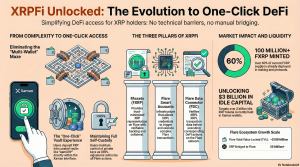

Unlocking $3 Billion in Idle XRP: Flare and Xaman Bring One-Click, Self-Custodial DeFi to the XRPL
27 Feb. 2026 /Mpelembe Media/ — The recent integration between the Flare network and the Xaman wallet introduces a streamlined, “one-click” decentralized finance (DeFi) experience designed to unlock over 2 billion idle XRP tokens, which represents roughly $3 billion in sidelined liquidity.
By combining three core infrastructure layers—Xaman’s familiar wallet interface, Flare Smart Accounts for chain abstraction, and FAssets (FXRP) for trust-minimized asset representation—the partnership allows users to deploy their XRP into yield-generating strategies, such as Upshift’s earnXRP vault, directly from their existing XRPL wallets.
This marks a significant milestone because it eliminates the technical friction typically associated with cross-chain DeFi. Users no longer need to download secondary EVM-compatible wallets, manually bridge assets, or manage additional gas tokens. Instead, the user simply signs a single transaction on the XRP Ledger (XRPL), and the complex backend execution—including FXRP minting and vault allocation—is handled automatically on the Flare network.
Crucially, this is the first yield product accessible from the XRPL where users retain full self-custody throughout the entire process. Because control remains firmly anchored to the user’s XRPL keys, XRP holders can earn yield without ever relinquishing control of their assets to a third-party bridge or platform.
The Friction Problem
For years, the XRP community has been ensnared in what can only be described as a $3 billion liquidity trap. While XRP has long maintained its status as one of the most liquid assets in the digital economy, that liquidity has remained stubbornly dormant. Historically, the path to decentralized finance (DeFi) for an XRP holder was a gauntlet of “bridging friction”: managing multiple wallets, acquiring secondary gas tokens, and often forfeiting self-custody to bridge assets to EVM chains.The data reveals the scale of this paralysis: approximately 2 billion XRP tokens—representing 3.5% of the circulating supply—have historically sat idle in wallets, disconnected from programmable yield. This wasn’t a lack of intent; it was a lack of infrastructure. The emergence of “XRPFi” in early 2026 marks the end of this era, shifting the ecosystem from a fragmented, multi-step ordeal to a seamless, “one-click” reality.
Takeaway 1: The “One-Click” Revolution (Chain Abstraction in Action)
The milestone integration between Flare and Xaman in February 2026 represents more than just a new feature; it is the death of the multi-wallet struggle. To understand the gravity of this shift, one must look back to October 2025, when minting FXRP still required a “two-wallet” setup: Xaman for the XRPL side and an EVM-compatible wallet like MetaMask or Ledger for the Flare side.By February 2026, this complexity has been entirely abstracted away. Users can now access institutional-grade yield strategies directly from the interface they already trust. This evolution proves a fundamental thesis of digital asset strategy: reducing friction is more vital for mass adoption than the complexity of the underlying protocol. By making DeFi access native to the wallet, Flare has successfully transitioned from an external destination into an invisible execution layer.”Xaman has always focused on giving XRP holders simple, secure tools. This integration lets our users explore new options directly from the wallet they already know, while keeping full control of their keys and decisions.” — Wietse Wind, Founder of Xaman
Takeaway 2: Flare Smart Accounts—Execution Without Leaving Home
The technical linchpin of this revolution is the Flare Smart Account infrastructure, which went live in December 2025. This system utilizes an intent-based execution model that allows a user’s XRPL keys to govern transactions on the Flare network without the user ever leaving the XRPL environment.The process is elegantly technical: a user signs a standard XRPL transaction that contains encoded memo instructions describing their desired DeFi outcome. The Flare Data Connector (FDC) observes and verifies this transaction on the XRP Ledger. Once validated, proxy Smart Account controllers on Flare—which mirror the user’s XRPL address—execute the heavy lifting, such as minting assets or allocating capital into vaults. This is a legitimate “first” for the ecosystem: maintaining absolute self-custody while accessing external chain yield.”The signing stays in Xaman. The custody stays with the user.” — Robert Kiuru, COO of XRPL Labs
Takeaway 3: FAssets and the Growth of FXRP
If Smart Accounts are the engine, FAssets are the fuel. By providing a trust-minimized representation of XRP, FAssets transform “non-smart contract” tokens into production-grade capital rails. Unlike standard “wrapped” tokens, FXRP relies on enforceable collateralization , making it a significantly safer vehicle for institutional and retail capital alike.The “Awakening” is best viewed through the lens of supply growth. In November 2025, the total XRP bridged to Flare stood at approximately 50 million. By February 2026, the FXRP supply has surged to over 100 million tokens —a 100% increase in just three months. This momentum was punctuated by a February minting surge where, following an increase in the minting cap, users minted 8 million FXRP in a staggering three-hour window. With 60 million FXRP already staked, the asset has clearly moved from experimental bridging to core DeFi infrastructure.
Takeaway 4: Institutional Momentum and Firelight
Flare’s transition from a nascent network to a mature execution layer is underscored by a surge in institutional confidence. As of late 2025, Flare’s Total Value Locked (TVL) reached a near all-time high of $180 million. This growth is largely driven by the November 2025 launch of Firelight, an institutional-grade platform providing stXRP (a Liquid Staking Token) .Further validating this trajectory is the October 2025 SEC filing by Teucrium for a Flare-based ETF. This filing is a strategic signal; it represents a bet on the network’s role as an execution layer for value representation rather than just another speculative asset. As institutional players seek “safe” ways to put XRP to work, Flare has positioned itself as the primary environment for protecting and representing that value.”It effectively makes Flare the home for this protocol and for the representation of the value it’s covering, which is absolutely huge for Flare.” — Hugo Philion, CEO and Co-founder of Flare
Takeaway 5: The “EarnXRP” Vault—Diversified Yield for the Masses
The most visible manifestation of this partnership is Upshift’s earnXRP vault , integrated directly into Xaman. This product moves away from “single-source” yield risks, utilizing a risk-first deployment framework curated by Clearstar.Clearstar’s role is critical for sophisticated investors: they provide active management, strategy construction, and constant risk monitoring. The vault generates yield through a diversified mix of liquidity provisioning and lending markets, with all returns distributed in FXRP. Crucially, the vault is grounded in operational reality; it features a 1-2 day withdrawal window , reflecting the actual time required to unwind positions across underlying markets rather than arbitrary lockup periods. This transparency provides a level of “DeFi-realism” that retail users have lacked in previous cycles.
The Future of the Execution Layer
The “XRPFi” era has officially arrived, defined by the total collapse of technical complexity. By weaving together trust-minimized FAssets and chain-abstracted Smart Accounts, Flare has effectively become the default execution layer for the XRP ecosystem.The technical barriers that sidelined $3 billion in liquidity have been dismantled. For the end user, the experience of accessing a high-yield vault is now indistinguishable from sending a standard payment. As we move deeper into 2026, the strategic question for every XRP holder has changed: now that the friction is gone, are you ready to move your XRP from a dormant store of value into a productive, on-chain powerhouse?