The 2026 Global Pivot: 5 Surprising Realities Reshaping the Middle East and Beyond
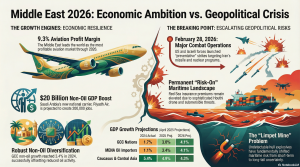
28 Feb. 2026 /Mpelembe Media/ — The geopolitical landscape has drastically deteriorated, culminating in joint “pre-emptive” military strikes launched by the United States and Israel against Iran in late February 2026. The US military announced “major combat operations” aimed at razing Iran’s missile industry and naval capabilities. This severe escalation follows a previous 12-day war in June 2025, during which Israel and the US targeted Iranian nuclear facilities, including Fordow and Natanz, fundamentally altering the region’s risk profile.
Commodity Shocks and Supply Chain Disruption The conflict has severely threatened vital maritime chokepoints, particularly the Red Sea and the Strait of Hormuz, forcing shipping companies to adopt longer routes and maritime insurers to implement permanent “war risk” premiums. The heightened threat of oil supply disruptions has kept crude prices highly volatile. Simultaneously, investors have rapidly fled to safe-haven assets, driving gold prices to record highs above $5,260 per ounce. The crisis has also spilled over into agricultural markets; disruptions to natural gas supplies and regional shipping have triggered a sharp spike in fertilizer prices, exacerbating global food insecurity and humanitarian crises.
Trade Policy and Macroeconomic Instability Compounding these geopolitical shocks is a wave of aggressive new US trade policies, including sweeping global tariffs and “Liberation Day” levies. While the US Supreme Court recently struck down the administration’s use of emergency powers to impose these broad tariffs, the administration has signaled it will use alternative legal frameworks to maintain trade barriers, creating a highly volatile transition period for the global economy.
Central Bank Paralysis and Industry Fallout The combination of rising energy costs, global supply chain bottlenecks, and tariff implementations has created a “sticky” inflationary environment. Consequently, major central banks, including the US Federal Reserve and the European Central Bank, are being forced to delay anticipated interest rate cuts, increasing the likelihood of a prolonged period of high borrowing costs and slower global growth. Energy-intensive sectors are bearing the brunt of this macroeconomic environment; notably, the European chemical industry has entered a critical crisis, facing unprecedented structural realignment, capacity closures, and massive employment losses due to insurmountable energy cost disadvantages.
From Economic Haze to the Thunder of Conflict
In late 2024, the International Monetary Fund described the global economy as navigating an “extraordinary uncertainty,” a period of “charting a path through the haze.” By February 28, 2026, that haze was burned away by the definitive thunder of major combat operations. For the global executive and macro strategist, “risk” has moved from a stochastic variable in a financial model to a raw, daily operational reality.The strikes launched by the United States and Israel in early 2026 mark the definitive collapse of the “containment through commerce” era. We have transitioned into a period of permanent instability where traditional economic predictability has been replaced by geoeconomic fragmentation. As aviation records historic profits in the shadow of regional fire and shipping lanes face a permanent “risk-on” baseline, the following five realities define our new strategic landscape.
Takeaway 1: The Iran Shock—The End of Strategic Ambiguity
The strikes of February 28 represent more than a tactical escalation; they are the culmination of a clear geopolitical trajectory. The groundwork for this “February Shock” was laid on January 13, 2026, when President Donald Trump explicitly promised Iranian protestors that “help was coming.” This bridge between domestic unrest and military intervention signaled the end of strategic ambiguity.The preventative operations were designed for total neutralization, targeting the systematic destruction of the Iranian Navy and the complete annihilation of the domestic missile industry to preclude nuclear armament. In a definitive communication via Truth Social, Donald Trump underscored the uncompromising nature of the mission:”The United States military has undertaken a massive and ongoing operation to prevent this very wicked, radical dictatorship from threatening America and our core national security interests. We are going to destroy their missiles and raze their missile industry to the ground. It will be totally, again, obliterated. We are going to annihilate their navy.”For the macro strategist, this event shifts the regional struggle from a domestic political crisis into a total geopolitical war. The opportunity for a negotiated de-escalation has passed, replaced by a “risk-on” environment where military force is the primary instrument of statecraft.
Takeaway 2: The Aviation Paradox—Institutional Resilience Amidst Regional Fire
In a startling defiance of regional instability, the Middle East has emerged as the world’s most profitable aviation market. This is the “Aviation Paradox”: record-breaking financial success in a theater of active conflict. According to IATA data, the region is outperforming Europe and North America by significant margins.The sector’s resilience is anchored by several critical metrics:
- 9.3% net profit margin: The highest global regional performance.
- $6.8 billion: Total regional profit projected for 2026.
- $28.60 net profit per passenger: While down slightly from the $28.90 recorded in 2025, this remains the global benchmark for efficiency.This success is driven by a “coordinated aviation infrastructure” model. Beyond the aggressive expansion of Riyadh Air —which is projected to add $20 billion to Saudi Arabia’s non-oil GDP—the most significant institutional catalyst is the movement toward a common GCC safety regulator . This cross-border regulatory integration provides a level of operational quality and safety oversight that serves as a vital buffer against the “deep economic scars” visible in neighboring conflict zones.
Takeaway 3: The End of “Risk-Off”—Shipping’s Permanent New Normal
The maritime domain has entered an era where a ceasefire no longer triggers a return to “normal” pricing. Risk managers must now price for a permanent “risk-on” baseline in the Red Sea. The threat has evolved from primitive, single-drone strikes into sophisticated, multi-domain attacks involving missiles, unmanned surface vessels (USVs), and unmanned submersible vehicles (UUVs).Crucially, we are seeing a strategic fragmentation of supply chains. Major energy companies are increasingly utilizing partner traders to move cargo through high-risk zones, sacrificing cost efficiency to insulate their direct operations from Red Sea exposure. Furthermore, the “Shadow Fleet” represents a systemic vulnerability. Unlike the Western insurance market, which relies on hundreds of years of experience and deep capitalization, these alternative markets have not been stress-tested at scale . A single failure could result in unrecoverable global losses.Perhaps most alarming is the “limpet mine problem,” which shifts the nature of risk from transit worry to long-tail uncertainty:”This threat fundamentally changes maritime war risk from a short-tail exposure (did the vessel get hit during transit?) to a long-tail uncertainty (could this vessel have been compromised weeks ago and we just don’t know yet?). Vessels that appear to be in ‘safe’ areas may still carry explosive devices from previous high-risk zone transits.”
Takeaway 4: The 100-Year Tariff Wall
Global trade policy has reached a protectionist zenith not seen in a century. Effective tariff rates have climbed to historic levels, with the U.S. implementing a 10% baseline that escalates dramatically for specific regional players. As of April, countries including Algeria, Iraq, Jordan, Kazakhstan, and Tunisia faced effective tariffs ranging from 20% to 40% .The strategic concern for the Middle East is the high growth elasticity to external demand . For the ten most exposed countries in the region, a 1% decline in the growth of trade partners translates into a GDP loss of between 1% and 1.8% . While energy exports remain largely exempt, oil exporters are uniquely vulnerable to a global slowdown. If prolonged trade wars suppress external demand, the resulting decline in oil prices will severely weaken the fiscal positions of even the most resilient regional actors.
Takeaway 5: The Great Divergence—GCC Resilience vs. Fragile Contraction
The MENA region is experiencing a “Great Divergence” in macroeconomic stability. On one side, the GCC economies demonstrate robust non-oil growth (3.4%–3.8%), supported by ambitious FDI targets and structural reforms. A prime example of this resilience is Egypt’s $35 billion Ras El-Hekma deal , which serves as a vital model for utilizing large-scale FDI to build fiscal buffers against regional shocks.In stark contrast, conflict zones are facing a devastating economic contraction:
- Sudan: 40% contraction.
- West Bank and Gaza: 30% contraction.
- Lebanon: 8% contraction.As the IMF notes, these hostilities have inflicted:”…profound humanitarian costs and left deep economic scars that will take generations to heal.”This divergence underscores a reality where institutional credibility and the ability to rebuild fiscal and external buffers are no longer just policy recommendations—they are the prerequisites for national survival.
Navigating the Post-Predictability Era
The events of 2026 have redefined the global risk landscape. The ability of the GCC to lead the world in aviation profits while a total geopolitical war erupts in Iran proves that we have entered an era of extreme contradictions.Strategic planning must now account for a world where geoeconomic triggers can activate threats with zero warning. Rebuilding fiscal buffers and diversifying revenue is the only insulation against a world of escalating trade wars and permanent military tension. It leaves the global community with one haunting question: In an era where the Middle East can simultaneously lead the world in aviation profits and face the century’s most significant military escalation, have we entered a period where traditional economic predictability is dead?