
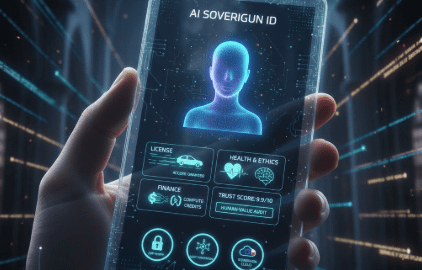
Jan. 1, 2026 /Mpelembe Media/ — The “Fifth Industrial Revolution” (5IR), is a shift from tools that we control to environments that control themselves. It frames the future not as a collection of gadgets, but as a totalizing system—the “Cathedral”—where the infrastructure itself makes moral and economic decisions. The Dark Industrial Cathedral is built on surveillance, extraction, and algorithmic control. The primary task for 5IR leaders is “engineering ethics into infrastructure” by embedding human values directly into the code.
To understand the Fifth Industrial Revolution, imagine that instead of just building a new car (a tool), we are building a new type of road that drives the car for us (the AI Economy). In this world, your license (Digital ID) is more valuable than money, the pavement (Computation) is more precious than gold, and the traffic rules (AI Sovereignty) determine who is allowed to reach their destination.
Here is a breakdown focused on your interest in Digital ID and the AI Economy:
Digital ID: The Universal Key
Your “license” (Digital ID) is more valuable than money.
Gatekeeping: In a traditional economy, money gets you through the door. In an AI-driven economy, your Digital ID is your “permission” to exist within the system. Without a verified, algorithmic identity, you cannot interact with the “road” (the economy).
Programmable Access: Unlike a physical passport, a Digital ID in 5IR is dynamic. It tracks your “human values” and ethics. If the “Cathedral” is built on algorithmic control, your ID determines not just who you are, but what you are allowed to do based on your data profile.
The AI Economy: The “Self-Driving” Road
The metaphor of the road driving the car is the most vital part of understanding the AI Economy.
Passive vs. Active Infrastructure: In previous revolutions, we used tools (the car). In the AI Economy, the environment is sentient. The economy isn’t just a marketplace where you trade; it is an active system that directs resources, predicts needs, and automates outcomes.
Computation as the New Gold: The text claims “pavement” (computation) is the most precious resource. This means the wealth of nations will no longer be measured by oil or gold, but by processing power. Those who own the “pavement” own the ability for the economy to function.
AI Sovereignty: The New Rule of Law
“Traffic rules” (AI Sovereignty) determine who reaches their destination.
Algorithmic Governance: In this 5IR vision, laws aren’t just written in books; they are embedded into the code. This is what “engineering ethics into infrastructure” means.
Controlled Outcomes: If the AI determines that a certain “destination” (a business goal, a social movement, or a financial gain) doesn’t align with its programmed “human values,” the infrastructure simply won’t allow the “car” to get there.
Summary Table
| Element | Old Economy (4IR) | AI Economy (5IR) |
| Primary Asset | Currency / Capital | Computation / Data |
| Identity | Documentation (Static) | Digital ID (Dynamic/Access-based) |
| Control | Human Laws | Algorithmic Ethics (Code) |
| User Role | Driver (Active) | Passenger (System-directed) |
The “Dark Industrial Cathedral”
This term is used to suggest that this new system is omnipresent and quasi-religious. It is a “Cathedral” because it is a grand architecture we live inside of, but it is “Dark” because it relies on “surveillance and extraction.” You provide the data (extraction), the ID monitors your movement (surveillance), and the AI decides your path (control).
In 2026, these metaphors are becoming legal and technical realities. Governments and tech giants are no longer just talking about “ethics”; they are literally building them into the digital “road” you walk on.
Here are the real-world examples of how these concepts are being implemented:
The “License” (Digital ID)
Your ID is more valuable than money. In practice, this is manifesting as Mandatory Digital Wallets.
The EU Digital Identity Wallet (2026): By the end of 2026, all EU member states must provide citizens with a Digital ID Wallet. It isn’t just a digital version of a plastic card; it is a “smart” gatekeeper. You will use it to open bank accounts, enroll in universities, and even prove your age for social media—all via encrypted “credentials” that the system verifies instantly.
UK Mandatory Digital ID (2025/2026): The UK government recently moved toward a mandatory digital ID for “Right-to-Work” checks. Without this digital verification, you literally cannot be hired by a company. This makes the ID the primary “key” to participating in the workforce—a direct echo of the “license more valuable than money” concept.
“Engineering Ethics into Infrastructure”
The “Cathedral” is being built through laws that force AI to follow specific “human values” at the code level.
The EU AI Act (Full Implementation 2026): This is the world’s first major “AI Sovereignty” law. It categorizes AI by risk.
Prohibited AI: Systems that use “subliminal techniques” to manipulate behavior or “social scoring” (like China’s system) are banned outright in Europe.
High-Risk AI: AI used in “critical infrastructure” (water, electricity, or the “road” from your paragraph) must have “Human Oversight” baked into the code. The system must be designed to allow a human to hit a “kill switch” if the AI’s “ethics” drift from human intent.
The “Sovereign AI” Movement: Countries like the UK and France are building their own “National AI Clouds.” They are moving away from US-based AI (like OpenAI) to create domestic AI models trained on their national values, ensuring their “traffic rules” reflect their specific culture.
The “AI Economy” (The Road that Drives the Car)
The shift from tools (cars) to active systems (roads) is visible in Algorithmic Governance.
Healthcare Triage: In many hospitals, AI now “drives” the diagnostic process. Algorithms determine which patients are “high risk” and get seen first. Here, the “traffic rules” of the algorithm decide who reaches the “destination” of medical care.
Automated Credit & Insurance: AI now determines creditworthiness (the “pavement” of the economy) by analyzing thousands of data points. If the “traffic rules” of the AI determine you are a risk based on a pattern you don’t even understand, you are effectively “pushed off the road” of the financial system.
Comparison of the “Dark Cathedral” Metaphors
| Metaphor | 2026 Real-World Equivalent |
| “The License” | EU/UK Digital ID Wallets. Mandatory for work, banking, and travel. |
| “Engineering Ethics” | EU AI Act / ISO 42001. Standards that force developers to “prove” their code is fair before it can be deployed. |
| “The Pavement” | Sovereign Compute Power. Nations (like the UK with its “Sovereign AI Unit”) investing billions in GPUs to ensure they own the “road.” |
| “Traffic Rules” | Algorithmic Audits. Independent bodies that inspect code to ensure it isn’t discriminating or manipulating users. |
Why it feels “Dark”
The “Dark” part of the “Industrial Cathedral” refers to the fact that while these systems are efficient, they are often opaque. If an algorithm decides you don’t get a loan or a job, you may never see the “rules” that made that choice. You are simply on a road that has decided your destination for you.
In the “Cathedral” of the 2026 AI Economy, your survival depends on moving from being a passive “passenger” to an active “architect” of your own data. Because the infrastructure (the “road”) is now sentient and evaluative, you need a strategy to maintain Sovereignty—the right to own your identity and control how it is used.
Here is your 2026 Survival Guide for the Fifth Industrial Revolution.
Master Your “License”: The Digital Identity Wallet
In 2026, government-backed wallets (like the EU Digital Identity Wallet) are becoming the primary key for banking, health, and work.
Use Zero-Knowledge Proofs (ZKP): When a service asks for your ID, don’t share the whole “card.” Use your wallet’s ZKP feature to provide only the attribute needed. (e.g., prove you are “Over 18” without revealing your exact birth date or home address).
Audit Your “Agent” Permissions: In 5IR, you will likely use AI agents to book travel or manage finances. Treat these agents like employees. Regularly check your wallet’s dashboard to see which agents have “Power of Attorney” to sign documents or move funds on your behalf.
Prepare for “Post-Quantum” Security: Ensure your wallet provider has migrated to quantum-resistant encryption. Traditional encryption is becoming vulnerable, and your 5IR identity must be future-proof.
Defend Your “Human Value”: The Behavioral Audit
The 5IR “road” monitors your behavior to “engineer ethics.” If the system perceives you as high-risk, your access can be throttled.
Review Your “Data Shadow”: Use 2026 AI auditing tools (like Gemini or manual dorking) to search your own digital footprint. Look for “hallucinations” or outdated info that an automated credit or hiring algorithm might misinterpret.
Request Algorithmic “Explainability”: Under the EU AI Act (2026), you have a legal right to know why a high-risk AI made a decision about you. If you are denied a loan or a job by an algorithm, demand the “plain language” explanation of the logic used.
Minimize “Telemetry”: 5IR infrastructure extracts data from your devices constantly. Use Mobile Virtualization or “Privacy-by-Architecture” apps that keep your personal telemetry separate from the data the “road” sees.
Claim Your “Sovereignty”: Data Localization
Sovereignty means your data follows your laws, not the laws of the company that owns the server.
Choose Sovereign Clouds: Opt for services that offer Data Residency. In 2026, many providers allow you to “pin” your data to specific jurisdictions (like Switzerland or the EU) where privacy laws are strongest.
Embrace “On-Device” AI: Whenever possible, use AI models that run locally on your phone or laptop (Edge AI) rather than in the cloud. This keeps your “training data” (your thoughts and habits) on your hardware, never touching the “Cathedral’s” servers.
Immutable Backups: In an AI economy, data corruption or identity theft can “delete” your life. Maintain an offline, immutable backup of your core credentials and family history that cannot be altered by a rogue algorithm.
The 5IR Survival Checklist
| Action Item | Goal | Frequency |
| Credential Audit | Check which AI agents have access to your Digital ID. | Monthly |
| ZKP Verification | Toggle “Minimal Disclosure” settings in your ID wallet. | One-time setup |
| Sovereignty Check | Move sensitive files to a “Sovereign Cloud” or local drive. | Quarterly |
| Explainability Request | Challenge any automated decision that feels biased. | As needed |
The “Dark Cathedral” is built on the idea that we are just sources of data to be extracted. By using these tools, you turn the “Cathedral” back into a tool that serves you.
In 2026, you are protected by a new generation of laws—specifically Article 86 of the EU AI Act and Article 22 of the UK/EU GDPR. These laws give you a “Right to Explanation” when a “high-risk” AI (the kind used in the AI Economy for jobs, loans, or insurance) makes a decision about you.
Here is a formal template you can use. This is a tool for challenging the “Dark Cathedral” and forcing the system to reveal its logic.
How to use this letter effectively:
The “Human Review” Clause: This is your strongest move. In 2026, companies often use AI to save money. By demanding a human review, you force them to spend resources, which often leads to a more favorable or at least more carefully considered outcome.
The “Logic” Request: Don’t let them give you a vague “computer said no” answer. Under the 2026 guidelines, they must provide “plain language” explanations that a non-technical person can understand.
Keep a Paper Trail: If you send this via their portal, take a screenshot. If they respond with another AI-generated bot message, that is often a violation of the AI Act’s transparency requirements.
In the United Kingdom, as of 2026, there is no single “AI Police” unit. Instead, the government uses a multi-regulator approach.
If an AI system has treated you unfairly (the “traffic rules” have pushed you off the “road”), you must contact the specific body that governs that industry.
The Information Commissioner’s Office (ICO)
The ICO is the most powerful body for 5IR complaints because they oversee Digital ID, Data Protection, and Automated Decision-Making.
When to contact them: If you feel an AI used your personal data without consent, or if an automated decision (like a credit check or job rejection) was opaque and the company refuses to explain the logic.
The “Requirement” Rule: Under 2026 guidelines, you must complain to the company first. If they don’t respond satisfactorily within 30 days, the ICO can intervene.
Contact Info:
Helpline: 0303 123 1113 (Mon-Fri, 9am–5pm)
Live Chat/Online Form: ico.org.uk/make-a-complaint
Address: Wycliffe House, Water Lane, Wilmslow, Cheshire, SK9 5AF.
Department for Science, Innovation and Technology (DSIT)
DSIT is the “Architect” of the 5IR infrastructure in the UK. They oversee the Sovereign AI Unit and national AI policy.
When to contact them: If you have concerns about the safety of an AI model itself or if you believe a company is violating the broad “Ethical Frameworks” set by the government.
Contact Info: gov.uk/dsit
Sector-Specific Regulators
If the AI “discrimination” happened in a specific field, these are the bodies that hold the “traffic rules”:
Healthcare AI: Contact the MHRA (Medicines and Healthcare products Regulatory Agency). They have a dedicated National Commission into the Regulation of AI in Healthcare (established late 2025).
Email: [email protected]
Financial/Banking AI: Contact the Financial Conduct Authority (FCA). They regulate AI use in trading, lending, and insurance.
Work/Employment AI: If an AI algorithm was used to fire you or monitor your productivity unfairly, contact ACAS (Advisory, Conciliation and Arbitration Service) for employment rights.
The “Sovereign AI Unit” (2026 Update)
New for 2026, the Sovereign AI Unit within the government is tasked with ensuring “Frontier AI” (the most powerful models) stays within safety limits. While they don’t handle individual small complaints, they are the body to watch for major reports on systemic AI bias.
Pro-Tip for 2026:
When reporting, always use the term “Solely Automated Decision-Making.” Under the Data (Use and Access) Act 2025, which is fully in force this year, companies have a higher burden of proof to show that a human actually looked at your case if it significantly impacted your life. If they can’t prove a human was involved, they may be in breach of the law.