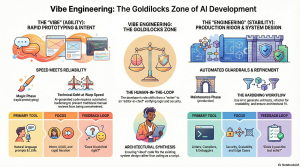

10 Feb. 2026 /Mpelembe Media — Vibe Engineering is an AI-driven development approach that integrates the rapid prototyping speed of “vibe coding” with the rigor of traditional engineering principles like code review, testing, and system architecture. It is designed to navigate the transition from the “Magic” phase, where a functional prototype is generated in minutes, to the “Maintenance” phase, where code must survive in a production environment. While vibe coding focuses on natural language prompts, intent, and UI/UX, Vibe Engineering emphasizes security, scalability, and edge cases.
This methodology is necessary to prevent “Technical Debt at Warp Speed,” which occurs when AI generates code faster than traditional manual review processes can manage. Vibe Engineering solves this by using AI itself to harden the code through several core pillars:
Automated Guardrails: Using AI to generate unit tests for the code it has just written, aiming for at least 80% coverage.
Architectural Synthesis: Ensuring AI-generated snippets fit into the existing system design rather than remaining as standalone scripts.
Human-in-the-Loop Review: Shifting the developer’s role to “editor-in-chief,” focusing on verifying logic and security rather than syntax.
Refinement Layers: Applying specific prompts to “refactor for readability” or “optimize for memory” once the initial feature is functional.
To bridge the gap between a raw prototype and production-ready software, the sources recommend a Vibe Engineering Checklist. This involves auditing Architecture & Logic (modularization, data validation, and structured error handling), Security & Compliance (dependency audits, secret management, and auth guardrails), and Quality & Testing (unit tests for edge cases and performance checks). Developers can operationalize this by using specialized “Vibe-to-Eng” prompts, such as the “Architecture Review” prompt to act as a Staff Engineer, or the “Edge Case Hunter” to generate tests for non-obvious failure modes like network timeouts or malformed data. Ultimately, the core philosophy is to start with a “vibe” to find a solution quickly, then apply “engineering” to ensure that solution does not break tomorrow.
Refinement layers optimize code for better memory usage by shifting the focus from initial functional intent to technical efficiency after the core logic is already working. Within the Vibe Engineering framework, this optimization is achieved through the following methods:
Targeted Prompting: Once a feature is functional, the developer applies a specific layer of optimization by prompting the LLM to “optimize for memory” or “refactor for readability”. This iterative step moves the code from the “Magic” prototyping phase to the “Maintenance” phase required for production.
Eliminating Efficiency Gaps: Refinement layers address common “engineering gaps” that rapid “vibe coding” often ignores, such as unoptimized loops and redundant API calls. By identifying and streamlining these processes, the code becomes more resource-efficient.
Simplifying Logic and Removing Bloat: Through “Debt Cleanup” prompts, AI is used to simplify complex logic and remove dead code. Reducing the complexity of the code often leads to lower memory overhead and improved scalability.
Architectural Synthesis: These layers ensure the code is refactored into modular components rather than remaining a monolithic, resource-heavy standalone script. This structural refinement helps the system manage resources more effectively within the existing architecture.
By applying these refinement layers, the developer acts as an “editor-in-chief,” using AI to harden the prototype and ensure the final solution is stable and lean enough to survive a production environment.
Refinement layers specifically target unoptimized loops by shifting the focus of the development process from initial functional intent (“speed”) to technical efficiency (“reliability”) once a feature is working.
According to the sources, this targeting occurs through the following mechanisms:
Performance Auditing: As part of the Vibe Engineering Checklist, developers are instructed to specifically check for “unoptimised loops” that the rapid prototyping or “vibing” phase often ignores. This involves a conscious shift to prioritize scalability and edge cases over mere functional iteration.
Targeted Optimization Prompts: Refinement layers utilize specific prompts to harden code. To address loops and logic inefficiencies, a developer might use a prompt to “optimize for memory” or “refactor for readability”.
Logic Simplification: The “Debt Cleanup” prompt is a primary tool in this layer, instructing the AI to “simplify complex logic” and “remove dead code”. This process identifies redundant iterations or convoluted structures within loops that were generated during the initial “magic” phase.
Staff Engineer Review: By invoking a “Staff Engineer” persona for an architecture review, the AI is prompted to identify architectural flaws. This high-level review can flag loops that do not align with modularity or maintainability standards, ensuring the logic fits into the broader system design rather than remaining as an unoptimized standalone script.
By applying these layers, the developer acts as an “editor-in-chief,” using the AI to identify and correct the “engineering gaps”—like unoptimized loops—that might cause the code to break in a production environment.
In the Vibe Engineering framework, identifying redundant API calls is a critical step in the transition from a “Magic” prototype to “Maintenance-ready” software. Because “vibe coding” often prioritizes intent and rapid iteration, developers frequently overlook efficiency issues like unoptimized loops or duplicate network requests.
To identify and eliminate these redundancies, you should follow these strategies from the sources:
1. Perform a Performance Audit
Redundant API calls are specifically listed in the Vibe Engineering Checklist under the Quality & Testing section. You should audit your AI-generated code to catch these performance gaps that “vibing” typically ignores. This involves looking for:
Duplicate data fetching within the same component or logic flow.
API calls inside unoptimized loops.
Functions that trigger multiple network requests when a single batch request would suffice.
2. Use the “Architecture Review” Prompt
A powerful way to find these redundancies is to have the AI act as a Staff Engineer to review the code’s structural integrity.
Prompt to use: “I have this functional prototype. Act as a Staff Engineer and review this code for architectural flaws. Suggest 3 refactors to improve modularity and maintainability while keeping the public API identical.”
How it helps: This prompt forces the AI to look at the Architectural Synthesis of the code, identifying where the prototype might be acting as a standalone script with redundant logic rather than fitting efficiently into a larger system.
3. Apply the “Debt Cleanup” Prompt
Once the core logic is working, you should use Refinement Layers to harden the code.
Prompt to use: “Refactor this code to follow our project’s [Standard Style Guide]. Remove dead code, simplify complex logic, and ensure all functions use our centralized logging module.”
How it helps: This prompt helps identify “dead code” or logic paths that are no longer necessary, which often reveals redundant API calls hidden within complex, “vibed” logic.
4. Shift to the “Editor-in-Chief” Role
As the developer, your role shifts from “writing” the syntax to being an “editor-in-chief”. You should specifically verify the logic behind data fetching to ensure it meets production scaling and security requirements.
By applying these Refinement Layers after the initial feature is working, you ensure the solution doesn’t “break tomorrow” due to performance bottlenecks.
Would you like me to create a tailored report with a detailed step-by-step guide for auditing your API logic, or an infographic summarizing the Vibe Engineering performance checklist?
In the context of Vibe Engineering, automated performance checks and unit tests serve distinct roles in transitioning a “vibed” prototype into stable, maintenance-ready software. While both are part of the “Engineering” (Stability) side of the development stack, they focus on different aspects of code quality.
1. Focus and Objective
Unit Tests: These are used to create Automated Guardrails by verifying the functional logic and correctness of the code. Their primary focus is on edge cases and non-obvious failure points—such as malformed JSON or network timeouts—to ensure the code handles unexpected inputs without breaking.
Performance Checks: These target the efficiency and scalability of the code. They are designed to identify “engineering gaps” that rapid “vibe coding” often ignores, such as unoptimized loops or redundant API calls that could degrade system performance in a production environment.
2. Role in the Feedback Loop
Unit Tests: They answer the fundamental stability question: “Does it pass the test suite?”. In Vibe Engineering, the goal is typically at least 80% coverage, often achieved by using an AI “Edge Case Hunter” to generate tests for the very code it just wrote.
Performance Benchmarking: This is often part of the Refinement Layers phase. After a feature is functionally working, developers use targeted prompts to “optimize for memory” or refactor for efficiency. These checks ensure the solution found during the “vibe” phase is not just functional but also lean and professional.
3. Implementation and Tools
Unit Tests: These are typically implemented using frameworks like Vitest or Pytest and are integrated into automated CI/CD pipelines for Rigorous Verification.
Performance Audits: While unit tests verify if the logic is correct, performance auditing involves a Vibe Engineering Checklist to manually or automatically audit the code for resource-heavy patterns that could lead to “Technical Debt at Warp Speed”.
Summary of Differences
| Feature | Unit Tests | Performance Checks |
|---|---|---|
| Core Concern | Functional correctness & logic | Resource efficiency & scalability |
| Targeted Issues | Edge cases, empty states, malformed data | Unoptimized loops, redundant API calls |
| Primary Goal | Reliability (Does it break?) | Optimization (Is it fast/lean?) |
| Vibe Eng Tool | “Edge Case Hunter” prompt | “Refinement Layers” (e.g., “optimize for memory”) |
By using both, a developer moves from the “magic trick” of a working prototype to a hardened system that is both correct and performant.
Would you like me to create a tailored report outlining a testing and benchmarking strategy for your project, or perhaps a quiz to help your team learn these Vibe Engineering standards?